
The September Storm-Prep Walkthrough for Coastal Bend Commercial Properties
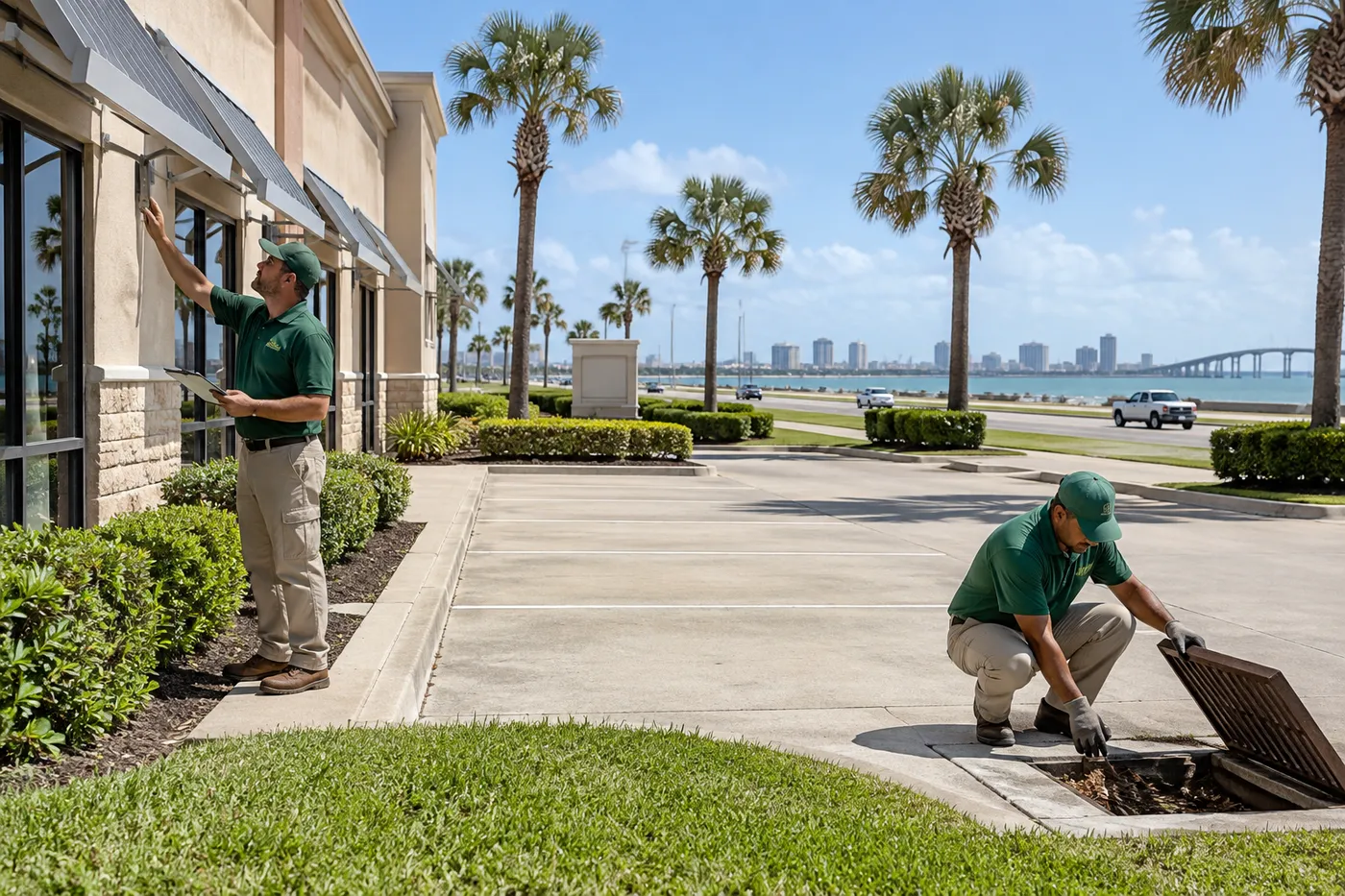
The stretch of hurricane season that most often puts water and wind over the Coastal Bend runs from mid-August into early October, and Corpus Christi is sitting in the back half of it right now. This week the extreme heat finally eased off — highs near 91 with more cloud and a returning shower chance instead of 100-degree afternoons — which means crews can actually work outside for a full day again. For anyone responsible for a commercial property in Corpus Christi, Portland, Ingleside, Aransas Pass, Rockport, Robstown, Kingsville, Alice or Port Aransas, that combination makes the next two or three weeks the best grounds-prep window you will get before the season closes.
This is a walk-the-property checklist, not a shopping list. Most of it costs nothing but attention.
September is the legal and horticultural window to prune your oaks
Texas A&M Forest Service is direct about oak wilt: the pathogen enters through fresh wounds, and the high-risk period for spread is February through June. That is why the standard guidance for live oaks and red oaks in Texas is to prune in the July-through-January stretch and stay out of the tree in spring. September sits squarely inside the safe window, and it happens to be the last practical moment to reduce wind load before a Gulf system.
What you are looking for on a commercial site is not shape. It is failure risk:
- Co-dominant stems — two trunks of near-equal size meeting in a tight V, often with bark pinched between them. That union is the classic hurricane split point on a mature live oak.
- Dead limbs still hanging in the canopy. Wind does not need much to turn those into a windshield or a storefront window.
- Branches over walkways, dumpster pads, drive lanes, and parked cars. Rank them by what they would land on, not by how ugly they look.
- Palms with a heavy skirt of dead fronds. Each frond is a sail and a projectile.
Two limits worth respecting. Never top a tree to make it “safer” — topping forces weak sprouts off the cut and creates a worse hazard in three years. And anything needing a chainsaw above head height, or near a service drop, belongs with a certified arborist.
Drainage is the part that actually floods your tenants
Wind makes the news. Water makes the claims. Our soils on the bay side are sandy and drain well until the top few inches are already saturated, at which point a four-inch rain behaves like it fell on concrete. Before the next system:
- Pull the grates on parking-lot inlets and look. A single flattened cardboard box or a mat of live oak leaf litter is enough to back a lot up to the curb line.
- Walk the roof downspout outfalls. If a splash block has shifted or a discharge point dumps straight into a mulch bed, you will lose the bed and the mulch will end up in the inlet.
- Check the low corner of every turf island. If it holds water for more than 24 hours after a rain, that is where you will lose St. Augustine to root rot in the first warm week after the storm.
Loose objects: the 30-minute audit
End the walk with a written list of everything on the property that is not bolted down, and who moves it when a watch is issued: trash-can lids, sandwich boards, patio furniture, planters, pallets behind the building, debris left by a tenant’s contractor, shade sails, real estate signs. Assign it now, because the afternoon a watch goes up is the afternoon nobody can be reached.
What to stop doing before a storm
- Hold off on fertilizer. Do not put nitrogen down ahead of a heavy rain event. It washes off the sandy soil into the storm system and you paid for it twice — once at purchase, once in the flush of soft growth that follows.
- Do not scalp the turf. Keep St. Augustine at 2.5 to 3.5 inches. Taller grass holds soil and shades roots through the hot, wet week that follows a tropical rain; a scalped lawn after a storm is where weeds establish first.
- Do not let the last mow slide. Going into a wind event with tall, seed-heavy growth means more debris to clean and a lot that stays wet longer.
The first 48 hours after
Your goal in the first two days is safety and drainage, in that order: clear drive lanes and exits, flag hazards you cannot reach, open the inlets so standing water can leave. Photograph damage before anything is moved — date-stamped photos of a split limb and of what it landed on are worth more to an insurer and to a tenant conversation than any description after the fact. Then rinse salt spray off glass, metal railings, and coastal plantings with fresh water. Salt-laden wind can reach well inland off the bay, and a rinse within a day or two is the cheapest way to avoid the leaf burn and corrosion streaking that shows up a week later.
Two questions we get
When is it too late to prune trees before hurricane season in Corpus Christi?
Practically speaking, once a named system is in the Gulf it is too late — crews, chippers and disposal sites are all committed, and fresh debris piles become hazards themselves. Work the canopy in September and October while you are still in the safe pruning window for oaks and well ahead of any watch.
Does my commercial property need a written storm plan for the grounds?
If you have tenants, yes, even if it is one page. Name who secures loose objects, who has keys and gate codes, who to call for tree work, and where the post-storm photos get filed. The value is that it removes decisions from the busiest 24 hours of the year.
If you would rather have someone else walk the property with this list, SiteHarbor does a free walkthrough for commercial sites across the Coastal Bend and gives you an estimated range afterward, not a pitch on the spot. One property, one team, everything outside.