Your Pool Filter Is the Most Ignored Part of a Corpus Christi Pool
Corpus Christi is still running summer numbers. Highs this week sit in the mid 90s with feels-like readings near 100, an east wind at 15 to 25 mph pushing dust and salt inland, and a front trying to arrive at the end of the week. That combination is hard on one piece of pool equipment almost nobody looks at until the water turns cloudy: the filter.
A filter is the only part of your system that physically removes anything. Chlorine kills, the pump moves water, but the filter is what takes suspended dirt, pollen, sunscreen, and windblown grit out of the pool. After a full South Texas swim season, most residential filters in the Coastal Bend are loaded. Here is how to tell, and what to do about it before the first cool front.
The only number that matters: clean starting pressure
Write down the pressure your filter reads right after it is cleaned, with the pump at normal speed and the skimmer baskets empty. That is your baseline, and it is different for every pool. Pentair’s own owner manuals tell you to clean the element when the gauge reads 8 to 10 psi above that clean reading. Not on a calendar, not when the water looks bad — on the gauge.
If you never recorded a baseline, clean the filter now and record the reading on a piece of tape stuck to the filter tank. Then you have a real number instead of a guess for the rest of the year.
Two common mistakes here. First, reading the gauge with a dirty pump basket, which inflates the number and sends you cleaning a filter that was fine. Second, trusting a gauge that has failed. If the needle never moves, or does not drop to zero when the pump is off and the air relief is open, replace the gauge. They are cheap and they fail often in this humidity.
What rising pressure is actually telling you
High pressure means restricted flow through the filter. Low pressure with poor skimming usually means the restriction is before the pump — a clogged skimmer, a blocked pump basket, or an air leak on the suction side. Knowing which side of the pump the problem is on saves you from cleaning a filter that was not the issue.
Once the filter is restricted, everything downstream suffers. Flow drops, so your salt cell produces less chlorine, your heater short-cycles, and the returns stop turning the pool over. Cloudy water in late September is usually a flow problem wearing a chemistry costume.
Cartridge filters
- Shut the pump off, open the air relief valve, and let pressure drop to zero before opening the tank. Do this every time, with no exceptions.
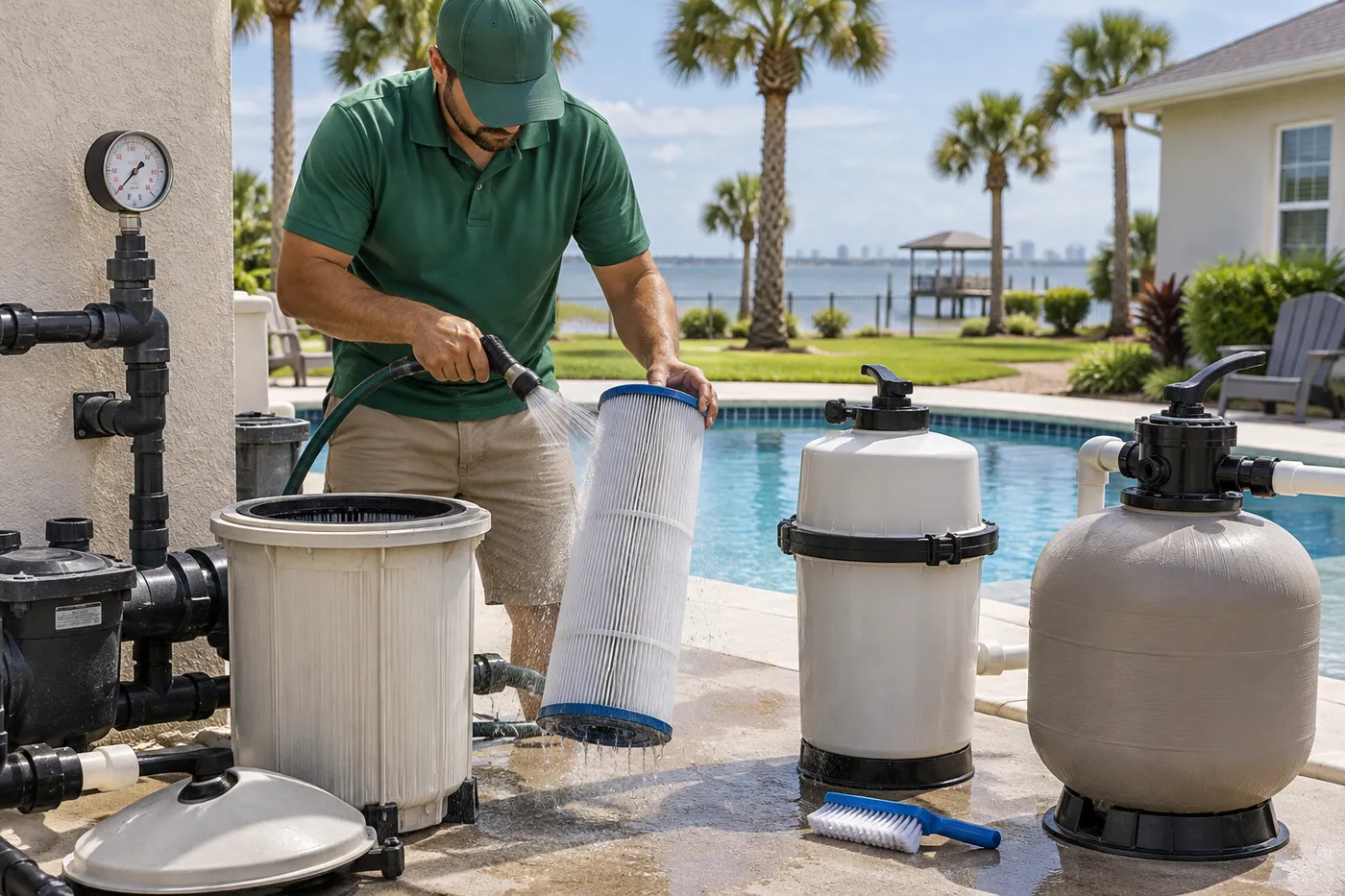
- Rinse the pleats with a garden hose from top to bottom, fanning the pleats open. A pressure washer will cut the fabric and shorten the cartridge’s life.
- Rinsing alone does not remove sunscreen, body oil, or the fine mineral scale you get from hard Coastal Bend fill water. Those need a soak: a degreaser soak for oils, then a separate diluted acid soak for scale. Never mix the two, and never soak in chlorine and acid together.
- Let the cartridge dry before reinstalling if you can. A dry element rinses cleaner next time.
- Replace pleated cartridges when the fabric is thinning, the end caps are loose, or the pleats stay permanently flattened — not on a set date.
DE and sand filters
For a DE filter, the routine step is a backwash at that same 8 to 10 psi trigger, followed immediately by recharging with fresh DE through the skimmer. Skipping the recharge runs bare grids, which is how grids get coated and clogged. Backwashing alone does not equal a clean filter: grids still need to come out for a full teardown and, on year-round pools, that is a job for roughly every six months. Fall is the natural time, because you want clean grids going into the months when you run the pump less.
Sand filters need backwashing on the same pressure rule, then a rinse cycle before returning to filter. Sand channels and clumps over time; if the pressure climbs back within days of a backwash, the bed is the problem, not the dirt.
Why to do it before the front, not after
When that first real cool front pushes through the Coastal Bend, three things happen at once. Water temperature drops, so your salt cell output drops with it. You cut pump run time because the water is cooler. And the north wind loads the pool with leaf litter and blown debris in a single afternoon. A filter already sitting 8 psi over baseline going into that will not keep up, and you will spend October chasing cloudy water with chemicals that were never the issue.
A clean filter, a recorded baseline pressure, and a working gauge is maybe two hours of work. It is the highest-return thing you can do to a Corpus Christi pool in late September.
Two questions we get
How often should I clean my pool filter in Corpus Christi? By pressure, not by calendar. Clean it when the gauge reads 8 to 10 psi above your recorded clean starting pressure. In practice, heavy summer use, wind-blown grit, and pollen mean most local pools hit that every four to eight weeks in season and less often in winter. DE and cartridge elements also need a full teardown clean about every six months on a year-round pool.
Why is my pool cloudy even though the chlorine is fine? Nine times out of ten it is circulation, not chemistry. A restricted filter, a clogged pump basket, or too little daily run time means the water is not passing through the filter enough times to clear. Check filter pressure against your baseline first, then look at run hours, then look at chemistry.
If you would rather have someone else own the gauge, the grids, and the fall transition, SiteHarbor handles residential pool care across Corpus Christi, Portland, Rockport, and the surrounding Coastal Bend. A free walkthrough gets you an estimated range for your property with no obligation.