
Black Streaks, Green Fences, Chalky Driveways: What Salt Air Really Does to a Corpus Christi Home
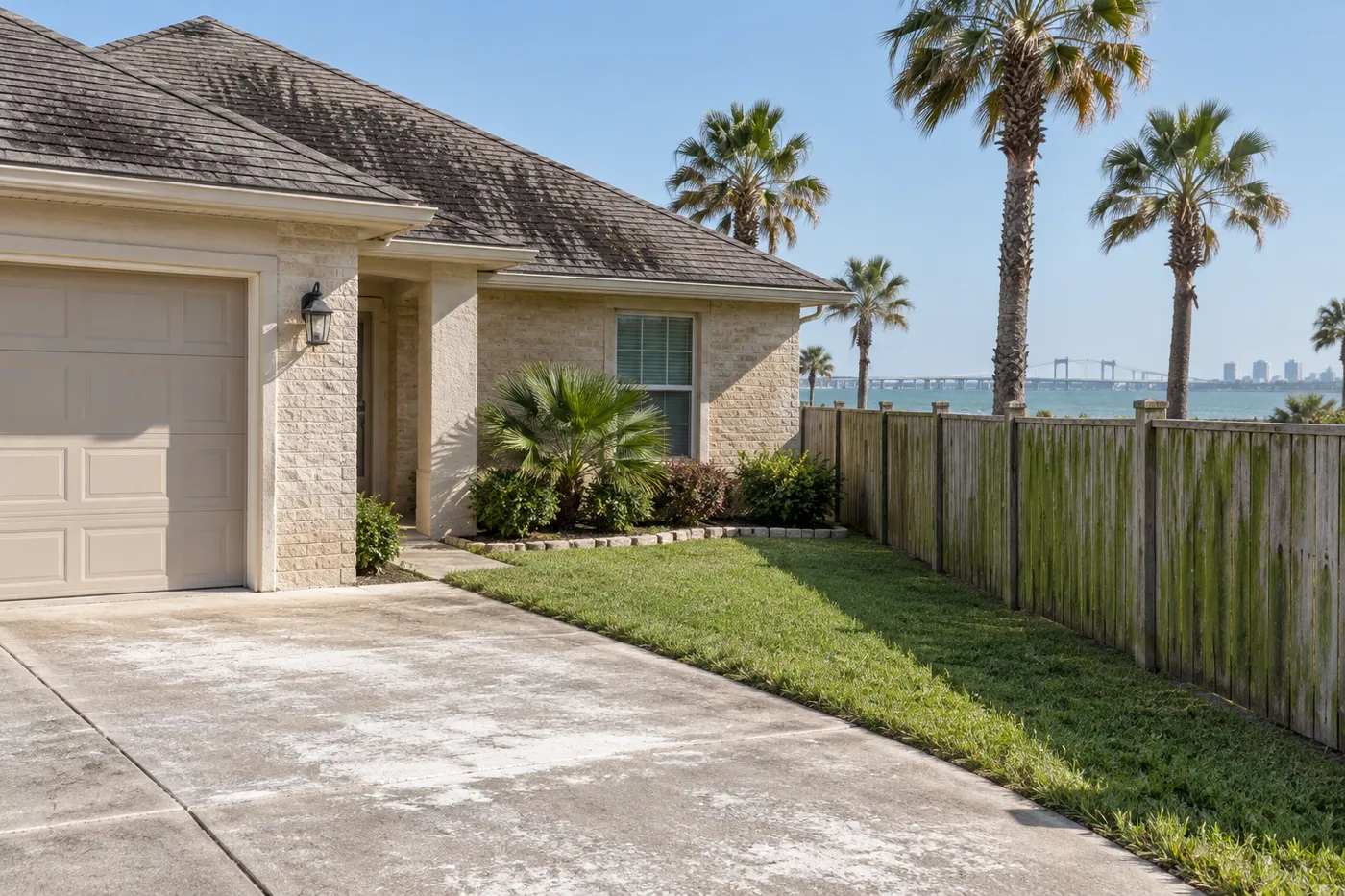
Drive any Corpus Christi neighborhood in September and you can read the humidity off the houses. Dark vertical streaks running down the north slope of a roof. A wood fence that is honey-colored on one side and gray-green on the other. A driveway with a chalky bloom where the sprinkler hits it. None of that is dirt in the ordinary sense, and that is why hosing it off does almost nothing.
Here is what each of those problems actually is, and what removes it without wrecking the surface underneath.
The black streaks on your roof are alive
Those streaks are Gloeocapsa magma, a cyanobacterium that feeds on the limestone filler in asphalt shingles and holds onto moisture. It shows up on humid coastlines first and worst, and it always starts on the shaded north- and east-facing slopes because those stay damp the longest after our morning dew and afternoon storms.
The important part for a homeowner: the Asphalt Roofing Manufacturers Association is explicit that high-pressure washing should not be used to remove algae from asphalt shingles. Pressure blasts the protective granules off the shingle, which shortens the life of the roof and can void a manufacturer warranty. ARMA’s own guidance is a chlorine-and-water solution applied with a low-pressure sprayer, left to dwell 15-20 minutes, then rinsed gently.
That method has a name in the trade: soft washing. It uses volume and chemistry instead of force. If a company quotes you “pressure washing the roof,” ask what PSI they are putting on the shingles. If they cannot answer, that is your answer.
Why fences and north walls go green
Fences and shaded siding grow a different organism – mostly algae and mildew – for the same reason: shade plus humidity plus a food source. In the Coastal Bend there is a third ingredient. Salt aerosol drifts inland off the bay and settles on every horizontal and vertical surface. Salt is hygroscopic: it pulls moisture out of the air and holds it against the wood or the paint film, so a surface within a few miles of the water stays damp far longer than the same surface in San Antonio.
Practical consequences:
- Wood fences on the bay side of a property gray out and grow faster than the street side. Cleaning on a schedule (rather than a rescue wash every three years) is what keeps the boards from cupping and splitting.
- Painted siding, especially on the north elevation, mildews in the seams and under eaves where rain never rinses.
- Screens, railings and light fixtures corrode – salt film plus dew is a nightly wet-dry cycle on bare metal.
Rinsing salt film off metal, glass and painted surfaces is genuinely useful maintenance here in a way it simply is not further inland.
The chalky white bloom on concrete
That is usually efflorescence: dissolved salts and lime migrating to the surface as water evaporates out of the slab. It is common on newer concrete, on driveways where irrigation overspray keeps one strip permanently damp, and around pool decks. Efflorescence is not algae, so chlorine does not touch it. It needs a mild acidic masonry cleaner, and the real fix is upstream – adjust the sprinkler head so it stops watering the concrete.
Organic staining on concrete (the gray-green film on shaded walkways, the black rings under a live oak) is the opposite: chemistry first, pressure second. A surface cleaner attachment on a driveway leaves an even finish; a wand in someone’s hands leaves stripes you will see every day for a year.
How often, realistically, in the Coastal Bend
There is no single right answer, but these are the intervals that hold up on properties here:
- House wash (siding, soffits, eaves): annually. Shaded elevations near the water sometimes want it sooner.
- Driveway, sidewalk, patio: annually, or twice a year if it is shaded or gets sprinkler overspray.
- Roof soft wash: when streaking appears, then every few years. Do not wait until it is uniform black – the longer it grows, the more granule loss you are already carrying.
- Pool deck and outdoor living areas: spring, before the season you actually use them.
- Commercial and HOA-managed property: quarterly is the standard that keeps common areas from ever looking neglected, which is usually what the complaint emails are about.
The two mistakes that cost the most money
First, pressure where chemistry belongs: shingles, soft wood, painted siding, window seals and older mortar all lose when someone reaches for 3,000 PSI. Second, washing in the wrong order. Wash the house before the driveway and you dirty the concrete twice. Wash before hurricane season debris rather than after and you pay for the same job again in October.
One more Coastal Bend detail
Late summer is the worst time to judge your own exterior and the best time to schedule cleaning for it. Growth peaks now, after months of humidity, and everything you clean in the next several weeks stays clean through the dry stretch that follows. If you are already having lawn or pool service done, sequencing the wash with those visits keeps trucks, water and cleanup on one schedule instead of three.
SiteHarbor handles lawn, pool care and exterior washing on one contract, one schedule and one monthly invoice for Corpus Christi and the Coastal Bend. If you want a straight opinion on what your property actually needs – and what it does not – call (361) 792-0247.
SiteHarbor bundles lawn, pool and exterior cleaning on one contract across the Coastal Bend. See residential services, commercial grounds care, or get a quote.