
Three Brown Patches, Three Different Causes: How to Read a Struggling St. Augustine Lawn in September
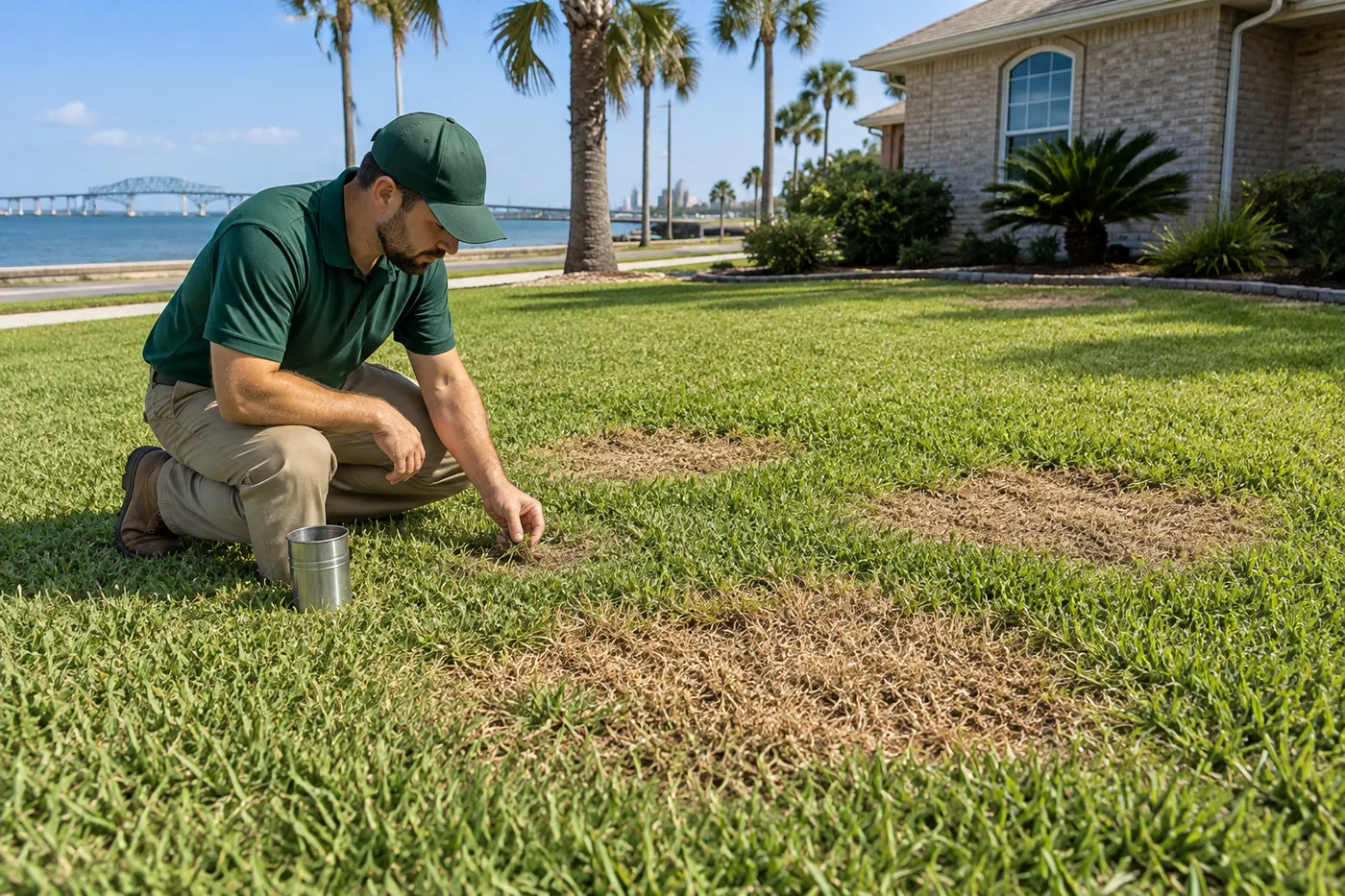
Corpus Christi just set a record high of 99 degrees on Tuesday, September 15, and the forecast holds in the low 90s with tropical moisture and rain chances building into Thursday. That combination of extreme heat followed by humid, wet air is the worst possible week for St. Augustine, and it is why so many lawns from Calallen to Flour Bluff have brown patches right now.
The problem is that three completely different causes look almost identical from the driveway. Chinch bug damage, take-all root rot and simple heat and drought stress all show up as irregular tan or straw-colored areas in an otherwise green lawn. Treating the wrong one wastes money and loses turf. You can sort out which one you have in about ten minutes.
Step one: pull on the grass
Walk to the edge of a brown patch, where the brown meets the green, and pinch a handful of runners. Then tug.
If the stolons, the horizontal runners, pull out of the ground easily and the roots look short, dark and rotted, you are looking at take-all root rot. Texas A&M AgriLife notes that with take-all, the leaf blades stay attached to the stolon even though the root system underneath has been destroyed. With large patch, the other common fungal disease here, blades slip off the stolon easily and often have a slimy dark brown lesion at the base of the leaf.
If the runners are firmly anchored and the roots are white and fibrous, the fungus is not your problem. Move on.
Step two: flush for chinch bugs
Southern chinch bug is the one insect that reliably devastates St. Augustine, and it does its worst work in exactly these conditions: hot, dry, sunny ground. AgriLife’s description matches what you see in yards along the bay: islands of dying grass ringed by a halo of yellowing turf, expanding and merging as bug numbers climb. The hottest, most reflective strips get hit first, next to a south-facing wall, along a concrete driveway, at the curb.
To confirm, take a coffee can, cut out both ends, and push it two to three inches into the soil at the edge of the damage. Fill it with water and keep it topped off for five to ten minutes. Chinch bugs float. Adults are small, about a fifth of an inch, black with folded white wings; the nymphs are reddish with a pale band. If several float up in that small circle, you have your answer.
Two things worth knowing before you spray. First, damage is worst in full sun, so test there, not in the shade. Second, a lawn thick with thatch shelters them, which is one more reason mowing height and thatch control matter.
Step three: check the water, not the grass
If the roots are sound and nothing floated in the can, you almost certainly have heat and drought stress. Push a long screwdriver into a brown area and into a green area. If it slides in six inches in the green spot and stops at two inches in the brown one, that area is simply not getting water. In our sandy Coastal Bend soils, water moves through fast and unevenly, and the dry spots are usually mechanical: a sprinkler head blocked by a shrub, a slope that sheds water, compacted soil along a walkway where the mower turns.
What to actually do this week
- Raise the mower. AgriLife’s recommended range for St. Augustine is 2.5 to 3.5 inches. Taller blades shade the soil and support deeper roots, and a lawn under heat stress recovers faster at the top of that range than the bottom.
- Water deeply, not often. Fewer, heavier soakings that reach several inches down beat a daily sprinkle that never leaves the top inch. Water in the early morning so blades dry before nightfall, which matters more once the humidity climbs Thursday.
- Hold back the nitrogen. Balanced fertility is part of managing both take-all root rot and large patch. Pushing a fast, high-nitrogen feed into a diseased or heat-stressed lawn in mid-September makes the problem worse, not better.
- For confirmed take-all, lower the pH at the surface. AgriLife’s control recommendation is a sphagnum peat moss topdressing at one to two bales per 1,000 square feet per application, each bale about 3.8 cubic feet, one to two applications per year. Their field work found a single bale per 1,000 square feet protected turf for two years. The peat is acidic, roughly pH 4.4, and that acidity suppresses the fungus. Reducing thatch by core aerating and mowing at the correct height helps too.
- For confirmed chinch bugs, treat the active edge. Target the damaged area plus a buffer of healthy grass around it, since the bugs are moving outward, and water the area as the product label directs.
Why September is the hinge month
What you do in the next two weeks decides how the lawn looks in March. Roots damaged now do not get a second growing season to recover before dormancy. A take-all problem left alone through a wet, warm October usually reappears as bare ground next spring, and reseeding is not an option with St. Augustine, so the repair is sod or plugs.
SiteHarbor serves Corpus Christi, Portland, Ingleside, Aransas Pass, Rockport, Robstown, Calallen, Flour Bluff and Padre Island. If you have a patch you cannot diagnose, we will walk the property with you at no charge, tell you which of the three it is, and give you an estimated range if you want us handling it.
Questions we get
Why is my St. Augustine brown along the driveway but green in the middle of the yard? That strip is the hottest and driest ground on the property, which makes it the first place chinch bugs cause visible damage and the first place drought stress shows. Do the coffee can flush there; if nothing floats, check how much water actually reaches that edge.
Should I water more if my lawn has brown patches? Only if the soil is genuinely dry, which a screwdriver will tell you in seconds. If the cause is take-all root rot or large patch, extra water and extended leaf wetness feed the fungus. Water deeply in the early morning instead of frequently in the evening.