
Your Pool’s Shoulder Season Starts Now: What Changes as Corpus Christi Cools Off
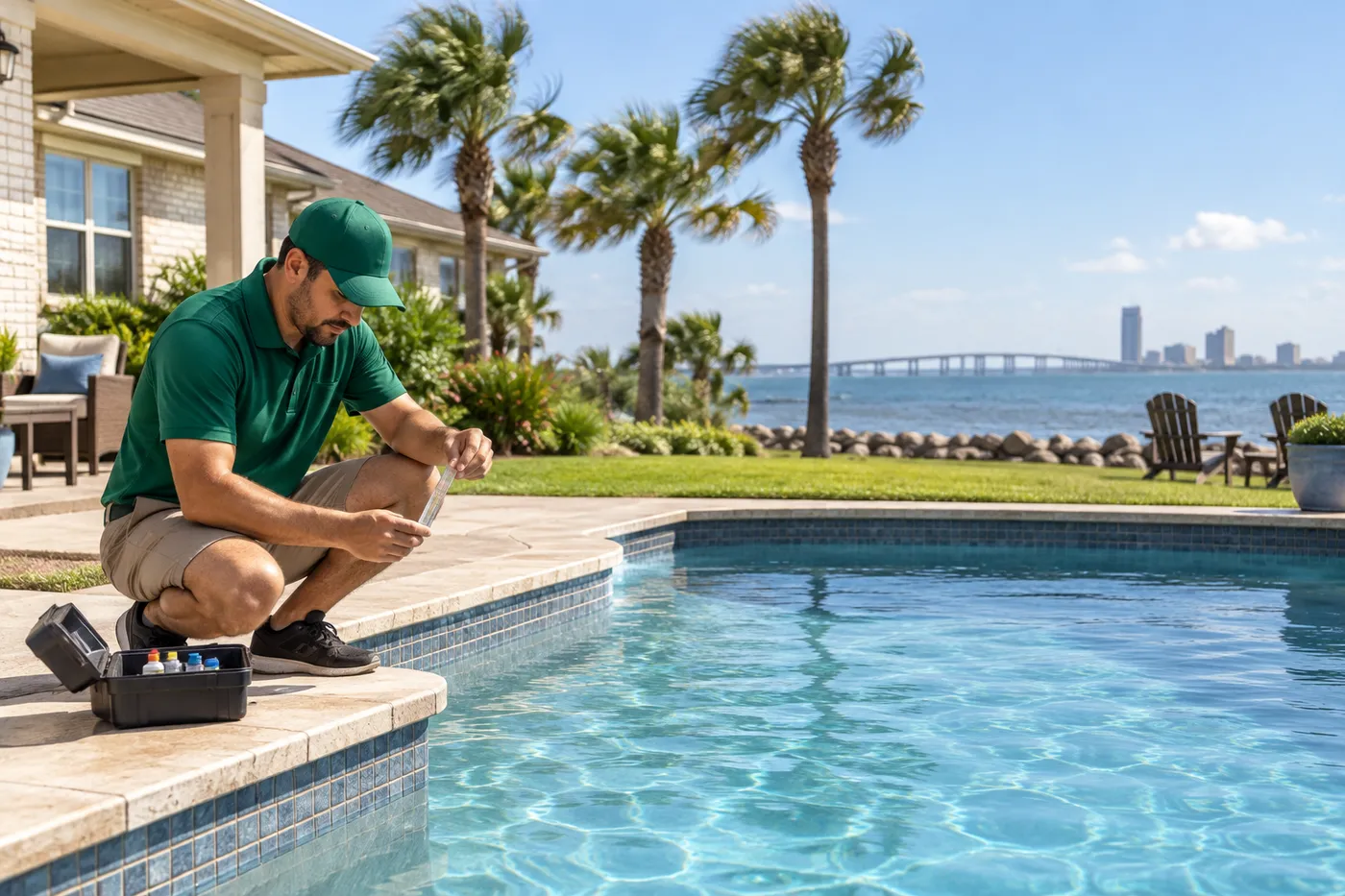
The forecast for Corpus Christi this week is a high near 91 with slight shower chances, after a stretch of middle-to-upper 90s and a record 99 degrees earlier in the month. That is the first real hint of the shoulder season here. Air temperatures ease, the days get noticeably shorter, and pool water lags weeks behind both. If you leave your equipment on July settings until Thanksgiving, you overspend on electricity. If you cut everything the first cool morning, you get a green pool. The way through is to run your pool off water temperature instead of the calendar.
Buy a thermometer before you change a setting
Almost every fall pool decision keys off water temperature, and in zone 9a the water can still be in the mid to upper 80s while mornings feel pleasant. Drop a cheap pool thermometer in and read it at the same time each day, or use the temperature readout on your automation panel. Write the number down once a week. That single habit tells you when each of the steps below is actually due.
Step pump run time down in stages
A common service rule of thumb is roughly one hour of pump run time per 10 degrees of water temperature, as a floor, run during daylight. At 88-degree water that is about eight or nine hours; at 70 degrees it is closer to seven; in the 60s you can often hold at four to six. Take it down an hour at a time, wait a week, and watch the water. Clarity and a stable chlorine reading mean the shorter cycle is working. Cloudiness, or chlorine that keeps sliding, means you cut too soon.
Two Coastal Bend cautions. First, do not shut the pump off for days at a time, even in December. Algae still grows above 60 degrees, and our winter is a series of warm spells, not a freeze. Second, our fall wind is loaded with leaf and seed debris off live oaks, palms and mesquite, plus salt-laden dust. Skimmer and pump baskets fill faster in October than in July, and a clogged basket starves the pump no matter how long the timer says it runs.
Chlorine demand falls, but sunlight is still the enemy
Cooler water burns less chlorine, so the same output that barely held 3 ppm in August may push the reading high in November. Test before you dose, and turn output down rather than skipping tests. What does not change is ultraviolet loss. Cyanuric acid is what protects chlorine from sunlight, and the industry standard from the Pool & Hot Tub Alliance sets an ideal range of 30 to 50 ppm with a maximum of 100 ppm. Our long UV season means many local pools are running high on CYA by September because stabilized chlorine keeps adding more. High CYA does not evaporate. The only real fix is dilution: drain a portion and refill.
Salt pool owners: this is your cell maintenance window
Salt chlorine generators are temperature-aware by design. Pentair’s IntelliChlor throws a LOW TEMP warning when water falls below 60 degrees and stops producing at about 52 degrees. Hayward’s Salt & Swim reduces generation between 50 and 60 degrees and stops below 50. That means the shoulder season is exactly when you should inspect the cell, before output naturally drops and hides a scale problem. Common guidance is to check the cell every three months or roughly 500 operating hours, and to clean it with a diluted acid solution only when you can see scale on the plates, because acid shortens cell life. Heavy rain also dilutes salt concentration, so recheck salt level after any soaking event before you assume the cell is failing.
Watch the phosphate side of your yard
Fall is when many Coastal Bend homeowners make a last fertilizer application, and fertilizer that lands on the deck or washes off a sloped bed ends up in the pool. Phosphate is algae food, and levels above roughly 300 parts per billion are commonly associated with blooms. If your water goes hazy every time it rains, look upslope before you buy another jug of remover. Keep granular fertilizer off hardscape, sweep the deck rather than hosing it toward the pool, and get the basics right first: CYA in range, free chlorine 3 to 5 ppm, pH 7.4 to 7.6, total alkalinity 80 to 120 ppm. Phosphate treatment does not work on an unbalanced pool.
A simple fall sequence
- Record water temperature weekly.
- Reduce pump run time one hour at a time, verifying clarity for a week between cuts.
- Test chlorine before adjusting salt cell output or dosing.
- Check CYA now; plan a partial drain and refill if it is above 50 ppm and climbing.
- Inspect the salt cell while the water is still warm enough to judge output honestly.
- Empty baskets more often as wind and leaf drop pick up.
Done in that order, the transition is uneventful, which is the whole goal. If you would rather have someone else read the water and step the settings down for you, SiteHarbor serves Corpus Christi, Portland, Ingleside, Aransas Pass, Rockport, Robstown, Calallen, Flour Bluff and Padre Island. We will walk the property, look at the equipment pad, and give you an estimated range with a free walkthrough before anything is scheduled.
Questions we get this time of year
How many hours should I run my pool pump in the fall in Corpus Christi? Start from about one hour per 10 degrees of water temperature during daylight, then step down gradually. With water in the upper 80s that is eight to nine hours; expect to be near four to six hours once the water sits in the 60s. Never leave it off for days.
Why did my salt system stop making chlorine when it got cool? That is usually a designed temperature cutoff, not a failure. Pentair IntelliChlor warns below 60 degrees and stops near 52 degrees, and Hayward Salt & Swim reduces output between 50 and 60 degrees and stops below 50. Check water temperature and salt level, especially after heavy rain, before replacing anything.