
Driveway Pressure Washing in Corpus Christi: What to Expect
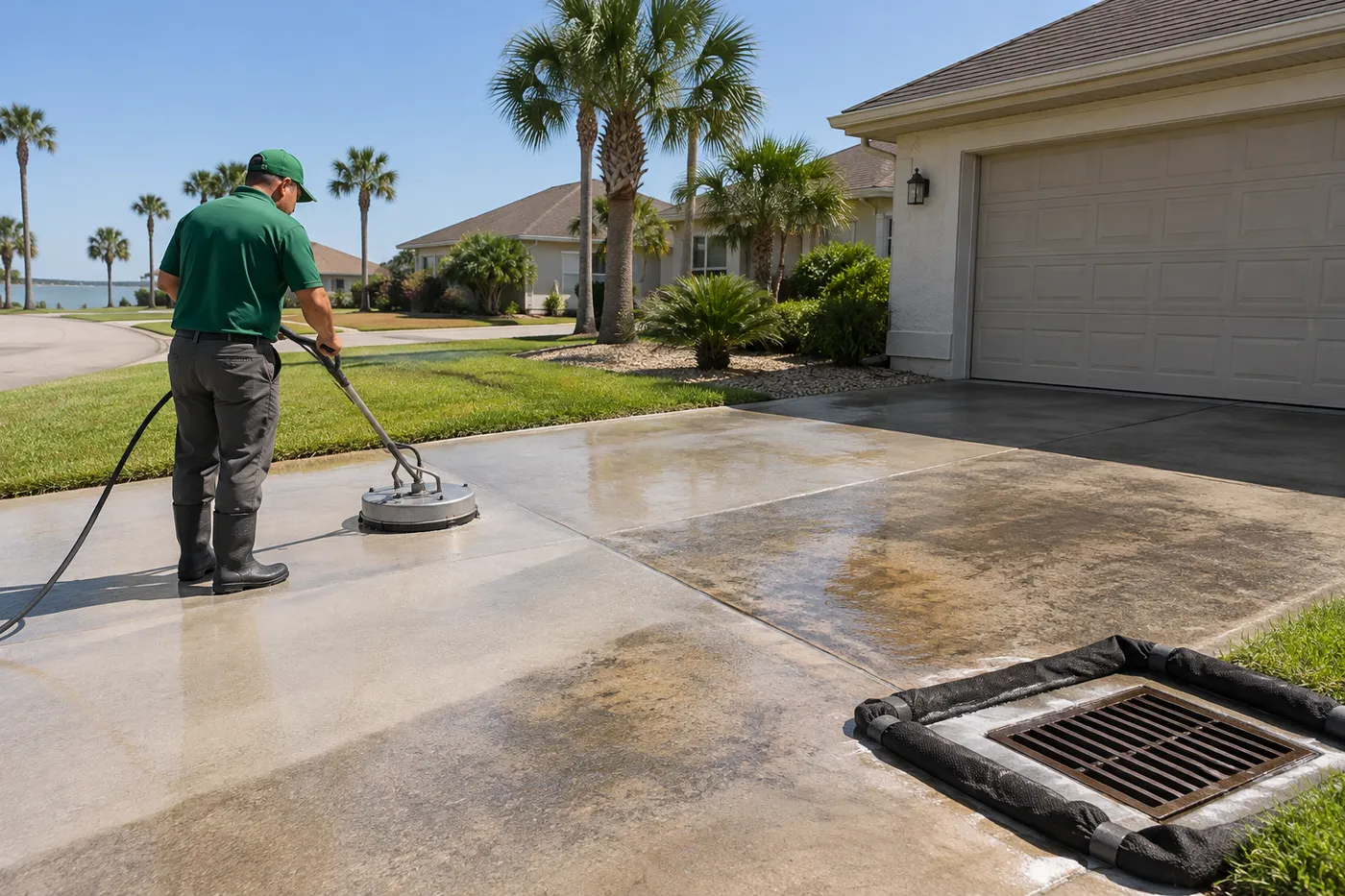
Driveway pressure washing in Corpus Christi works best when it is treated as three separate jobs: lifting the everyday grime and mildew with a surface cleaner at moderate pressure, treating rust and oil stains with the chemistry each one needs, and keeping the wash water out of the storm drain. Salt air, humidity and iron-heavy runoff mean a Coastal Bend driveway darkens faster than one inland, so knowing what a proper cleaning involves helps you judge any quote you get.
What does driveway pressure washing include in Corpus Christi?
A thorough driveway cleaning is more than one pass with a wand. Here is what a complete job usually covers:
- Pre-treatment. Mildew and algae, the green-black film common on shaded Coastal Bend concrete, loosen far more easily with a cleaning solution applied first than with pressure alone.
- Surface cleaner on the flat areas. A rotary surface cleaner keeps the nozzles at a fixed height and gives an even result. Hand wands used across a whole slab are what cause the light-and-dark bands people call zebra or tiger striping.
- Edges, joints and the apron. Expansion joints, the strip along the lawn edge and the curb apron collect soil and weeds, and they need detail work.
- Spot treatment for stains. Rust and oil do not respond to the same cleaner (more below).
- Post-rinse and cleanup. Rinsing off cleaning residue, and keeping debris and chemicals out of the gutter.
Can pressure washing damage a concrete driveway?
Yes, if the pressure is too high or the nozzle is too close. Concrete can be etched, which leaves permanent marks or a rough, sandy surface where the cream layer has been stripped away. Many exterior-cleaning guides treat roughly 2,000 to 3,000 PSI as the working range for residential concrete, with a wide fan tip or a surface cleaner rather than a narrow zero-degree tip.
It helps to know the difference between etching and striping. Striping is uneven cleaning, and it comes out with a proper second pass. Etching is damage to the concrete itself, and it does not come out.
New concrete is a special case. Concrete takes about 28 days to cure, and the common guidance is to wait at least that long before pressure washing a freshly poured driveway or slab.
How do you get rust stains off a driveway?
Orange and brown spots are one of the most common complaints on Corpus Christi driveways. The usual sources are granular fertilizer that contains iron and gets tossed onto the concrete during spreading, sprinkler water that carries iron, and metal furniture, grills or planters left in one spot.
Bleach-based cleaners do not remove rust. Rust needs an acid-based cleaner made for it. Oxalic acid is the standard choice, and it is the active ingredient in many hardware-store concrete rust removers. Extension guidance for iron stains describes soaking the stain in an oxalic acid solution for a couple of hours, then scrubbing and rinsing. Oxalic acid is toxic, so label directions and eye and skin protection matter, and plants along the edge should be rinsed.
If the same spots keep coming back, the source is still active. Blowing fertilizer back onto the lawn after spreading, and checking where sprinklers overspray onto the driveway, prevents repeat stains.
What about oil stains?
Oil and transmission-fluid drips need a degreaser that is allowed to dwell before rinsing, and sometimes more than one round. Fresh drips come out more completely than stains that have soaked in for years. Older stains often lighten a lot but can leave a faint shadow, and a fair contractor will say so before starting rather than after.
Where does the wash water go?
This part is easy to overlook. The City of Corpus Christi notes that its storm water system carries runoff directly to local creeks, streams and bays without any treatment, and its guidance is simple: only rain down the storm drain. Cleaning chemicals, oil lifted off the slab and loose dirt should not be washed into the curb inlet. In practice that means using the smallest amount of chemical that does the job, treating oil stains as spot work, and steering rinse water toward lawn areas rather than the street where possible. The City’s storm water pollution prevention page explains the rules.
How often should you pressure wash a driveway on the Coastal Bend?
There is no fixed schedule, but many homeowners here clean once or twice a year. Shaded driveways, north-facing slabs and homes near the water tend to grow mildew faster.
Some owners follow a cleaning with a penetrating silane or siloxane sealer. These products soak into the concrete instead of forming a glossy film, and they reduce how much water, salt and dirt get into the surface. Sealing is optional, but it can make the next cleaning easier.
The roof and siding are a different job. Shingles and stucco call for low-pressure soft washing, which we covered in what causes black streaks on Corpus Christi roofs.
Frequently asked questions
How long does it take to pressure wash a driveway in Corpus Christi?
A typical two-car driveway with a sidewalk is usually a few hours of work, longer if rust or oil stains need treatment and dwell time. Allow some time afterward for the concrete to dry before parking on it.
Will pressure washing remove fertilizer rust stains from my driveway?
Pressure alone usually will not. Rust from fertilizer or iron in sprinkler water needs an acid-based rust cleaner such as oxalic acid, followed by a rinse. Pressure washing then cleans the rest of the slab evenly.
Get a driveway cleaning quote
SiteHarbor handles pressure washing and exterior cleaning for driveways, walkways, patios and home exteriors across Corpus Christi and the Coastal Bend, with commercial pressure washing for storefronts and parking areas. Tell us about your property and we will send an estimated range, then set up a free walkthrough. Request your free quote.