
The Last Fertilizer of the Year: Fall Feeding St. Augustine in Corpus Christi
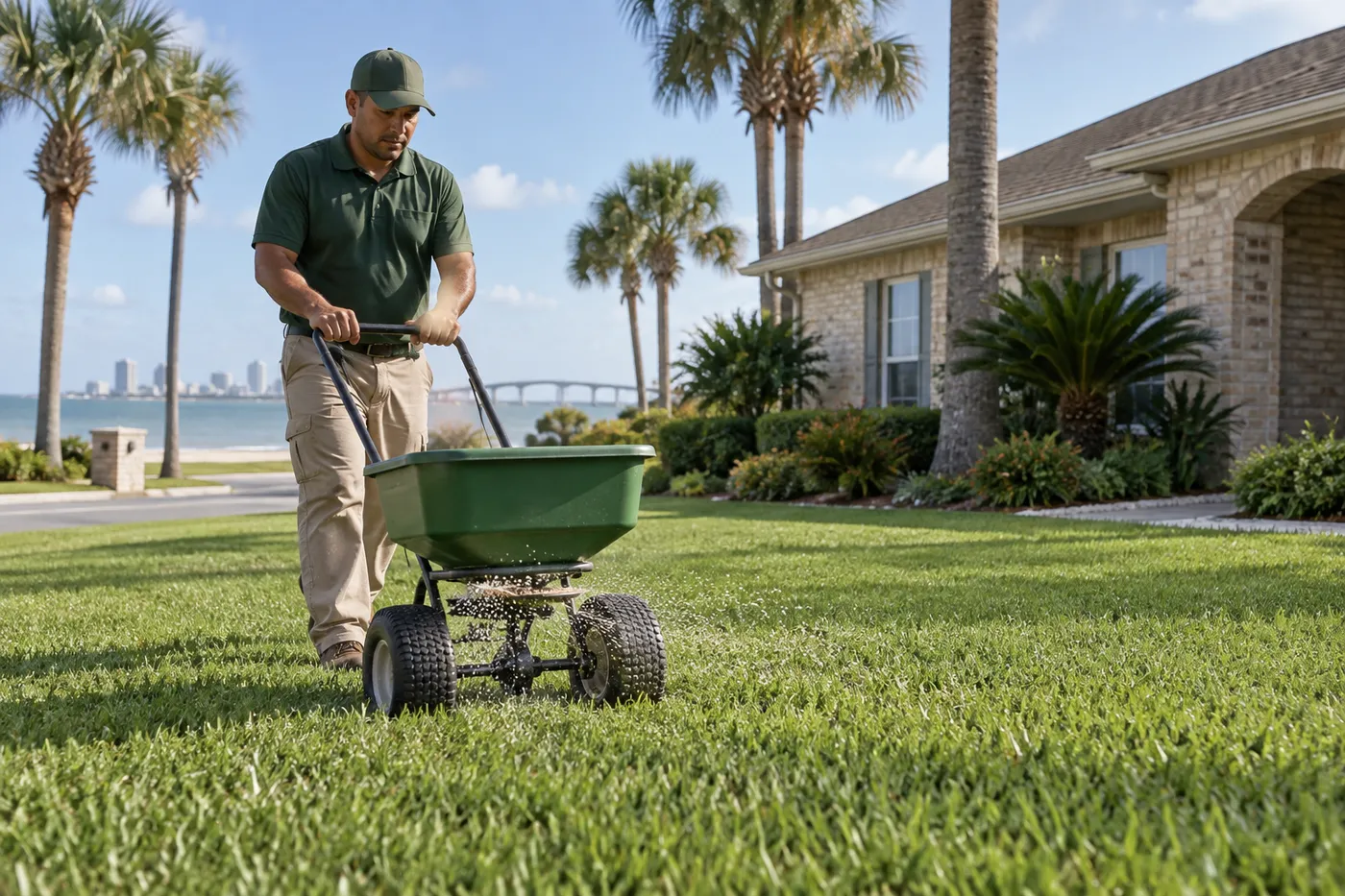
It is the last week of September and Corpus Christi is still running in the low to mid 90s, with a cold front forecast for late in the week. That front will not end the growing season, but it is a reminder that the window for the year’s final fertilizer application is open now and closes sooner than most people think.
Fall feeding is worth doing right. Texas A&M AgriLife notes that a modest fall nitrogen application thickens the turf so it resists winter weeds, holds color longer into fall and recovers faster in spring. Done wrong, the same bag feeds disease and leaches into the bay.
The date that matters: November 1
AgriLife’s lawn fertilization guidance sets a cut-off date for the last nitrogen application of the year, grouped by frost zone. Corpus Christi sits in the same group as Harlingen and McAllen, and the recommended cut-off is November 1. The rule behind the date is simple: the final late-season nitrogen should go down no later than about six weeks before the expected first frost, so the grass can actually use it before growth slows.
In practice, for most lawns in Corpus Christi, Portland, Rockport and Flour Bluff, the sweet spot is early to mid October, once the worst heat has broken but while the grass is still growing and needing a mow every week. Out toward Robstown, Calallen and Sinton, where inland nights run cooler than on the island, lean toward the earlier end.
How much to put down
Less than the bag usually suggests. AgriLife recommends modest fall rates of 1 pound of actual nitrogen per 1,000 square feet or less, and the Harris County AgriLife St. Augustine guide goes further for the late-season feeding: no more than half a pound of nitrogen per 1,000 square feet, in a low-nitrogen, higher-potassium product.
To turn that into bag math, divide the first number on the label into 100. A 15-0-15 product is 15 percent nitrogen, so about 6.7 pounds of product covers 1,000 square feet at 1 pound of nitrogen, and about 3.3 pounds gets you to half a pound. Set the spreader low and make two passes at right angles rather than one heavy pass. Striping and burned stripes are almost always a spreader problem, not a product problem.
AgriLife’s annual ceiling for St. Augustine is 4 pounds of nitrogen per 1,000 square feet across the whole year. If the lawn was fed in spring and again this summer, a light fall application is plenty.
When to skip it
- The lawn is stressed. AgriLife is direct about this: do not fertilize stressed grass. If you are fighting chinch bug damage or dry, sunburned patches along the driveway, fix the water and the insects first. Nitrogen on a struggling lawn pushes top growth the roots cannot support.
- You have a history of large patch. Large patch, the fall and spring disease that makes rings of yellow-orange St. Augustine, becomes active as soil temperatures fall toward 70°F, and AgriLife lists balanced nitrogen as one of the main defenses. If those rings showed up last November or this spring, use the half-pound rate or skip nitrogen this fall entirely.
- It is already November. Late nitrogen sits unused in cool soil, and in our sandy soils that means it moves toward groundwater and Oso Bay instead of into the grass.
- Heavy rain is in the forecast. Sandy Coastal Bend soil drains fast. Apply before a light rain or water it in with about a quarter inch yourself, not ahead of a two-inch tropical downpour.
Test before you guess
Coastal Bend soils vary lot to lot, and fertilizer that adds a nutrient the soil already has is wasted. A soil test through the Texas A&M AgriLife Soil, Water and Forage Testing Laboratory tells you what is actually missing, so you are not paying for nutrients the lawn does not need. Pull a sample from several spots in the lawn, 3 to 4 inches deep, and mix them together. Results in hand make next spring’s plan easier too.
If you cannot test this year, AgriLife suggests watching the grass instead. A lawn that has been growing steadily and holding color through September does not need much help. One that has thinned and faded without an insect or disease cause is the one that benefits most from a light feeding.
Common questions
When should I stop fertilizing St. Augustine in Corpus Christi? Texas A&M AgriLife sets November 1 as the cut-off for the last nitrogen application in the Corpus Christi frost zone. Early to mid October is the practical target for most lawns, while the grass is still actively growing.
Should I use a winterizer fertilizer on my lawn in South Texas? A low-nitrogen, higher-potassium product at no more than half a pound of nitrogen per 1,000 square feet is what the Harris County AgriLife St. Augustine guide recommends for the late-season feeding. The label name matters less than the numbers on the bag and the rate you spread it at. A soil test is the best way to know whether you need the potassium at all.
If you would rather have someone look at the lawn and tell you whether it needs a fall feeding, a disease watch or nothing at all, we will walk the property with you — free walkthrough, then an estimated range in writing.