Lawn Care Articles | SiteHarbor

SiteHarbor

Category: Lawn Care

  • Lawn Service in Flour Bluff, Corpus Christi

    Lawn Care

    Lawn Service in Flour Bluff, Corpus Christi

    SiteHarbor · Corpus Christi & the Coastal Bend
    Lawn Service in Flour Bluff, Corpus Christi

    Lawn service in Flour Bluff, Corpus Christi should start with a walkthrough of the actual mowing area, backyard access, and cleanup boundaries. SiteHarbor provides residential lawn maintenance in Flour Bluff, including mowing, edging, line trimming, and blowing hard surfaces clean. The first step is to identify what your property needs, rather than approve a plan based only on the front yard.

    For a homeowner comparing recurring service, the useful questions are concrete: Can equipment reach the backyard? Which fence lines need trimming? Is a separate grass strip included? What happens when the ground is too wet? Clear answers give both the homeowner and the crew the same definition of a finished visit.

    What should a Flour Bluff lawn service walkthrough cover?

    Walk the route the crew would use, starting at the unloading area and continuing through each gate. Point out anything that is not obvious from the street. A narrow side passage, a locked backyard, or a detached grass area belongs in the service notes before the first visit.

    • Gate access: Show the usable opening, latch, lock, and any instructions for securing it afterward.
    • Equipment route: Identify steps, tight corners, soft spots, and areas that should not be crossed.
    • Objects near the lawn: Point out exposed cables, low fixtures, drain covers, and fragile edging.
    • Pets and belongings: Agree on who clears toys, pet waste, hoses, and movable furniture before arrival.
    • Communication: Decide how access problems or unfinished areas should be reported.

    If backyard access depends on someone being home, explain that before agreeing to a recurring service day. Ask what happens if the gate is locked. Do not leave the crew to guess whether to complete only the front or return later.

    Which parts of my Flour Bluff yard are included?

    Ask for the maintained areas to be written down. Include the front, back, side yards, and any separate sections you want serviced. For corner properties or grass outside a fence, clarify the intended boundary rather than assuming it is included.

    Separate mowing from other work. Cutting grass beside a bed does not define whether bed weeding, shrub trimming, leaf removal, or hauling is part of the agreement. Ask which tasks belong in the recurring plan and which need a separate scope.

    A useful request is: “Please include every grass area shown during the walkthrough, identify the edges to maintain, and explain how the hard surfaces will be left.” That is easier to check than a general promise to keep the yard neat. For broader questions about comparing providers, see how to choose a lawn care company in Corpus Christi.

    How should a lawn crew handle St. Augustine grass?

    Ask the provider to identify the turf before choosing a cutting height. Texas A&M AgriLife explains that St. Augustinegrass mowing height depends partly on the cultivar and mower capability. A single low setting should not be the default for every property.

    AgriLife also recommends removing no more than one third of the green canopy height at one mowing. If the lawn is overgrown when service begins, ask how the first cut will respect that limit instead of forcing an immediate short finish.

    Discuss clippings separately from hard-surface cleanup. AgriLife supports returning fine, evenly distributed clippings to the turf, with exceptions such as active disease or flowering weeds. Ask how the crew will handle heavy accumulations rather than assuming every clipping must be bagged.

    What happens if my backyard is wet on service day?

    Agree on the response before it becomes a scheduling problem. AgriLife advises avoiding heavy riding mowers on wet turf because they can cause rutting and soil compaction. A scheduled visit is not a reason to drive through soft ground.

    Ask whether the provider will contact you, postpone the affected area, or reschedule the visit. If one part of the property stays soft, mark it during the walkthrough and make sure it appears in the property notes. Also clarify whether a partial visit changes what happens next.

    What information should I send for a lawn service quote?

    Send the Flour Bluff property address, contact information, and clear photos of the front, back, side passages, and gates. Include any overgrown areas and explain whether you want recurring maintenance or an initial cleanup followed by maintenance.

    Request an estimated range, then a free walkthrough to confirm the scope. Before approving service, check that the written plan matches the areas discussed, explains access arrangements, and identifies any work outside routine maintenance. Keep those notes available for the first visit.

    Can a lawn service maintain a backyard with a narrow gate? Have the provider inspect the opening and the full access route before confirming the plan. Do not assume the equipment used in the front yard will fit through the gate or around backyard corners.

    Does recurring lawn service automatically include beds and shrubs? Ask for those tasks to be listed explicitly. Confirm which bed and shrub work is included in your particular plan and which work needs separate approval.

    For residential lawn maintenance in Flour Bluff, request a free quote. Start with an estimated range, then use the free walkthrough to confirm access, boundaries, and the maintenance plan.


  • How to Choose a Lawn Care Company in Corpus Christi

    Lawn Care

    How to Choose a Lawn Care Company in Corpus Christi

    SiteHarbor · Corpus Christi & the Coastal Bend
    How to Choose a Lawn Care Company in Corpus Christi

    To choose a lawn care company in Corpus Christi, compare how each provider evaluates your yard, explains mowing decisions, handles schedule changes, and documents the work. Ask for a free walkthrough before agreeing to recurring service. Whether your home is in Flour Bluff, Calallen, or another Coastal Bend neighborhood, use the actual property and a written scope to compare providers, rather than choosing from a short message with an unexplained total.

    What should you ask a lawn care company before hiring?

    Start with a simple question: what would the crew need to know before its first visit? Walk through the front, back, and side yards together. Point out narrow gates, pets, outdoor furniture, exposed roots, and places where equipment should not travel. Ask the provider to explain any limitations before work begins.

    For SiteHarbor’s residential lawn maintenance, use the walkthrough to discuss your property’s needs and confirm the proposed work. Do not assume that a request for lawn care automatically includes every outdoor task.

    • Who will answer questions about the account or a completed visit?
    • How will the crew receive gate and pet instructions?
    • What happens if part of the yard is inaccessible?
    • How are additional tasks approved before work starts?
    • What is the process for reporting an area that was missed?

    Ask for specific answers. A named contact and a clear approval process are more useful for your hiring decision than a general promise to keep everything looking good.

    How can you tell whether a company understands your grass?

    Ask the provider to identify the turf and explain its proposed cutting height. Texas A&M AgriLife recommends selecting mowing height for the grass variety rather than using one setting everywhere. Its St. Augustinegrass guidance also recommends sharp mower blades and avoiding removal of more than one third of the green canopy height at a time. These give you concrete questions to ask without needing to become a turf specialist.

    Ask how the crew would handle a wet section or a lawn that has become overgrown before the first visit. AgriLife advises against operating heavy riding mowers on wet turf because of rutting and compaction, and notes that mowing needs change with growing conditions. Look for an explanation tied to your yard, not a promise to cut everything as short as possible.

    You can also ask whether the provider will flag unfamiliar damage instead of immediately recommending a treatment. Keep routine maintenance and any proposed treatment separate in the written agreement, with additional work subject to your approval.

    How do you compare lawn care estimates fairly?

    Give each company the same property information and ask it to describe the same requested work. Otherwise, you may be comparing a front-yard visit with an entire-property visit, or routine maintenance with a first-time cleanup.

    Request an estimated range, then a free walkthrough to confirm the scope. Before accepting, check that the written estimate addresses:

    • Service area: Which front, back, side, and outside-fence areas are included?
    • Starting condition: Is any initial cleanup separate from recurring maintenance?
    • Finishing work: What edging, trimming, and hard-surface cleanup are specified?
    • Material handling: How will clippings and collected debris be handled?
    • Changes: What requires a revised estimate and homeowner approval?

    For a baseline scope checklist, read what residential lawn care service includes in Corpus Christi. Use that checklist to ask questions, not to assume every provider offers an identical package.

    What should a lawn service agreement say about scheduling?

    Ask about the normal service window, how changes are communicated, and what happens when a visit cannot be completed. Keep this discussion focused on the agreement rather than accepting a vague promise that someone will return later.

    Confirm whether a delayed visit is rescheduled, skipped, or handled another way under the proposed terms. Ask what happens if the gate is locked, pets remain outside, or the homeowner requests a change. Get the cancellation and pause policies in writing before starting recurring service.

    For a property you do not occupy full time, ask how completion will be communicated. If you want photographs or a message after each visit, request that explicitly and confirm whether the provider agrees to it.

    What should you check after the first lawn service visit?

    Walk the property and compare the completed work with the agreed scope. Check the areas behind gates, along fences, and beside parked vehicles. Look at the driveway, sidewalk, and patio for cleanup, and confirm that gates were secured as instructed.

    If something appears unfinished, describe the location and send a photograph when possible. Ask how the provider will address it and prevent the same issue on the next visit. Evaluate the response against the process discussed before hiring, rather than judging only the appearance of the front yard.

    Keep the original estimate and any approved changes together. That gives both sides a clear reference when the property’s needs or your requested work change.

    Should a lawn care company visit before giving a firm estimate? Request a free walkthrough before accepting a firm scope. Use it to confirm access, property boundaries, starting condition, and any work that needs separate approval.

    Do all lawn care estimates include the same work? Do not assume they do. Ask each provider to identify the areas covered, finishing work, debris handling, and exclusions so you can compare the written proposals directly.

    For help comparing your property’s needs with a clear maintenance scope, review SiteHarbor’s residential lawn maintenance service and request a free walkthrough and quote.

  • Lawn Care Service in Corpus Christi: What’s Included

    Lawn Care

    Lawn Care Service in Corpus Christi: What’s Included

    SiteHarbor · Corpus Christi & the Coastal Bend
    Lawn Care Service in Corpus Christi: What’s Included

    A lawn care service in Corpus Christi should, at minimum, mow St. Augustine at the right height on a steady schedule, edge and trim every visit, blow hard surfaces clean, and tell you what it saw on the property. Anything beyond that, like fertilizer, weed control, or bed work, should be spelled out in writing before the first visit. This guide covers what to expect from a weekly or biweekly lawn service on the Coastal Bend and the questions worth asking before you sign.

    What does a lawn care service include in Corpus Christi?

    Most residential service here is built around a mowing visit. A complete visit usually covers:

    • Mowing front, back and side yards at a set height for your grass type.
    • Edging along driveways, sidewalks and curbs so the turf does not creep onto concrete.
    • String trimming around fences, beds, trees, AC units and other spots a mower cannot reach.
    • Blowing clippings off driveways, walks, patios and the street gutter in front of the house.
    • A quick look for problems: brown patches, chinch bug damage, a broken sprinkler head, low limbs, or storm debris.

    If a quote only says “mow,” ask whether edging, trimming and blowing are part of it. Those three steps are what make a yard look finished, and they take real time on corner lots and properties with a lot of beds.

    What height should St. Augustine be mowed in Corpus Christi?

    Most Corpus Christi lawns are St. Augustine. Texas A&M AgriLife recommends keeping it at roughly 2.5 to 4 inches, and AggieTurf lists 2.5 to 3.5 inches as the recommended range. AgriLife turf specialists note that one of the most common mistakes is mowing St. Augustine short, the way you would cut Bermuda grass. Short cuts expose runners, stress the turf in summer heat, and leave room for weeds.

    A good crew also follows what AgriLife calls the one-third rule: never remove more than one third of the leaf height in a single mowing. That rule is the real reason schedules matter. When a lawn goes too long between cuts, the only way to get it back to height is to take off too much at once, which scalps it.

    Blade condition counts too. AgriLife’s mowing guidance says dull blades crush and shred grass instead of cutting it. Torn tips turn gray or brown and give fungal disease an easier way in, which matters on the Coast, where humidity and warm nights already favor problems like large patch in the fall.

    Weekly or biweekly lawn service in Corpus Christi?

    AggieTurf lists weekly mowing with a rotary mower as the recommended frequency for St. Augustine, and AgriLife’s St. Augustine maintenance calendar says to mow weekly, or as often as needed to avoid scalping. During the long Coastal Bend growing season, that usually means weekly visits. Biweekly service can work when growth slows or when watering is limited.

    That second point is live right now. The City of Corpus Christi has been under Stage 1 water restrictions since late August, which limits lawn watering to once a week on your assigned day, before 10 a.m. or after 6 p.m. As of the city’s September 25 update, combined storage in Choke Canyon and Lake Corpus Christi was 39.3 percent. Lawns watered once a week grow slower and handle stress worse, so a good service should raise the cut height and skip cuts on heat-stressed turf rather than mow on autopilot.

    What should be written into a lawn service agreement?

    Before you hire a lawn care company in Corpus Christi, get these points in writing:

    • Visit frequency and what happens during slow-growth months or rain delays.
    • What each visit includes: mow, edge, trim, blow, and whether clippings are left on the lawn or bagged.
    • Mowing height for your grass type, and whether the crew adjusts it through the year.
    • Add-on services such as fertilizer, weed control, bed cleanup, mulch, hedge trimming and storm cleanup, and how those are priced.
    • Gate, pet and access notes, so the crew knows what to close and where to park.
    • How problems get reported, such as a photo or text when the crew spots damage, disease or a broken sprinkler head.

    On clippings, AgriLife encourages grasscycling, leaving clippings on the lawn when the mowing schedule keeps them short. They break down quickly and return nutrients to the soil. Bagging makes sense when the grass got too long or a disease is spreading, but it should not be the default.

    How SiteHarbor handles residential lawn service

    SiteHarbor’s residential lawn maintenance is built around the checklist above: mowing at the right height for St. Augustine, edging, trimming, blowing hard surfaces clean, and a note when something on the property needs attention. We work across Corpus Christi, Flour Bluff, Padre Island, Calallen, Portland and nearby Coastal Bend towns. If you want to know what a typical yard runs, our lawn care cost guide explains what drives the price. For timing as the season winds down, see when to stop mowing St. Augustine in Corpus Christi.

    Frequently asked questions

    How often should a lawn be mowed in Corpus Christi?
    For St. Augustine during the growing season, weekly is the standard recommendation from AggieTurf and AgriLife. Growth slows in the cooler months and under watering limits, so some yards can move to every other week then.

    Does lawn service in Corpus Christi include edging and weed eating?
    It should, but not every company includes it. Ask whether edging along concrete and string trimming around fences and beds happen on every visit or are billed as extras.

    If you want a lawn service that shows up on schedule and cuts St. Augustine the right way, start with our residential lawn maintenance page or request a free quote. You will get an estimated range first, then a free walkthrough of the property.

  • The Last Fertilizer of the Year: Fall Feeding St. Augustine in Corpus Christi

    Lawn Care

    The Last Fertilizer of the Year: Fall Feeding St. Augustine in Corpus Christi

    SiteHarbor · Corpus Christi & the Coastal Bend
    The Last Fertilizer of the Year: Fall Feeding St. Augustine in Corpus Christi

    It is the last week of September and Corpus Christi is still running in the low to mid 90s, with a cold front forecast for late in the week. That front will not end the growing season, but it is a reminder that the window for the year’s final fertilizer application is open now and closes sooner than most people think.

    Fall feeding is worth doing right. Texas A&M AgriLife notes that a modest fall nitrogen application thickens the turf so it resists winter weeds, holds color longer into fall and recovers faster in spring. Done wrong, the same bag feeds disease and leaches into the bay.

    The date that matters: November 1

    AgriLife’s lawn fertilization guidance sets a cut-off date for the last nitrogen application of the year, grouped by frost zone. Corpus Christi sits in the same group as Harlingen and McAllen, and the recommended cut-off is November 1. The rule behind the date is simple: the final late-season nitrogen should go down no later than about six weeks before the expected first frost, so the grass can actually use it before growth slows.

    In practice, for most lawns in Corpus Christi, Portland, Rockport and Flour Bluff, the sweet spot is early to mid October, once the worst heat has broken but while the grass is still growing and needing a mow every week. Out toward Robstown, Calallen and Sinton, where inland nights run cooler than on the island, lean toward the earlier end.

    How much to put down

    Less than the bag usually suggests. AgriLife recommends modest fall rates of 1 pound of actual nitrogen per 1,000 square feet or less, and the Harris County AgriLife St. Augustine guide goes further for the late-season feeding: no more than half a pound of nitrogen per 1,000 square feet, in a low-nitrogen, higher-potassium product.

    To turn that into bag math, divide the first number on the label into 100. A 15-0-15 product is 15 percent nitrogen, so about 6.7 pounds of product covers 1,000 square feet at 1 pound of nitrogen, and about 3.3 pounds gets you to half a pound. Set the spreader low and make two passes at right angles rather than one heavy pass. Striping and burned stripes are almost always a spreader problem, not a product problem.

    AgriLife’s annual ceiling for St. Augustine is 4 pounds of nitrogen per 1,000 square feet across the whole year. If the lawn was fed in spring and again this summer, a light fall application is plenty.

    When to skip it

    • The lawn is stressed. AgriLife is direct about this: do not fertilize stressed grass. If you are fighting chinch bug damage or dry, sunburned patches along the driveway, fix the water and the insects first. Nitrogen on a struggling lawn pushes top growth the roots cannot support.
    • You have a history of large patch. Large patch, the fall and spring disease that makes rings of yellow-orange St. Augustine, becomes active as soil temperatures fall toward 70°F, and AgriLife lists balanced nitrogen as one of the main defenses. If those rings showed up last November or this spring, use the half-pound rate or skip nitrogen this fall entirely.
    • It is already November. Late nitrogen sits unused in cool soil, and in our sandy soils that means it moves toward groundwater and Oso Bay instead of into the grass.
    • Heavy rain is in the forecast. Sandy Coastal Bend soil drains fast. Apply before a light rain or water it in with about a quarter inch yourself, not ahead of a two-inch tropical downpour.

    Test before you guess

    Coastal Bend soils vary lot to lot, and fertilizer that adds a nutrient the soil already has is wasted. A soil test through the Texas A&M AgriLife Soil, Water and Forage Testing Laboratory tells you what is actually missing, so you are not paying for nutrients the lawn does not need. Pull a sample from several spots in the lawn, 3 to 4 inches deep, and mix them together. Results in hand make next spring’s plan easier too.

    If you cannot test this year, AgriLife suggests watching the grass instead. A lawn that has been growing steadily and holding color through September does not need much help. One that has thinned and faded without an insect or disease cause is the one that benefits most from a light feeding.

    Common questions

    When should I stop fertilizing St. Augustine in Corpus Christi? Texas A&M AgriLife sets November 1 as the cut-off for the last nitrogen application in the Corpus Christi frost zone. Early to mid October is the practical target for most lawns, while the grass is still actively growing.

    Should I use a winterizer fertilizer on my lawn in South Texas? A low-nitrogen, higher-potassium product at no more than half a pound of nitrogen per 1,000 square feet is what the Harris County AgriLife St. Augustine guide recommends for the late-season feeding. The label name matters less than the numbers on the bag and the rate you spread it at. A soil test is the best way to know whether you need the potassium at all.

    If you would rather have someone look at the lawn and tell you whether it needs a fall feeding, a disease watch or nothing at all, we will walk the property with you — free walkthrough, then an estimated range in writing.

  • Fall Pre-Emergent in the Coastal Bend: Watch the Soil, Not the Calendar

    Lawn care

    Fall Pre-Emergent in the Coastal Bend: Watch the Soil, Not the Calendar

    SiteHarbor · Corpus Christi & the Coastal Bend
    Fall Pre-Emergent in the Coastal Bend: Watch the Soil, Not the Calendar

    Winter weeds in the Coastal Bend are decided in the next three weeks, not in February. Annual bluegrass, chickweed, henbit, spurweed and burclover all germinate from seed in fall, and by the time you can see them the window to stop them cheaply has already closed. Corpus Christi is still running hot — highs near 92 with slight showers this weekend — so most lawns here have not hit the trigger yet. That is exactly why now is the time to get the product, the spreader and the plan ready.

    The trigger is soil temperature, not the calendar

    Texas A&M AgriLife’s guidance for warm-season lawns is clear: apply fall pre-emergence herbicide when soil temperature falls to roughly 70 degrees for several days and is trending down. The 70-degree number comes from annual bluegrass, which germinates once soils drop below 70. Spring applications use a rising 55 degrees; fall uses a falling 70. In Texas that falling-70 point lands anywhere from September to late October depending on how far south you are, and on the far southern coast it is usually the later end of that range.

    Measure it, do not guess. Push a soil thermometer two inches into the turf, in the same spot, mid-morning, three or four days in a row. When the average sits near 70 and the forecast shows a front coming, spray or spread. In a year like this one, with 90s hanging on into late September, a homeowner who applies on a calendar date in early September has usually wasted the application — the barrier degrades before the weed seed ever wakes up.

    Why our sandy, salt-influenced soils punish late applications

    Much of the lawn ground from Flour Bluff out to Padre Island, and a lot of the older sandy loam inland, holds very little organic matter. Pre-emergent chemistry binds to organic matter and clay. In sand it binds less, moves with water more, and runs shorter. Two practical consequences:

    • You get less forgiveness on timing. A single heavy Gulf rain a week after application can shorten the effective barrier, so applying too early is worse here than in a Blackland clay yard in Dallas.
    • You need the activation water but not a flood. Most labels ask for rainfall or irrigation within about seven to ten days to move the product into the top layer of soil where seeds germinate. A quarter inch does that. Two inches in an hour does not help.

    The other local wrinkle is St. Augustine. Most of the residential turf in the nine cities we serve is St. Augustine, and it is sensitive to several common pre-emergents. Read the label for your exact grass before anything touches the yard. Atrazine-based products are labeled for St. Augustine and hit both germinating and very young winter annuals; prodiamine is a longer-residual option used on bermuda and, on some labels, St. Augustine at reduced rates. Label rate, label grass, label timing — that is the whole game. Never scale up a rate because the weeds were bad last year.

    What to do before the front arrives

    • Walk the yard and note where winter weeds showed up last January. Those are your seed banks: thin edges, the strip along the drive, the shady north side, anywhere the turf was bare in August.
    • Fix bare ground now. Pre-emergent does not thicken turf; it only keeps seed from establishing. Thin St. Augustine in September will be weedy in December regardless of chemistry.
    • Mow and rake before you apply so the material reaches soil, not a mat of clippings.
    • Calibrate the spreader on a driveway with a known weight. Most misses in home applications are coverage errors, not product errors.
    • Skip beds you plan to seed or plug. A pre-emergent does not distinguish between a weed seed and a wildflower seed.

    One application, or two

    AgriLife recommends two pre-emergence applications a year for warm-season lawns: one in spring for summer annuals, one in fall for winter annuals. Many lawns here also benefit from a second fall pass roughly eight to ten weeks after the first, because our germination season stretches out with mild Decembers. Check the label’s minimum retreatment interval and annual maximum before planning that, and count it into the year’s total, not as a bonus.

    FAQs

    When should I apply pre-emergent in Corpus Christi in the fall?
    When two-inch soil temperature drops to about 70 degrees and keeps falling for several days. In Corpus Christi that is usually October rather than early September, and in a hot year it can slide toward mid-October. Use a soil thermometer rather than a date.

    Will pre-emergent kill the weeds already in my lawn?
    No. Pre-emergents stop seeds from establishing. Weeds you can already see need a post-emergent labeled for your grass, or hand pulling. That is why fall timing matters — it is the only way to avoid a spring spraying project.

    If you would rather have someone read your yard before the first front, SiteHarbor does a free on-site walkthrough: we check turf density, mark the spots where winter weeds will show up first, and give you an estimated range for keeping it maintained. Call (361) 792-0247 or request a walkthrough at siteharborservices.com.

  • Your Sprinklers Are Probably Still on a July Schedule. Here Is the September Fix.

    Lawn Care

    Your Sprinklers Are Probably Still on a July Schedule. Here Is the September Fix.

    SiteHarbor · Corpus Christi & the Coastal Bend
    Your Sprinklers Are Probably Still on a July Schedule. Here Is the September Fix.

    Almost every irrigation controller we open in Corpus Christi in September is still running the schedule someone set in June or July. The grass does not need that anymore. Days are shorter, nights are cooler, evaporation has dropped, and the rain pattern has flipped from nothing to occasional heavy Gulf downpours. Keep watering on a July schedule and you get the same three problems every fall: shallow roots, fungus in the shaded areas, and a water bill that never comes back down.

    Here is the audit we run on a fall walkthrough, and what we set the controller to afterward. You can do all of it yourself in about twenty minutes.

    Step 1: Run each zone manually and watch it

    Do not trust the controller. Start each zone from the panel and stand in the yard while it runs. You are looking for five things:

    • Heads spraying the sidewalk, street or fence. Free water for the concrete, none for the grass. Rotate or adjust the arc.
    • Heads that no longer pop up. Usually a clogged nozzle or a head that got buried by two seasons of growth. Uncover and flush it.
    • Misting instead of spraying. A fine fog means pressure is too high; most of that water never lands. It needs a pressure-regulated head or a regulator at the valve.
    • Wet spots and geysers. A cracked lateral or a broken head wastes more water than the rest of the zone uses.
    • Dry gaps between heads. Coverage should overlap. If it does not, no schedule change will fix those dry patches.

    Step 2: Do the tuna-can test

    Put four or five straight-sided cans (tuna or cat food cans work) around one zone and run it for 15 minutes. Measure the water depth in each can with a ruler. Two things come out of this test: how much water the zone actually puts down per hour, and how evenly it does it. If one can has half an inch and another has an eighth, your problem is coverage, not run time.

    Most St. Augustine lawns here want about three quarters of an inch to one inch of water per week in September, rain included. If your zone puts down half an inch in 15 minutes, that is roughly a 25 to 30 minute run, once or twice a week. Not daily.

    Step 3: Water less often, but longer

    This is the change that actually matters. Daily short cycles train roots to stay in the top inch of soil, which is the first thing to dry out and the reason a lawn collapses the week you go out of town. Deep, infrequent watering pushes roots down.

    • September and October: two cycles a week for sun zones, one for shaded zones.
    • Run time: long enough to deliver about half an inch per cycle, based on your can test.
    • Start time: finish before sunrise. Between 4 and 6 a.m. is ideal.
    • Never water in the evening. Grass that sits wet overnight in our humidity is how brown patch fungus starts, and shaded St. Augustine is the first to get it.

    Step 4: Split the cycle on clay and slopes

    Much of the Coastal Bend sits on heavy clay that cannot absorb half an inch in one pass, so the water runs off into the street. Use the cycle-and-soak approach: two shorter runs, roughly an hour apart, instead of one long one. Same total water, all of it absorbed.

    Step 5: Make the rain sensor real

    Texas requires new systems to have a rain or moisture sensor, but plenty of them are unplugged, taped over or dead. Test yours by soaking it and starting a zone. If the system still runs, it is not working. A functioning sensor pays for itself the first week it stops a 30 minute cycle during a rainstorm.

    The fall schedule, in one line

    Two deep cycles a week in the sun, one in the shade, finished before sunrise, about an inch total including rain, with a rain sensor that actually shuts it off. That is the whole September schedule for a typical Corpus Christi St. Augustine lawn.

    When it is not a schedule problem

    If the audit turns up broken laterals, misting heads, valve leaks or zones that simply do not reach, those are repairs, not schedule problems, and they will keep wasting water until a licensed irrigator fixes them. In Texas, irrigation repair work has to be done by a licensed irrigator, so ask for the license number before anyone touches your system. On the lawn side, what we see most often is a lawn blamed on the grass when the real cause is the watering pattern: fix the schedule first, then judge the lawn. If your controller has not been touched since summer, that is the place to start.

  • Three Brown Patches, Three Different Causes: How to Read a Struggling St. Augustine Lawn in September

    Lawn Care

    Three Brown Patches, Three Different Causes: How to Read a Struggling St. Augustine Lawn in September

    SiteHarbor · Corpus Christi & the Coastal Bend
    Three Brown Patches, Three Different Causes: How to Read a Struggling St. Augustine Lawn in September

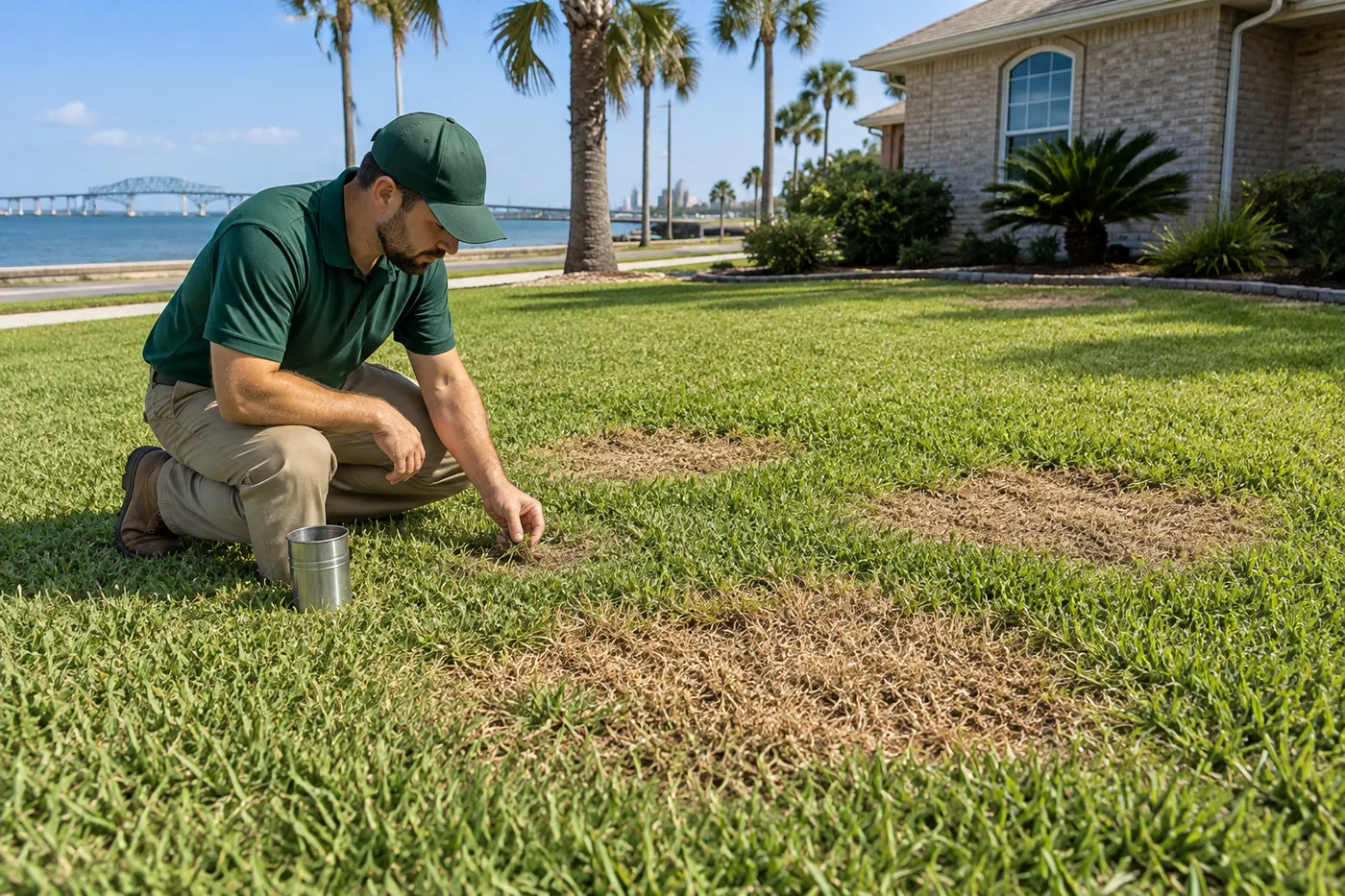
    Corpus Christi just set a record high of 99 degrees on Tuesday, September 15, and the forecast holds in the low 90s with tropical moisture and rain chances building into Thursday. That combination of extreme heat followed by humid, wet air is the worst possible week for St. Augustine, and it is why so many lawns from Calallen to Flour Bluff have brown patches right now.

    The problem is that three completely different causes look almost identical from the driveway. Chinch bug damage, take-all root rot and simple heat and drought stress all show up as irregular tan or straw-colored areas in an otherwise green lawn. Treating the wrong one wastes money and loses turf. You can sort out which one you have in about ten minutes.

    Step one: pull on the grass

    Walk to the edge of a brown patch, where the brown meets the green, and pinch a handful of runners. Then tug.

    If the stolons, the horizontal runners, pull out of the ground easily and the roots look short, dark and rotted, you are looking at take-all root rot. Texas A&M AgriLife notes that with take-all, the leaf blades stay attached to the stolon even though the root system underneath has been destroyed. With large patch, the other common fungal disease here, blades slip off the stolon easily and often have a slimy dark brown lesion at the base of the leaf.

    If the runners are firmly anchored and the roots are white and fibrous, the fungus is not your problem. Move on.

    Step two: flush for chinch bugs

    Southern chinch bug is the one insect that reliably devastates St. Augustine, and it does its worst work in exactly these conditions: hot, dry, sunny ground. AgriLife’s description matches what you see in yards along the bay: islands of dying grass ringed by a halo of yellowing turf, expanding and merging as bug numbers climb. The hottest, most reflective strips get hit first, next to a south-facing wall, along a concrete driveway, at the curb.

    To confirm, take a coffee can, cut out both ends, and push it two to three inches into the soil at the edge of the damage. Fill it with water and keep it topped off for five to ten minutes. Chinch bugs float. Adults are small, about a fifth of an inch, black with folded white wings; the nymphs are reddish with a pale band. If several float up in that small circle, you have your answer.

    Two things worth knowing before you spray. First, damage is worst in full sun, so test there, not in the shade. Second, a lawn thick with thatch shelters them, which is one more reason mowing height and thatch control matter.

    Step three: check the water, not the grass

    If the roots are sound and nothing floated in the can, you almost certainly have heat and drought stress. Push a long screwdriver into a brown area and into a green area. If it slides in six inches in the green spot and stops at two inches in the brown one, that area is simply not getting water. In our sandy Coastal Bend soils, water moves through fast and unevenly, and the dry spots are usually mechanical: a sprinkler head blocked by a shrub, a slope that sheds water, compacted soil along a walkway where the mower turns.

    What to actually do this week

    • Raise the mower. AgriLife’s recommended range for St. Augustine is 2.5 to 3.5 inches. Taller blades shade the soil and support deeper roots, and a lawn under heat stress recovers faster at the top of that range than the bottom.
    • Water deeply, not often. Fewer, heavier soakings that reach several inches down beat a daily sprinkle that never leaves the top inch. Water in the early morning so blades dry before nightfall, which matters more once the humidity climbs Thursday.
    • Hold back the nitrogen. Balanced fertility is part of managing both take-all root rot and large patch. Pushing a fast, high-nitrogen feed into a diseased or heat-stressed lawn in mid-September makes the problem worse, not better.
    • For confirmed take-all, lower the pH at the surface. AgriLife’s control recommendation is a sphagnum peat moss topdressing at one to two bales per 1,000 square feet per application, each bale about 3.8 cubic feet, one to two applications per year. Their field work found a single bale per 1,000 square feet protected turf for two years. The peat is acidic, roughly pH 4.4, and that acidity suppresses the fungus. Reducing thatch by core aerating and mowing at the correct height helps too.
    • For confirmed chinch bugs, treat the active edge. Target the damaged area plus a buffer of healthy grass around it, since the bugs are moving outward, and water the area as the product label directs.

    Why September is the hinge month

    What you do in the next two weeks decides how the lawn looks in March. Roots damaged now do not get a second growing season to recover before dormancy. A take-all problem left alone through a wet, warm October usually reappears as bare ground next spring, and reseeding is not an option with St. Augustine, so the repair is sod or plugs.

    SiteHarbor serves Corpus Christi, Portland, Ingleside, Aransas Pass, Rockport, Robstown, Calallen, Flour Bluff and Padre Island. If you have a patch you cannot diagnose, we will walk the property with you at no charge, tell you which of the three it is, and give you an estimated range if you want us handling it.

    Questions we get

    Why is my St. Augustine brown along the driveway but green in the middle of the yard? That strip is the hottest and driest ground on the property, which makes it the first place chinch bugs cause visible damage and the first place drought stress shows. Do the coffee can flush there; if nothing floats, check how much water actually reaches that edge.

    Should I water more if my lawn has brown patches? Only if the soil is genuinely dry, which a screwdriver will tell you in seconds. If the cause is take-all root rot or large patch, extra water and extended leaf wetness feed the fungus. Water deeply in the early morning instead of frequently in the evening.

  • When to Stop Mowing St. Augustine in Corpus Christi (and What to Do Instead)

    Lawn Care

    When to Stop Mowing St. Augustine in Corpus Christi (and What to Do Instead)

    SiteHarbor · Corpus Christi & the Coastal Bend
    When to Stop Mowing St. Augustine in Corpus Christi (and What to Do Instead)

    Most Corpus Christi lawns are St. Augustine, and most of them get treated the same way in September as they did in June. That’s the mistake. Our growing season runs long — St. Augustine here keeps pushing growth well into November and often doesn’t sit fully dormant until late December. What changes in the fall isn’t whether you mow. It’s how high, how often, and what you feed it.

    September to mid-November: keep mowing, raise the blade

    Set the deck to 3.5–4 inches. Taller blades shade the soil, hold moisture through our dry spells, and crowd out the winter weeds that germinate as soon as night temperatures drop into the 60s. Cutting short in the fall is the single most common reason a lawn comes out of winter thin and patchy.

    • Frequency: every 7–10 days through October, then every 10–14 days in November as growth slows.
    • Never remove more than a third of the blade height in one pass — scalping a stressed lawn in the fall invites take-all root rot, which is common on the coast.
    • Leave the clippings. They return nitrogen and cost you nothing.

    Water less often, but deeper

    Shorter days mean lower evaporation. Most Coastal Bend lawns need about 3/4 inch of water per week in October and closer to 1/2 inch by late November, delivered in one or two long soakings rather than daily sprinkles. Shallow daily watering builds shallow roots, and shallow roots are what fail you in the next drought or the next freeze.

    Water between 4 a.m. and 9 a.m. Evening watering leaves blades wet overnight, and with our humidity that’s how brown patch fungus gets started — you’ll see it as circular yellowing patches a foot or more across, usually first in low spots.

    The one fertilizer rule that matters

    Do not put down a high-nitrogen fertilizer after early October. Late nitrogen pushes soft top growth right when the plant should be moving energy into the roots, and that soft growth is what gets burned in a hard freeze. Instead:

    • Early-to-mid October: a potassium-heavy “winterizer” (something like a 5-10-30 or 0-0-50 blend) to harden the turf for cold.
    • Late October / early November: a pre-emergent for winter weeds — this is the timing that decides whether you spend March fighting poa annua and henbit.
    • Nothing else until the lawn greens up in spring.

    Coastal Bend specifics people miss

    Salt

    Properties near the bay, on the island, or in Flour Bluff pick up salt in the soil from spray and from irrigation water. A deep soaking once a month in the fall helps flush it below the root zone. If you see blade tips browning from the outside in while the rest of the lawn looks fine, salt is the usual suspect, not drought.

    Chinch bugs

    They stay active here far later than the calendar suggests. If you have an irregular dead patch in full sun that keeps expanding and does not respond to water, part the grass at the edge of the damage and look for small black insects at the soil line. Fall treatment is much cheaper than spring resodding.

    Freeze prep

    We don’t freeze often, but when we do it’s abrupt. Water the lawn deeply 24–48 hours before a hard freeze — moist soil holds heat far better than dry soil — and stop mowing once a freeze is forecast so the plant keeps its insulation.

    The short version

    • Keep mowing into November, at 3.5–4 inches.
    • Water deep and early, 1–2 times a week, not daily.
    • Winterizer in early October. No nitrogen after that.
    • Pre-emergent late October — this is the one that saves your spring.
    • Watch for chinch bugs and salt burn, not just “dry spots.”

    Do these five and your lawn comes out of February already green while the neighbors are waiting on it.

    SiteHarbor bundles lawn, pool and exterior cleaning on one contract across the Coastal Bend. See residential services, commercial grounds care, or get a quote.