
Tree Trimming in Corpus Christi: When to Cut and What to Ask
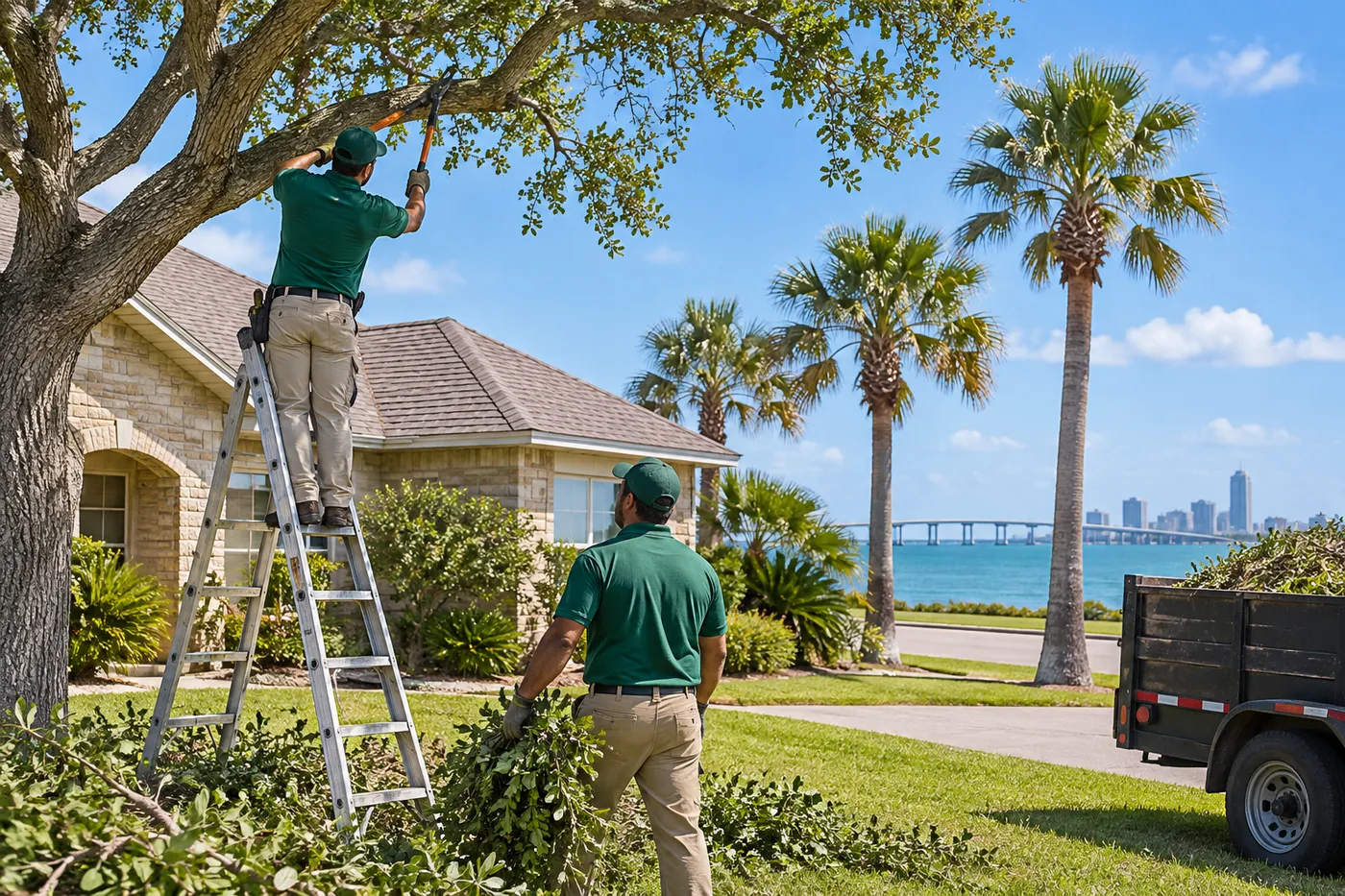
The best time for tree trimming in Corpus Christi is the stretch from July through January, and October sits right in the middle of it. Oaks are past the spring window when oak wilt spreads, hurricane season runs through November 30, and trees in full leaf show which limbs hang over the roof. This guide covers what a good trim looks like, what to avoid, and what to ask before you hire someone.
When is the best time to trim trees in Corpus Christi?
For live oaks and red oaks, timing is set by oak wilt. Texas A&M Forest Service says the sap beetles that carry the oak wilt fungus are most active in late winter and spring, so pruning or wounding oaks should be avoided from February through June. Outside that window, oaks can be trimmed, and every cut on an oak should be painted right away, at any time of year. Any paint or wound dressing works. For other trees, the Forest Service says paint is not needed.
That leaves the fall and early winter as the practical season on the Coastal Bend. October and November give you a chance to clear limbs before the last weeks of hurricane season and before the winter north winds, and December and January are still open for oaks. Mesquite, ash, palms and most ornamentals can be trimmed now as well.
What a proper tree trim looks like
A good trim is mostly about what stays on the tree. The goals are clearance, structure and removing wood that is dead, broken or weakly attached.
- Cuts at the branch collar. The Forest Service says to cut just outside the collar, the swollen area where branch meets trunk. Flush cuts into the trunk and long stubs both slow the wound from closing.
- Three cuts on heavy limbs. AgriLife Earth-Kind guidance calls for an undercut about a third of the way through, a top cut a few inches farther out to drop the weight, then the final cut at the collar. Skipping the undercut tears bark down the trunk.
- Limited removal. The International Society of Arboriculture’s homeowner guidance says no more than about 25 percent of the crown should come off at once, and less on mature trees.
- Clearance from the house. Limbs touching the roof, gutters or siding get cut back to a lateral branch or the collar, not sheared at the roofline.
Tree trimming mistakes to avoid on the coast
Topping. Cutting the top of a tree back to stubs removes a large share of the leaf canopy at once. ISA has warned against it for decades. The regrowth comes back as dense, weakly attached shoots, which are exactly the limbs that fail in high wind.
Lion-tailing. This is stripping all the inner branches and leaving foliage only at the ends. Extension publications note it moves the weight to the branch tips and makes limbs more likely to break in wind.
Over-pruning palms. The “hurricane cut,” where a palm is stripped down to a few fronds at the top, does not protect it. AgriLife’s Cameron County office says to remove only fully dead, brown fronds and never green ones unless they are badly damaged. University of Florida Extension notes that trimming no higher than the 9 o’clock to 3 o’clock line is the accepted limit.
Trees near power lines and over the roof
Do not trim around the lines that run from pole to pole. AEP Texas, which serves Corpus Christi, says cutting back trees near its power lines along streets and some private properties is its responsibility, and it asks homeowners to report trees growing close to those lines at 1-877-373-4858. AEP crews only trim or remove trees near the pole-to-pole lines, so limbs near the service line to your house are a separate question; ask the utility first.
Large limbs hanging over the house, cracked or split leaders, and any work that needs climbing or rigging over a structure should go to an ISA Certified Arborist. You can check an arborist’s credential on the ISA site at treesaregood.org.
What to ask before you hire a tree trimming service
- Will you paint every cut on my oaks?
- How much of the canopy do you plan to remove, and where will the cuts be made?
- Do you top trees or hurricane-cut palms? (The right answer is no.)
- Is haul-off included, or will the brush be left at the curb?
- Which limbs are you leaving for an arborist or the utility?
If the brush is staying with you, the City of Corpus Christi collects heavy brush on a zone schedule. Its heavy brush page lists the dates and the limits: a pile no larger than 6 by 10 by 6 feet, kept out of the street, gutter and ditch. If a trim produces more than that, a haul-off is usually simpler than waiting for the next cycle.
SiteHarbor’s tree trimming and limb removal service covers structural and clearance trimming, canopy raising, palm work and removal of storm-vulnerable limbs, with haul-off. If a tree already came through the recent rain with damage, our guide to storm debris cleanup in Corpus Christi covers what to handle first.
Frequently asked questions
Can you trim live oaks in October in Corpus Christi?
Yes. Texas A&M Forest Service only advises avoiding oak pruning from February through June. October is outside that window. Paint every cut right away, as the Forest Service recommends for oaks at any time of year.
How often should trees be trimmed in Corpus Christi?
Most mature yard trees do well with a light trim every few years, plus clearance work whenever limbs reach the roof, walks or driveway. Heavy cuts all at once are harder on the tree than smaller, regular ones.
If you have limbs over the roof or trees you want cleaned up before winter, request a free quote. You will get an estimated range from your address, then a free walkthrough to confirm what our tree trimming crew will cut and haul.