
Your Sprinklers Are Probably Still on a July Schedule. Here Is the September Fix.
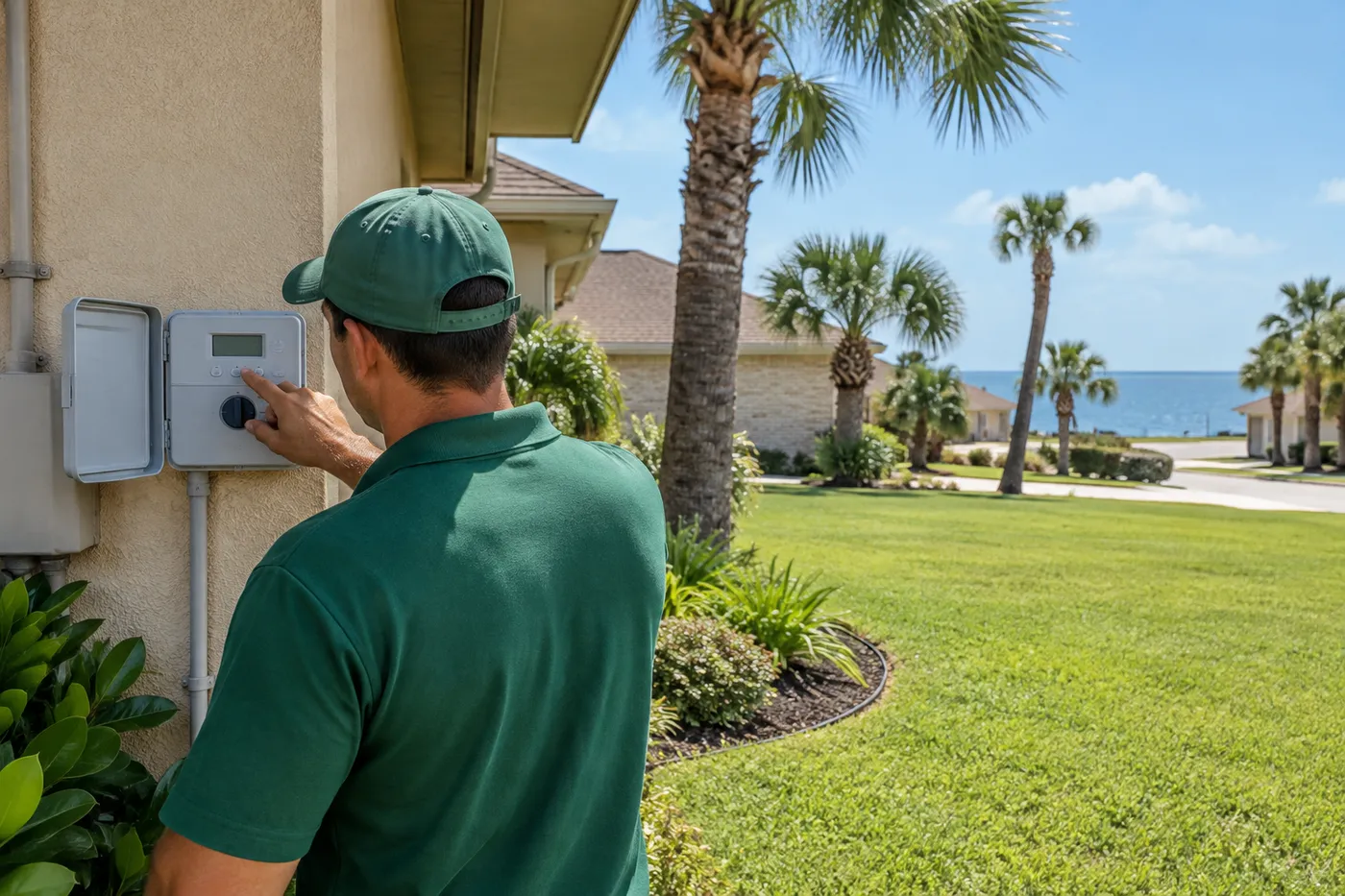
Almost every irrigation controller we open in Corpus Christi in September is still running the schedule someone set in June or July. The grass does not need that anymore. Days are shorter, nights are cooler, evaporation has dropped, and the rain pattern has flipped from nothing to occasional heavy Gulf downpours. Keep watering on a July schedule and you get the same three problems every fall: shallow roots, fungus in the shaded areas, and a water bill that never comes back down.
Here is the audit we run on a fall walkthrough, and what we set the controller to afterward. You can do all of it yourself in about twenty minutes.
Step 1: Run each zone manually and watch it
Do not trust the controller. Start each zone from the panel and stand in the yard while it runs. You are looking for five things:
- Heads spraying the sidewalk, street or fence. Free water for the concrete, none for the grass. Rotate or adjust the arc.
- Heads that no longer pop up. Usually a clogged nozzle or a head that got buried by two seasons of growth. Uncover and flush it.
- Misting instead of spraying. A fine fog means pressure is too high; most of that water never lands. It needs a pressure-regulated head or a regulator at the valve.
- Wet spots and geysers. A cracked lateral or a broken head wastes more water than the rest of the zone uses.
- Dry gaps between heads. Coverage should overlap. If it does not, no schedule change will fix those dry patches.
Step 2: Do the tuna-can test
Put four or five straight-sided cans (tuna or cat food cans work) around one zone and run it for 15 minutes. Measure the water depth in each can with a ruler. Two things come out of this test: how much water the zone actually puts down per hour, and how evenly it does it. If one can has half an inch and another has an eighth, your problem is coverage, not run time.
Most St. Augustine lawns here want about three quarters of an inch to one inch of water per week in September, rain included. If your zone puts down half an inch in 15 minutes, that is roughly a 25 to 30 minute run, once or twice a week. Not daily.
Step 3: Water less often, but longer
This is the change that actually matters. Daily short cycles train roots to stay in the top inch of soil, which is the first thing to dry out and the reason a lawn collapses the week you go out of town. Deep, infrequent watering pushes roots down.
- September and October: two cycles a week for sun zones, one for shaded zones.
- Run time: long enough to deliver about half an inch per cycle, based on your can test.
- Start time: finish before sunrise. Between 4 and 6 a.m. is ideal.
- Never water in the evening. Grass that sits wet overnight in our humidity is how brown patch fungus starts, and shaded St. Augustine is the first to get it.
Step 4: Split the cycle on clay and slopes
Much of the Coastal Bend sits on heavy clay that cannot absorb half an inch in one pass, so the water runs off into the street. Use the cycle-and-soak approach: two shorter runs, roughly an hour apart, instead of one long one. Same total water, all of it absorbed.
Step 5: Make the rain sensor real
Texas requires new systems to have a rain or moisture sensor, but plenty of them are unplugged, taped over or dead. Test yours by soaking it and starting a zone. If the system still runs, it is not working. A functioning sensor pays for itself the first week it stops a 30 minute cycle during a rainstorm.
The fall schedule, in one line
Two deep cycles a week in the sun, one in the shade, finished before sunrise, about an inch total including rain, with a rain sensor that actually shuts it off. That is the whole September schedule for a typical Corpus Christi St. Augustine lawn.
When it is not a schedule problem
If the audit turns up broken laterals, misting heads, valve leaks or zones that simply do not reach, those are repairs, not schedule problems, and they will keep wasting water until a licensed irrigator fixes them. In Texas, irrigation repair work has to be done by a licensed irrigator, so ask for the license number before anyone touches your system. On the lawn side, what we see most often is a lawn blamed on the grass when the real cause is the watering pattern: fix the schedule first, then judge the lawn. If your controller has not been touched since summer, that is the place to start.