
What a 100-Degree Week Does to Your Pool in Corpus Christi
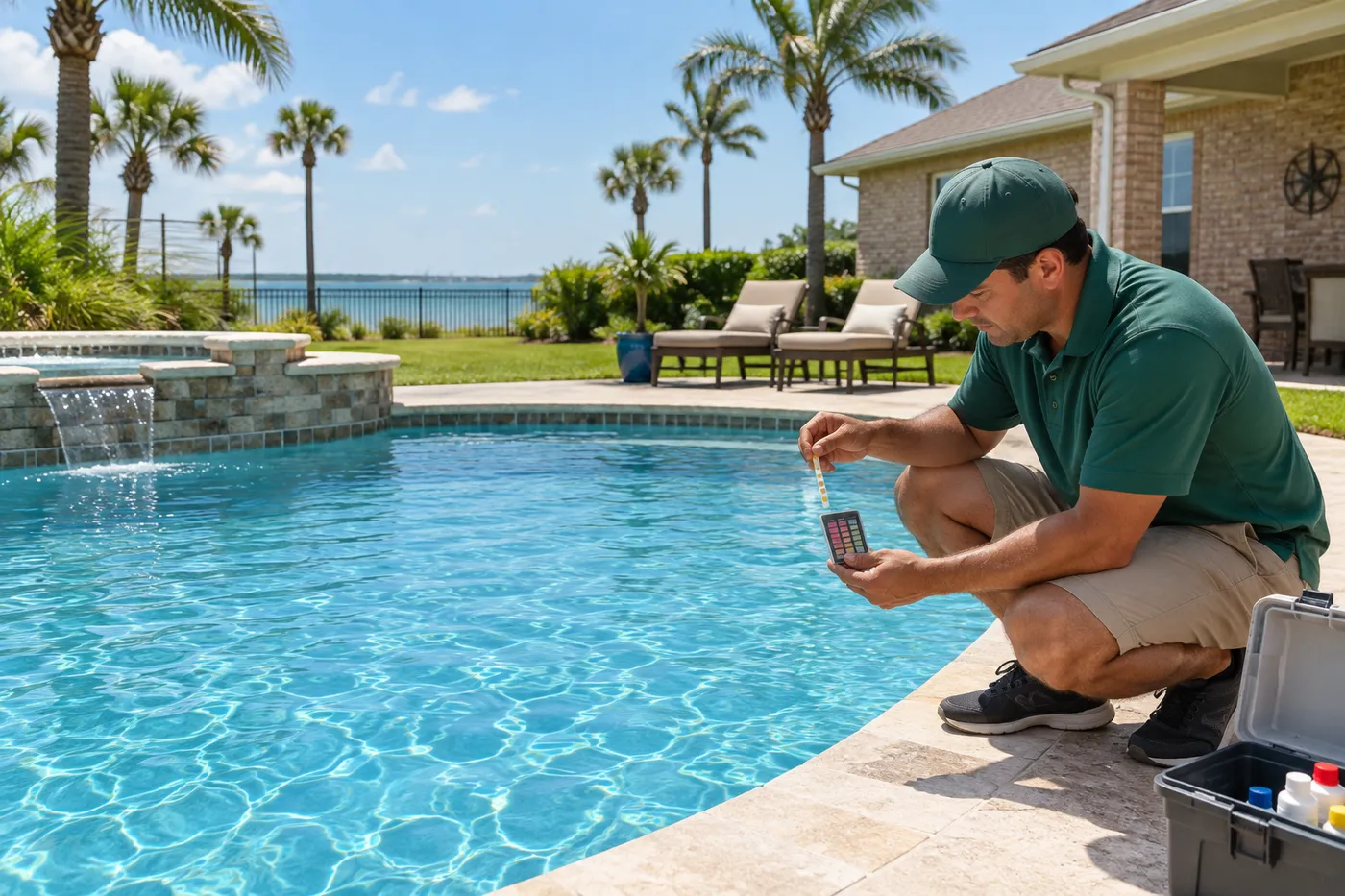
Corpus Christi just came off its hottest start to September on record, and the heat is not done: the National Weather Service has us in the upper 90s to around 100 through midweek with heat advisories, easterly breeze off the bay, and better rain chances arriving Thursday. Your lawn shows heat stress by wilting. Your pool shows it by quietly going out of balance, and by the time the water looks dull or slick on the walls, you are already three or four days behind.
Here is what a stretch of 100-degree afternoons actually does to a backyard pool in a coastal climate, and what you can check yourself this week.
Hot water burns chlorine faster than you think
Two things eat chlorine in September: ultraviolet light and warm water. Sunlight breaks down free chlorine directly. Unstabilized chlorine in an outdoor pool with no cyanuric acid can be gone in a matter of hours in full sun, which is why stabilizer exists. Warm water does the second half of the damage by speeding up algae and bacteria growth, so demand goes up at the same time supply is being destroyed.
Practical version: the chlorine level that held fine in April will not hold in a 90-degree pool in September. If you are testing once a week and finding zero free chlorine at that test, the pool spent several days unprotected. Test twice a week while the heat holds.
Check stabilizer before you add more chlorine
Cyanuric acid (CYA, sold as stabilizer or conditioner) is chlorine’s sunscreen. The Pool and Hot Tub Alliance puts the ideal range at 30 to 50 ppm for a typical residential pool using stabilized chlorine, and says it should not exceed 100 ppm. Too little and sun strips your chlorine. Too much and the chlorine you are paying for is chemically tied up and sluggish, which is the classic “I keep adding chlorine and nothing happens” pool.
Saltwater pools are a different case. A salt cell makes unstabilized chlorine, so salt system manufacturers commonly call for a higher CYA level, in the range of roughly 70 to 80 ppm, to keep that fresh chlorine from being cooked off. Follow your own cell manufacturer’s number rather than a generic chart. Also remember CYA does not evaporate or burn off. The only real way down is dilution, so it is worth knowing your number before you dump in more.
Run time matters more than shock
Filtration and circulation are what carry sanitizer around the pool. In water above the mid-80s, the same pump schedule you ran in spring is usually too short. Add hours rather than chemicals as your first move, and if you have a salt system, raising output percentage while extending run time is the correct order of operations. Brush the walls and steps weekly, because algae takes hold on surfaces before it clouds the water.
Watch the water line, not just the water
A pool typically loses about a quarter inch of water a day to evaporation, and hot, windy conditions can push that toward a half inch. On a normal Corpus Christi September week, two inches of loss is not a leak. It becomes a real problem when the level drops below the middle of the skimmer mouth: the skimmer starts pulling air, the pump loses prime, and a pump running dry can destroy a seal and then an impeller. That is a repair bill created by a garden hose you did not run.
If you want to know whether you have a leak or just September, do a bucket test. Set a bucket on a step, fill it to match the pool level, mark both, leave the pump on a normal schedule, and compare after 24 to 48 hours. If the pool drops noticeably more than the bucket, you likely have a leak. If they track together, it is evaporation.
Then Thursday’s rain changes everything again
Rain arriving after a long hot dry stretch is the worst-case sequence for water chemistry. You get dilution of your stabilizer and salt, a pH swing, and a load of pollen, dust, and yard debris washed in off decks and beds all at once, into water that is already low on chlorine. Plan on testing the day after the first real rain rather than waiting for your normal service day.
The salt air factor
Within a few miles of the bay and on the island, salt-laden air accelerates corrosion on everything metal around the pool: heater cabinets, light rings, handrail anchors, valve hardware, screws in equipment pads. Rinse equipment and rails with fresh water when you rinse the deck, and look at your pad every month for rust bleed at fasteners. Catching a corroding screw is a five-dollar problem. Catching a corroded heater panel is not.
FAQs
How often should I test my pool in Corpus Christi in the summer? Twice a week for free chlorine and pH while water temperatures stay in the high 80s and 90s, plus once more the day after any heavy rain. Test stabilizer and salt monthly, since those move slowly except when rain dilutes them.
Why does my pool lose so much water in September, and is it a leak? Around a quarter inch a day is normal evaporation, and a hot windy day can approach a half inch, so roughly two inches a week is expected here. Run a 24 to 48 hour bucket test before assuming a leak, and keep the level at least halfway up the skimmer opening so the pump never pulls air.
If you would rather not track it
Weekly pool care is mostly discipline: test, brush, adjust, watch the water line. If keeping up with it in this heat is not how you want to spend your Saturdays, SiteHarbor serves Corpus Christi, Portland, Ingleside, Aransas Pass, Rockport, Port Aransas, Robstown, Kingsville, and Padre Island, and a free walkthrough gets you an honest read on your pool and an estimated monthly range for keeping it right.
SiteHarbor bundles lawn, pool and exterior cleaning on one contract across the Coastal Bend. See residential services, commercial grounds care, or get a quote.