
Fall Pre-Emergent in the Coastal Bend: Watch the Soil, Not the Calendar
Winter weeds in the Coastal Bend are decided in the next three weeks, not in February. Annual bluegrass, chickweed, henbit, spurweed and burclover all germinate from seed in fall, and by the time you can see them the window to stop them cheaply has already closed. Corpus Christi is still running hot — highs near 92 with slight showers this weekend — so most lawns here have not hit the trigger yet. That is exactly why now is the time to get the product, the spreader and the plan ready.
The trigger is soil temperature, not the calendar
Texas A&M AgriLife’s guidance for warm-season lawns is clear: apply fall pre-emergence herbicide when soil temperature falls to roughly 70 degrees for several days and is trending down. The 70-degree number comes from annual bluegrass, which germinates once soils drop below 70. Spring applications use a rising 55 degrees; fall uses a falling 70. In Texas that falling-70 point lands anywhere from September to late October depending on how far south you are, and on the far southern coast it is usually the later end of that range.
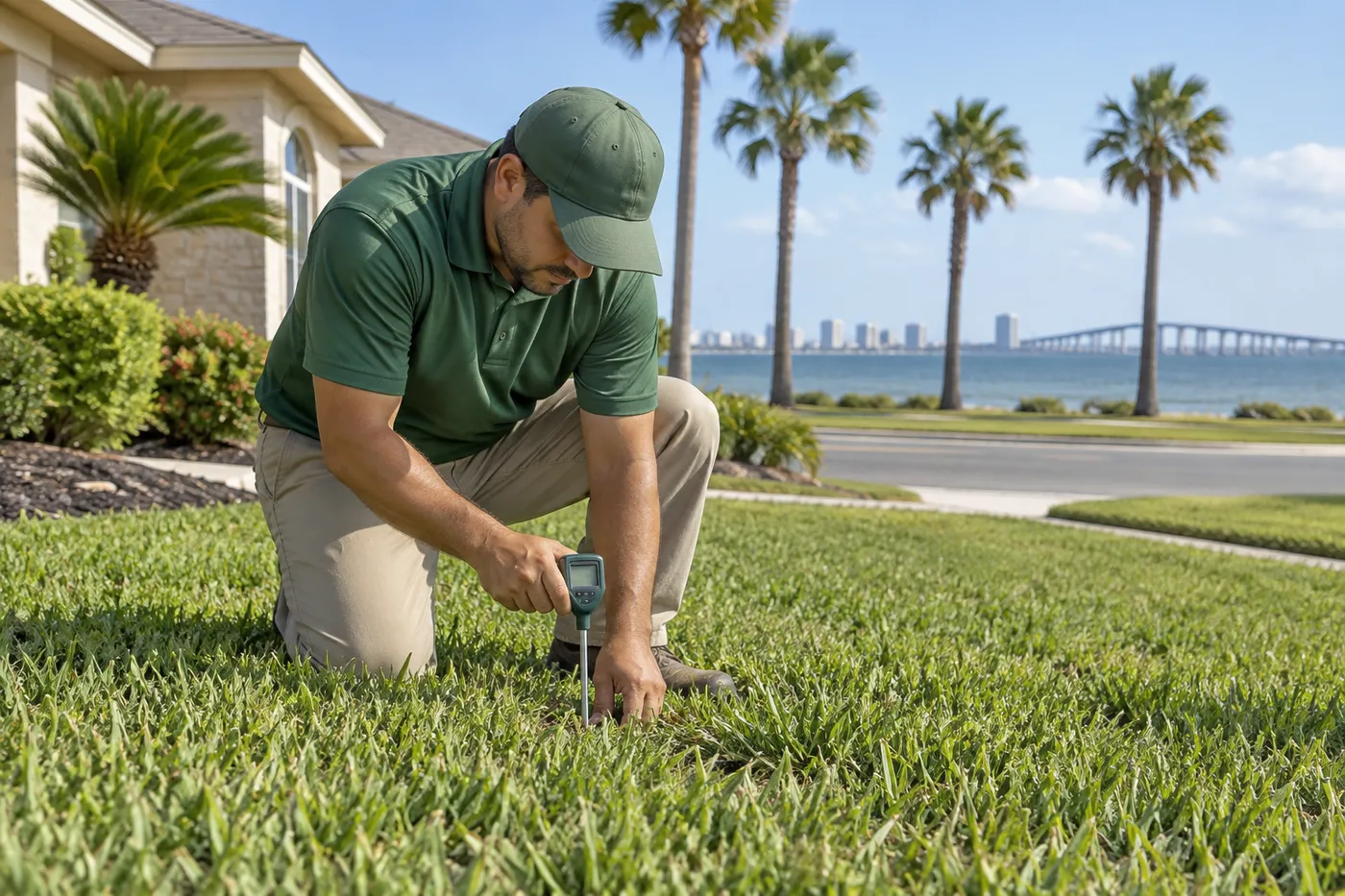
Measure it, do not guess. Push a soil thermometer two inches into the turf, in the same spot, mid-morning, three or four days in a row. When the average sits near 70 and the forecast shows a front coming, spray or spread. In a year like this one, with 90s hanging on into late September, a homeowner who applies on a calendar date in early September has usually wasted the application — the barrier degrades before the weed seed ever wakes up.
Why our sandy, salt-influenced soils punish late applications
Much of the lawn ground from Flour Bluff out to Padre Island, and a lot of the older sandy loam inland, holds very little organic matter. Pre-emergent chemistry binds to organic matter and clay. In sand it binds less, moves with water more, and runs shorter. Two practical consequences:
- You get less forgiveness on timing. A single heavy Gulf rain a week after application can shorten the effective barrier, so applying too early is worse here than in a Blackland clay yard in Dallas.
- You need the activation water but not a flood. Most labels ask for rainfall or irrigation within about seven to ten days to move the product into the top layer of soil where seeds germinate. A quarter inch does that. Two inches in an hour does not help.
The other local wrinkle is St. Augustine. Most of the residential turf in the nine cities we serve is St. Augustine, and it is sensitive to several common pre-emergents. Read the label for your exact grass before anything touches the yard. Atrazine-based products are labeled for St. Augustine and hit both germinating and very young winter annuals; prodiamine is a longer-residual option used on bermuda and, on some labels, St. Augustine at reduced rates. Label rate, label grass, label timing — that is the whole game. Never scale up a rate because the weeds were bad last year.
What to do before the front arrives
- Walk the yard and note where winter weeds showed up last January. Those are your seed banks: thin edges, the strip along the drive, the shady north side, anywhere the turf was bare in August.
- Fix bare ground now. Pre-emergent does not thicken turf; it only keeps seed from establishing. Thin St. Augustine in September will be weedy in December regardless of chemistry.
- Mow and rake before you apply so the material reaches soil, not a mat of clippings.
- Calibrate the spreader on a driveway with a known weight. Most misses in home applications are coverage errors, not product errors.
- Skip beds you plan to seed or plug. A pre-emergent does not distinguish between a weed seed and a wildflower seed.
One application, or two
AgriLife recommends two pre-emergence applications a year for warm-season lawns: one in spring for summer annuals, one in fall for winter annuals. Many lawns here also benefit from a second fall pass roughly eight to ten weeks after the first, because our germination season stretches out with mild Decembers. Check the label’s minimum retreatment interval and annual maximum before planning that, and count it into the year’s total, not as a bonus.
FAQs
When should I apply pre-emergent in Corpus Christi in the fall?
When two-inch soil temperature drops to about 70 degrees and keeps falling for several days. In Corpus Christi that is usually October rather than early September, and in a hot year it can slide toward mid-October. Use a soil thermometer rather than a date.
Will pre-emergent kill the weeds already in my lawn?
No. Pre-emergents stop seeds from establishing. Weeds you can already see need a post-emergent labeled for your grass, or hand pulling. That is why fall timing matters — it is the only way to avoid a spring spraying project.
If you would rather have someone read your yard before the first front, SiteHarbor does a free on-site walkthrough: we check turf density, mark the spots where winter weeds will show up first, and give you an estimated range for keeping it maintained. Call (361) 792-0247 or request a walkthrough at siteharborservices.com.