Viktor Service – Page 5 – SiteHarbor

SiteHarbor

Author: Viktor Service

  • The September Storm-Prep Walkthrough for Coastal Bend Commercial Properties
    Property Managers

    The September Storm-Prep Walkthrough for Coastal Bend Commercial Properties

    SiteHarbor · Corpus Christi & the Coastal Bend
    The September Storm-Prep Walkthrough for Coastal Bend Commercial Properties

    The stretch of hurricane season that most often puts water and wind over the Coastal Bend runs from mid-August into early October, and Corpus Christi is sitting in the back half of it right now. This week the extreme heat finally eased off — highs near 91 with more cloud and a returning shower chance instead of 100-degree afternoons — which means crews can actually work outside for a full day again. For anyone responsible for a commercial property in Corpus Christi, Portland, Ingleside, Aransas Pass, Rockport, Robstown, Kingsville, Alice or Port Aransas, that combination makes the next two or three weeks the best grounds-prep window you will get before the season closes.

    This is a walk-the-property checklist, not a shopping list. Most of it costs nothing but attention.

    September is the legal and horticultural window to prune your oaks

    Texas A&M Forest Service is direct about oak wilt: the pathogen enters through fresh wounds, and the high-risk period for spread is February through June. That is why the standard guidance for live oaks and red oaks in Texas is to prune in the July-through-January stretch and stay out of the tree in spring. September sits squarely inside the safe window, and it happens to be the last practical moment to reduce wind load before a Gulf system.

    What you are looking for on a commercial site is not shape. It is failure risk:

    • Co-dominant stems — two trunks of near-equal size meeting in a tight V, often with bark pinched between them. That union is the classic hurricane split point on a mature live oak.
    • Dead limbs still hanging in the canopy. Wind does not need much to turn those into a windshield or a storefront window.
    • Branches over walkways, dumpster pads, drive lanes, and parked cars. Rank them by what they would land on, not by how ugly they look.
    • Palms with a heavy skirt of dead fronds. Each frond is a sail and a projectile.

    Two limits worth respecting. Never top a tree to make it “safer” — topping forces weak sprouts off the cut and creates a worse hazard in three years. And anything needing a chainsaw above head height, or near a service drop, belongs with a certified arborist.

    Drainage is the part that actually floods your tenants

    Wind makes the news. Water makes the claims. Our soils on the bay side are sandy and drain well until the top few inches are already saturated, at which point a four-inch rain behaves like it fell on concrete. Before the next system:

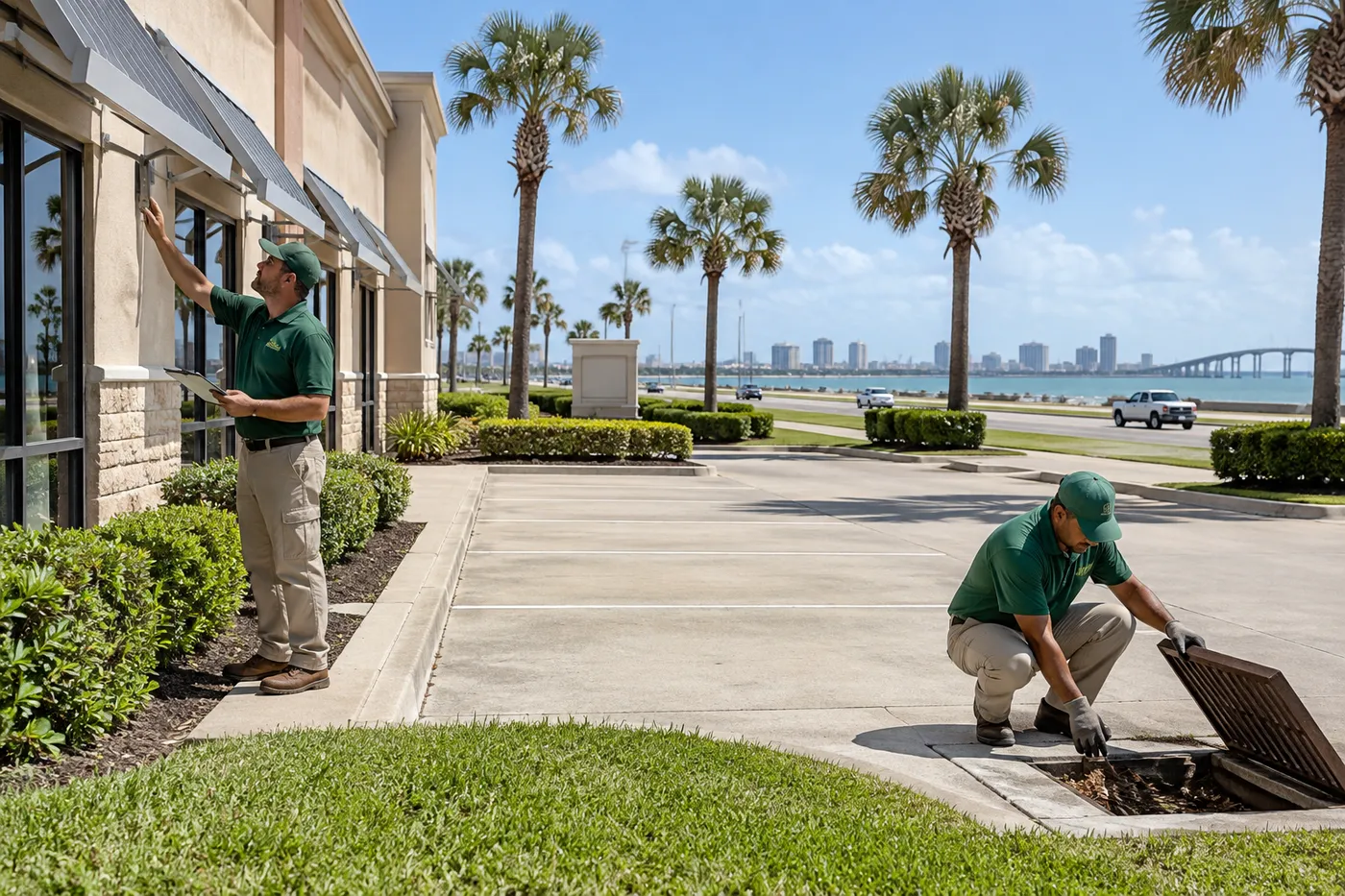
    • Pull the grates on parking-lot inlets and look. A single flattened cardboard box or a mat of live oak leaf litter is enough to back a lot up to the curb line.
    • Walk the roof downspout outfalls. If a splash block has shifted or a discharge point dumps straight into a mulch bed, you will lose the bed and the mulch will end up in the inlet.
    • Check the low corner of every turf island. If it holds water for more than 24 hours after a rain, that is where you will lose St. Augustine to root rot in the first warm week after the storm.

    Loose objects: the 30-minute audit

    End the walk with a written list of everything on the property that is not bolted down, and who moves it when a watch is issued: trash-can lids, sandwich boards, patio furniture, planters, pallets behind the building, debris left by a tenant’s contractor, shade sails, real estate signs. Assign it now, because the afternoon a watch goes up is the afternoon nobody can be reached.

    What to stop doing before a storm

    • Hold off on fertilizer. Do not put nitrogen down ahead of a heavy rain event. It washes off the sandy soil into the storm system and you paid for it twice — once at purchase, once in the flush of soft growth that follows.
    • Do not scalp the turf. Keep St. Augustine at 2.5 to 3.5 inches. Taller grass holds soil and shades roots through the hot, wet week that follows a tropical rain; a scalped lawn after a storm is where weeds establish first.
    • Do not let the last mow slide. Going into a wind event with tall, seed-heavy growth means more debris to clean and a lot that stays wet longer.

    The first 48 hours after

    Your goal in the first two days is safety and drainage, in that order: clear drive lanes and exits, flag hazards you cannot reach, open the inlets so standing water can leave. Photograph damage before anything is moved — date-stamped photos of a split limb and of what it landed on are worth more to an insurer and to a tenant conversation than any description after the fact. Then rinse salt spray off glass, metal railings, and coastal plantings with fresh water. Salt-laden wind can reach well inland off the bay, and a rinse within a day or two is the cheapest way to avoid the leaf burn and corrosion streaking that shows up a week later.

    Two questions we get

    When is it too late to prune trees before hurricane season in Corpus Christi?

    Practically speaking, once a named system is in the Gulf it is too late — crews, chippers and disposal sites are all committed, and fresh debris piles become hazards themselves. Work the canopy in September and October while you are still in the safe pruning window for oaks and well ahead of any watch.

    Does my commercial property need a written storm plan for the grounds?

    If you have tenants, yes, even if it is one page. Name who secures loose objects, who has keys and gate codes, who to call for tree work, and where the post-storm photos get filed. The value is that it removes decisions from the busiest 24 hours of the year.

    If you would rather have someone else walk the property with this list, SiteHarbor does a free walkthrough for commercial sites across the Coastal Bend and gives you an estimated range afterward, not a pitch on the spot. One property, one team, everything outside.


  • Your Pool’s Shoulder Season Starts Now: What Changes as Corpus Christi Cools Off

    Pool Care

    Your Pool’s Shoulder Season Starts Now: What Changes as Corpus Christi Cools Off

    SiteHarbor · Corpus Christi & the Coastal Bend
    Your Pool’s Shoulder Season Starts Now: What Changes as Corpus Christi Cools Off

    The forecast for Corpus Christi this week is a high near 91 with slight shower chances, after a stretch of middle-to-upper 90s and a record 99 degrees earlier in the month. That is the first real hint of the shoulder season here. Air temperatures ease, the days get noticeably shorter, and pool water lags weeks behind both. If you leave your equipment on July settings until Thanksgiving, you overspend on electricity. If you cut everything the first cool morning, you get a green pool. The way through is to run your pool off water temperature instead of the calendar.

    Buy a thermometer before you change a setting

    Almost every fall pool decision keys off water temperature, and in zone 9a the water can still be in the mid to upper 80s while mornings feel pleasant. Drop a cheap pool thermometer in and read it at the same time each day, or use the temperature readout on your automation panel. Write the number down once a week. That single habit tells you when each of the steps below is actually due.

    Step pump run time down in stages

    A common service rule of thumb is roughly one hour of pump run time per 10 degrees of water temperature, as a floor, run during daylight. At 88-degree water that is about eight or nine hours; at 70 degrees it is closer to seven; in the 60s you can often hold at four to six. Take it down an hour at a time, wait a week, and watch the water. Clarity and a stable chlorine reading mean the shorter cycle is working. Cloudiness, or chlorine that keeps sliding, means you cut too soon.

    Two Coastal Bend cautions. First, do not shut the pump off for days at a time, even in December. Algae still grows above 60 degrees, and our winter is a series of warm spells, not a freeze. Second, our fall wind is loaded with leaf and seed debris off live oaks, palms and mesquite, plus salt-laden dust. Skimmer and pump baskets fill faster in October than in July, and a clogged basket starves the pump no matter how long the timer says it runs.

    Chlorine demand falls, but sunlight is still the enemy

    Cooler water burns less chlorine, so the same output that barely held 3 ppm in August may push the reading high in November. Test before you dose, and turn output down rather than skipping tests. What does not change is ultraviolet loss. Cyanuric acid is what protects chlorine from sunlight, and the industry standard from the Pool & Hot Tub Alliance sets an ideal range of 30 to 50 ppm with a maximum of 100 ppm. Our long UV season means many local pools are running high on CYA by September because stabilized chlorine keeps adding more. High CYA does not evaporate. The only real fix is dilution: drain a portion and refill.

    Salt pool owners: this is your cell maintenance window

    Salt chlorine generators are temperature-aware by design. Pentair’s IntelliChlor throws a LOW TEMP warning when water falls below 60 degrees and stops producing at about 52 degrees. Hayward’s Salt & Swim reduces generation between 50 and 60 degrees and stops below 50. That means the shoulder season is exactly when you should inspect the cell, before output naturally drops and hides a scale problem. Common guidance is to check the cell every three months or roughly 500 operating hours, and to clean it with a diluted acid solution only when you can see scale on the plates, because acid shortens cell life. Heavy rain also dilutes salt concentration, so recheck salt level after any soaking event before you assume the cell is failing.

    Watch the phosphate side of your yard

    Fall is when many Coastal Bend homeowners make a last fertilizer application, and fertilizer that lands on the deck or washes off a sloped bed ends up in the pool. Phosphate is algae food, and levels above roughly 300 parts per billion are commonly associated with blooms. If your water goes hazy every time it rains, look upslope before you buy another jug of remover. Keep granular fertilizer off hardscape, sweep the deck rather than hosing it toward the pool, and get the basics right first: CYA in range, free chlorine 3 to 5 ppm, pH 7.4 to 7.6, total alkalinity 80 to 120 ppm. Phosphate treatment does not work on an unbalanced pool.

    A simple fall sequence

    • Record water temperature weekly.
    • Reduce pump run time one hour at a time, verifying clarity for a week between cuts.
    • Test chlorine before adjusting salt cell output or dosing.
    • Check CYA now; plan a partial drain and refill if it is above 50 ppm and climbing.
    • Inspect the salt cell while the water is still warm enough to judge output honestly.
    • Empty baskets more often as wind and leaf drop pick up.

    Done in that order, the transition is uneventful, which is the whole goal. If you would rather have someone else read the water and step the settings down for you, SiteHarbor serves Corpus Christi, Portland, Ingleside, Aransas Pass, Rockport, Robstown, Calallen, Flour Bluff and Padre Island. We will walk the property, look at the equipment pad, and give you an estimated range with a free walkthrough before anything is scheduled.

    Questions we get this time of year

    How many hours should I run my pool pump in the fall in Corpus Christi? Start from about one hour per 10 degrees of water temperature during daylight, then step down gradually. With water in the upper 80s that is eight to nine hours; expect to be near four to six hours once the water sits in the 60s. Never leave it off for days.

    Why did my salt system stop making chlorine when it got cool? That is usually a designed temperature cutoff, not a failure. Pentair IntelliChlor warns below 60 degrees and stops near 52 degrees, and Hayward Salt & Swim reduces output between 50 and 60 degrees and stops below 50. Check water temperature and salt level, especially after heavy rain, before replacing anything.

  • Your Sprinklers Are Probably Still on a July Schedule. Here Is the September Fix.

    Lawn Care

    Your Sprinklers Are Probably Still on a July Schedule. Here Is the September Fix.

    SiteHarbor · Corpus Christi & the Coastal Bend
    Your Sprinklers Are Probably Still on a July Schedule. Here Is the September Fix.

    Almost every irrigation controller we open in Corpus Christi in September is still running the schedule someone set in June or July. The grass does not need that anymore. Days are shorter, nights are cooler, evaporation has dropped, and the rain pattern has flipped from nothing to occasional heavy Gulf downpours. Keep watering on a July schedule and you get the same three problems every fall: shallow roots, fungus in the shaded areas, and a water bill that never comes back down.

    Here is the audit we run on a fall walkthrough, and what we set the controller to afterward. You can do all of it yourself in about twenty minutes.

    Step 1: Run each zone manually and watch it

    Do not trust the controller. Start each zone from the panel and stand in the yard while it runs. You are looking for five things:

    • Heads spraying the sidewalk, street or fence. Free water for the concrete, none for the grass. Rotate or adjust the arc.
    • Heads that no longer pop up. Usually a clogged nozzle or a head that got buried by two seasons of growth. Uncover and flush it.
    • Misting instead of spraying. A fine fog means pressure is too high; most of that water never lands. It needs a pressure-regulated head or a regulator at the valve.
    • Wet spots and geysers. A cracked lateral or a broken head wastes more water than the rest of the zone uses.
    • Dry gaps between heads. Coverage should overlap. If it does not, no schedule change will fix those dry patches.

    Step 2: Do the tuna-can test

    Put four or five straight-sided cans (tuna or cat food cans work) around one zone and run it for 15 minutes. Measure the water depth in each can with a ruler. Two things come out of this test: how much water the zone actually puts down per hour, and how evenly it does it. If one can has half an inch and another has an eighth, your problem is coverage, not run time.

    Most St. Augustine lawns here want about three quarters of an inch to one inch of water per week in September, rain included. If your zone puts down half an inch in 15 minutes, that is roughly a 25 to 30 minute run, once or twice a week. Not daily.

    Step 3: Water less often, but longer

    This is the change that actually matters. Daily short cycles train roots to stay in the top inch of soil, which is the first thing to dry out and the reason a lawn collapses the week you go out of town. Deep, infrequent watering pushes roots down.

    • September and October: two cycles a week for sun zones, one for shaded zones.
    • Run time: long enough to deliver about half an inch per cycle, based on your can test.
    • Start time: finish before sunrise. Between 4 and 6 a.m. is ideal.
    • Never water in the evening. Grass that sits wet overnight in our humidity is how brown patch fungus starts, and shaded St. Augustine is the first to get it.

    Step 4: Split the cycle on clay and slopes

    Much of the Coastal Bend sits on heavy clay that cannot absorb half an inch in one pass, so the water runs off into the street. Use the cycle-and-soak approach: two shorter runs, roughly an hour apart, instead of one long one. Same total water, all of it absorbed.

    Step 5: Make the rain sensor real

    Texas requires new systems to have a rain or moisture sensor, but plenty of them are unplugged, taped over or dead. Test yours by soaking it and starting a zone. If the system still runs, it is not working. A functioning sensor pays for itself the first week it stops a 30 minute cycle during a rainstorm.

    The fall schedule, in one line

    Two deep cycles a week in the sun, one in the shade, finished before sunrise, about an inch total including rain, with a rain sensor that actually shuts it off. That is the whole September schedule for a typical Corpus Christi St. Augustine lawn.

    When it is not a schedule problem

    If the audit turns up broken laterals, misting heads, valve leaks or zones that simply do not reach, those are repairs, not schedule problems, and they will keep wasting water until a licensed irrigator fixes them. In Texas, irrigation repair work has to be done by a licensed irrigator, so ask for the license number before anyone touches your system. On the lawn side, what we see most often is a lawn blamed on the grass when the real cause is the watering pattern: fix the schedule first, then judge the lawn. If your controller has not been touched since summer, that is the place to start.

  • Three Brown Patches, Three Different Causes: How to Read a Struggling St. Augustine Lawn in September

    Lawn Care

    Three Brown Patches, Three Different Causes: How to Read a Struggling St. Augustine Lawn in September

    SiteHarbor · Corpus Christi & the Coastal Bend
    Three Brown Patches, Three Different Causes: How to Read a Struggling St. Augustine Lawn in September

    Corpus Christi just set a record high of 99 degrees on Tuesday, September 15, and the forecast holds in the low 90s with tropical moisture and rain chances building into Thursday. That combination of extreme heat followed by humid, wet air is the worst possible week for St. Augustine, and it is why so many lawns from Calallen to Flour Bluff have brown patches right now.

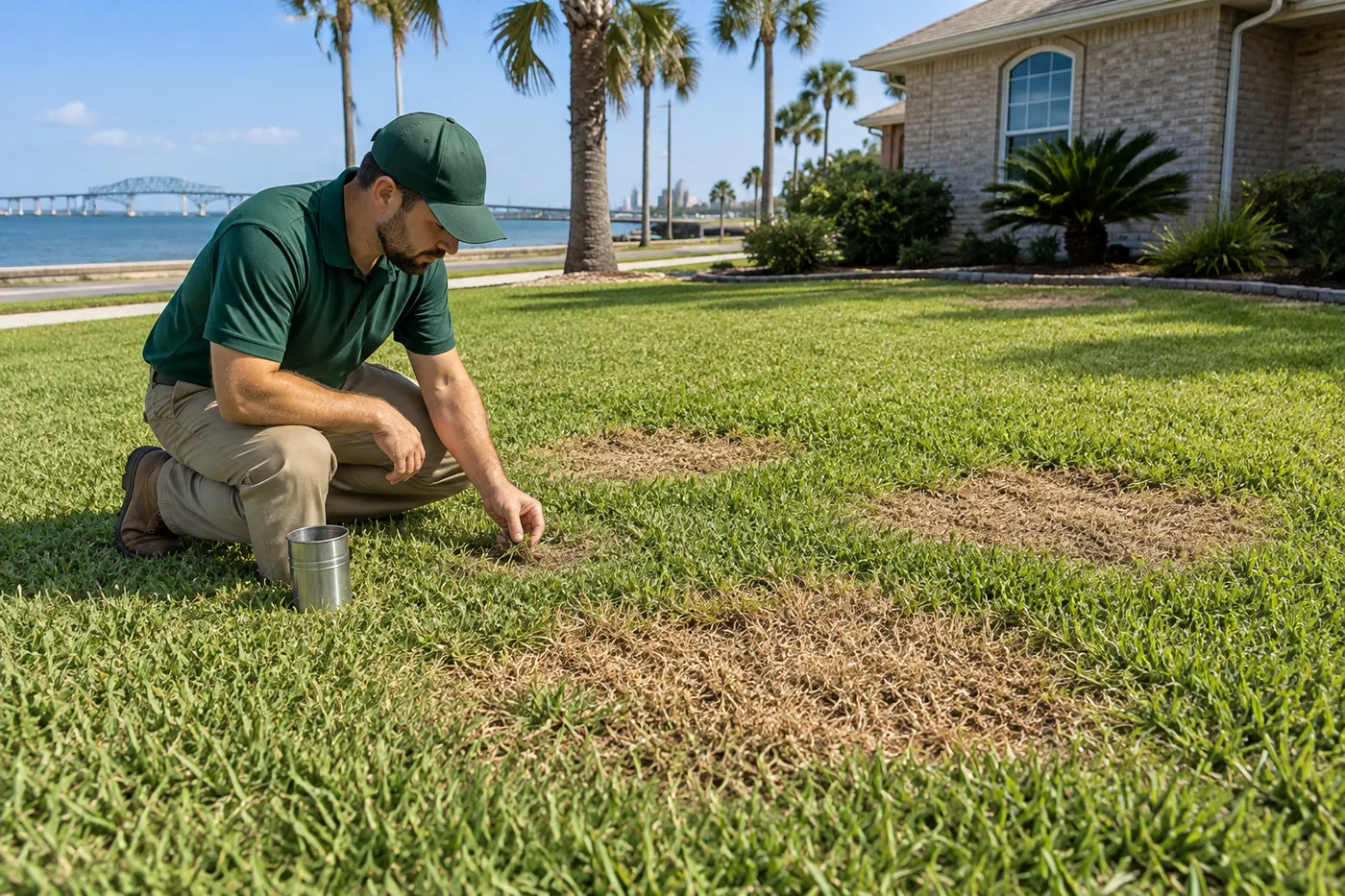
    The problem is that three completely different causes look almost identical from the driveway. Chinch bug damage, take-all root rot and simple heat and drought stress all show up as irregular tan or straw-colored areas in an otherwise green lawn. Treating the wrong one wastes money and loses turf. You can sort out which one you have in about ten minutes.

    Step one: pull on the grass

    Walk to the edge of a brown patch, where the brown meets the green, and pinch a handful of runners. Then tug.

    If the stolons, the horizontal runners, pull out of the ground easily and the roots look short, dark and rotted, you are looking at take-all root rot. Texas A&M AgriLife notes that with take-all, the leaf blades stay attached to the stolon even though the root system underneath has been destroyed. With large patch, the other common fungal disease here, blades slip off the stolon easily and often have a slimy dark brown lesion at the base of the leaf.

    If the runners are firmly anchored and the roots are white and fibrous, the fungus is not your problem. Move on.

    Step two: flush for chinch bugs

    Southern chinch bug is the one insect that reliably devastates St. Augustine, and it does its worst work in exactly these conditions: hot, dry, sunny ground. AgriLife’s description matches what you see in yards along the bay: islands of dying grass ringed by a halo of yellowing turf, expanding and merging as bug numbers climb. The hottest, most reflective strips get hit first, next to a south-facing wall, along a concrete driveway, at the curb.

    To confirm, take a coffee can, cut out both ends, and push it two to three inches into the soil at the edge of the damage. Fill it with water and keep it topped off for five to ten minutes. Chinch bugs float. Adults are small, about a fifth of an inch, black with folded white wings; the nymphs are reddish with a pale band. If several float up in that small circle, you have your answer.

    Two things worth knowing before you spray. First, damage is worst in full sun, so test there, not in the shade. Second, a lawn thick with thatch shelters them, which is one more reason mowing height and thatch control matter.

    Step three: check the water, not the grass

    If the roots are sound and nothing floated in the can, you almost certainly have heat and drought stress. Push a long screwdriver into a brown area and into a green area. If it slides in six inches in the green spot and stops at two inches in the brown one, that area is simply not getting water. In our sandy Coastal Bend soils, water moves through fast and unevenly, and the dry spots are usually mechanical: a sprinkler head blocked by a shrub, a slope that sheds water, compacted soil along a walkway where the mower turns.

    What to actually do this week

    • Raise the mower. AgriLife’s recommended range for St. Augustine is 2.5 to 3.5 inches. Taller blades shade the soil and support deeper roots, and a lawn under heat stress recovers faster at the top of that range than the bottom.
    • Water deeply, not often. Fewer, heavier soakings that reach several inches down beat a daily sprinkle that never leaves the top inch. Water in the early morning so blades dry before nightfall, which matters more once the humidity climbs Thursday.
    • Hold back the nitrogen. Balanced fertility is part of managing both take-all root rot and large patch. Pushing a fast, high-nitrogen feed into a diseased or heat-stressed lawn in mid-September makes the problem worse, not better.
    • For confirmed take-all, lower the pH at the surface. AgriLife’s control recommendation is a sphagnum peat moss topdressing at one to two bales per 1,000 square feet per application, each bale about 3.8 cubic feet, one to two applications per year. Their field work found a single bale per 1,000 square feet protected turf for two years. The peat is acidic, roughly pH 4.4, and that acidity suppresses the fungus. Reducing thatch by core aerating and mowing at the correct height helps too.
    • For confirmed chinch bugs, treat the active edge. Target the damaged area plus a buffer of healthy grass around it, since the bugs are moving outward, and water the area as the product label directs.

    Why September is the hinge month

    What you do in the next two weeks decides how the lawn looks in March. Roots damaged now do not get a second growing season to recover before dormancy. A take-all problem left alone through a wet, warm October usually reappears as bare ground next spring, and reseeding is not an option with St. Augustine, so the repair is sod or plugs.

    SiteHarbor serves Corpus Christi, Portland, Ingleside, Aransas Pass, Rockport, Robstown, Calallen, Flour Bluff and Padre Island. If you have a patch you cannot diagnose, we will walk the property with you at no charge, tell you which of the three it is, and give you an estimated range if you want us handling it.

    Questions we get

    Why is my St. Augustine brown along the driveway but green in the middle of the yard? That strip is the hottest and driest ground on the property, which makes it the first place chinch bugs cause visible damage and the first place drought stress shows. Do the coffee can flush there; if nothing floats, check how much water actually reaches that edge.

    Should I water more if my lawn has brown patches? Only if the soil is genuinely dry, which a screwdriver will tell you in seconds. If the cause is take-all root rot or large patch, extra water and extended leaf wetness feed the fungus. Water deeply in the early morning instead of frequently in the evening.

  • Black Streaks, Green Fences, Chalky Driveways: What Salt Air Really Does to a Corpus Christi Home

    Exterior Cleaning

    Black Streaks, Green Fences, Chalky Driveways: What Salt Air Really Does to a Corpus Christi Home

    SiteHarbor · Corpus Christi & the Coastal Bend
    Black Streaks, Green Fences, Chalky Driveways: What Salt Air Really Does to a Corpus Christi Home

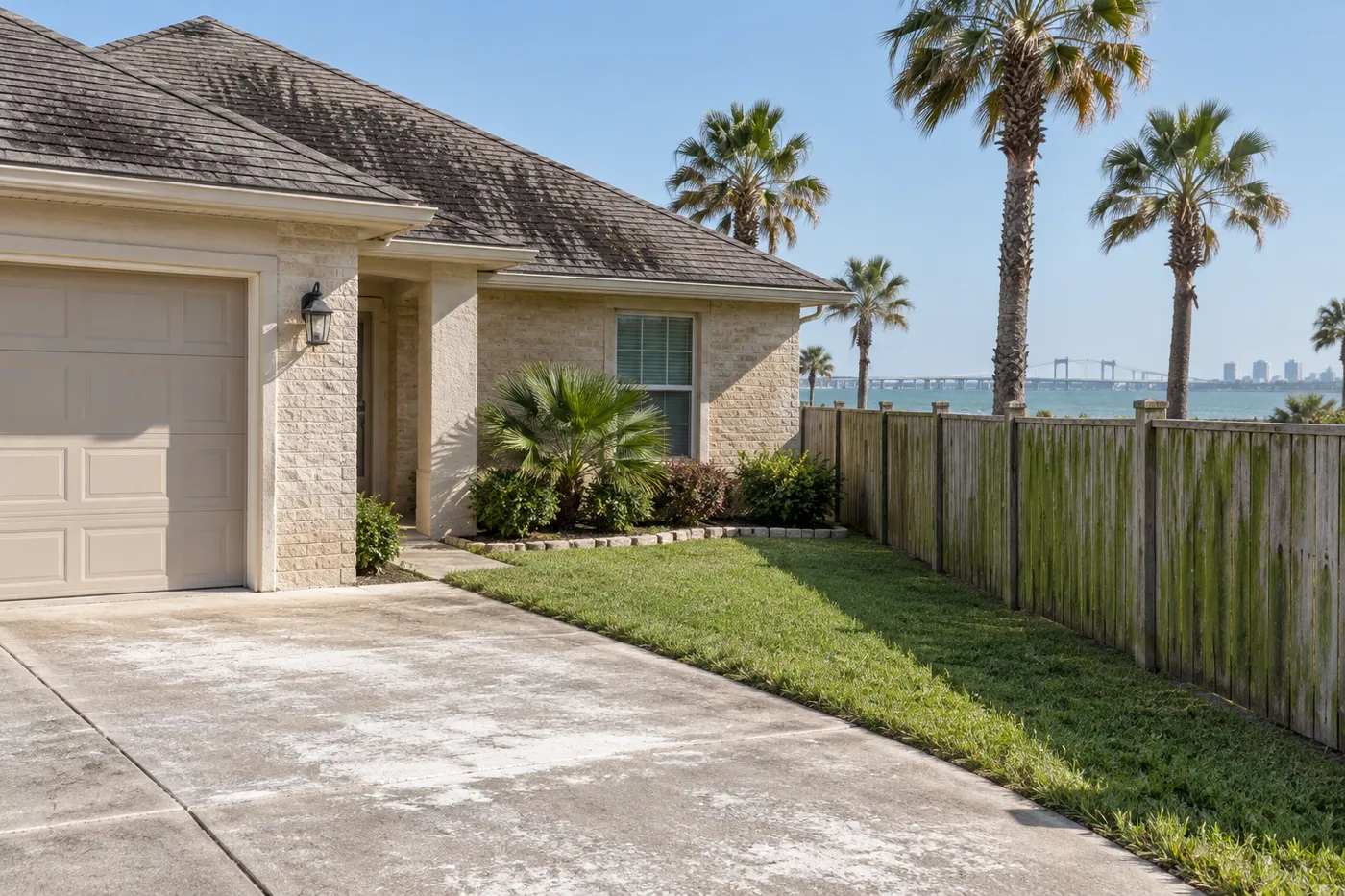
    Drive any Corpus Christi neighborhood in September and you can read the humidity off the houses. Dark vertical streaks running down the north slope of a roof. A wood fence that is honey-colored on one side and gray-green on the other. A driveway with a chalky bloom where the sprinkler hits it. None of that is dirt in the ordinary sense, and that is why hosing it off does almost nothing.

    Here is what each of those problems actually is, and what removes it without wrecking the surface underneath.

    The black streaks on your roof are alive

    Those streaks are Gloeocapsa magma, a cyanobacterium that feeds on the limestone filler in asphalt shingles and holds onto moisture. It shows up on humid coastlines first and worst, and it always starts on the shaded north- and east-facing slopes because those stay damp the longest after our morning dew and afternoon storms.

    The important part for a homeowner: the Asphalt Roofing Manufacturers Association is explicit that high-pressure washing should not be used to remove algae from asphalt shingles. Pressure blasts the protective granules off the shingle, which shortens the life of the roof and can void a manufacturer warranty. ARMA’s own guidance is a chlorine-and-water solution applied with a low-pressure sprayer, left to dwell 15-20 minutes, then rinsed gently.

    That method has a name in the trade: soft washing. It uses volume and chemistry instead of force. If a company quotes you “pressure washing the roof,” ask what PSI they are putting on the shingles. If they cannot answer, that is your answer.

    Why fences and north walls go green

    Fences and shaded siding grow a different organism – mostly algae and mildew – for the same reason: shade plus humidity plus a food source. In the Coastal Bend there is a third ingredient. Salt aerosol drifts inland off the bay and settles on every horizontal and vertical surface. Salt is hygroscopic: it pulls moisture out of the air and holds it against the wood or the paint film, so a surface within a few miles of the water stays damp far longer than the same surface in San Antonio.

    Practical consequences:

    • Wood fences on the bay side of a property gray out and grow faster than the street side. Cleaning on a schedule (rather than a rescue wash every three years) is what keeps the boards from cupping and splitting.
    • Painted siding, especially on the north elevation, mildews in the seams and under eaves where rain never rinses.
    • Screens, railings and light fixtures corrode – salt film plus dew is a nightly wet-dry cycle on bare metal.

    Rinsing salt film off metal, glass and painted surfaces is genuinely useful maintenance here in a way it simply is not further inland.

    The chalky white bloom on concrete

    That is usually efflorescence: dissolved salts and lime migrating to the surface as water evaporates out of the slab. It is common on newer concrete, on driveways where irrigation overspray keeps one strip permanently damp, and around pool decks. Efflorescence is not algae, so chlorine does not touch it. It needs a mild acidic masonry cleaner, and the real fix is upstream – adjust the sprinkler head so it stops watering the concrete.

    Organic staining on concrete (the gray-green film on shaded walkways, the black rings under a live oak) is the opposite: chemistry first, pressure second. A surface cleaner attachment on a driveway leaves an even finish; a wand in someone’s hands leaves stripes you will see every day for a year.

    How often, realistically, in the Coastal Bend

    There is no single right answer, but these are the intervals that hold up on properties here:

    • House wash (siding, soffits, eaves): annually. Shaded elevations near the water sometimes want it sooner.
    • Driveway, sidewalk, patio: annually, or twice a year if it is shaded or gets sprinkler overspray.
    • Roof soft wash: when streaking appears, then every few years. Do not wait until it is uniform black – the longer it grows, the more granule loss you are already carrying.
    • Pool deck and outdoor living areas: spring, before the season you actually use them.
    • Commercial and HOA-managed property: quarterly is the standard that keeps common areas from ever looking neglected, which is usually what the complaint emails are about.

    The two mistakes that cost the most money

    First, pressure where chemistry belongs: shingles, soft wood, painted siding, window seals and older mortar all lose when someone reaches for 3,000 PSI. Second, washing in the wrong order. Wash the house before the driveway and you dirty the concrete twice. Wash before hurricane season debris rather than after and you pay for the same job again in October.

    One more Coastal Bend detail

    Late summer is the worst time to judge your own exterior and the best time to schedule cleaning for it. Growth peaks now, after months of humidity, and everything you clean in the next several weeks stays clean through the dry stretch that follows. If you are already having lawn or pool service done, sequencing the wash with those visits keeps trucks, water and cleanup on one schedule instead of three.

    SiteHarbor handles lawn, pool care and exterior washing on one contract, one schedule and one monthly invoice for Corpus Christi and the Coastal Bend. If you want a straight opinion on what your property actually needs – and what it does not – call (361) 792-0247.

    SiteHarbor bundles lawn, pool and exterior cleaning on one contract across the Coastal Bend. See residential services, commercial grounds care, or get a quote.

  • What a 100-Degree Week Does to Your Pool in Corpus Christi

    Pool Care

    What a 100-Degree Week Does to Your Pool in Corpus Christi

    SiteHarbor · Corpus Christi & the Coastal Bend
    What a 100-Degree Week Does to Your Pool in Corpus Christi

    Corpus Christi just came off its hottest start to September on record, and the heat is not done: the National Weather Service has us in the upper 90s to around 100 through midweek with heat advisories, easterly breeze off the bay, and better rain chances arriving Thursday. Your lawn shows heat stress by wilting. Your pool shows it by quietly going out of balance, and by the time the water looks dull or slick on the walls, you are already three or four days behind.

    Here is what a stretch of 100-degree afternoons actually does to a backyard pool in a coastal climate, and what you can check yourself this week.

    Hot water burns chlorine faster than you think

    Two things eat chlorine in September: ultraviolet light and warm water. Sunlight breaks down free chlorine directly. Unstabilized chlorine in an outdoor pool with no cyanuric acid can be gone in a matter of hours in full sun, which is why stabilizer exists. Warm water does the second half of the damage by speeding up algae and bacteria growth, so demand goes up at the same time supply is being destroyed.

    Practical version: the chlorine level that held fine in April will not hold in a 90-degree pool in September. If you are testing once a week and finding zero free chlorine at that test, the pool spent several days unprotected. Test twice a week while the heat holds.

    Check stabilizer before you add more chlorine

    Cyanuric acid (CYA, sold as stabilizer or conditioner) is chlorine’s sunscreen. The Pool and Hot Tub Alliance puts the ideal range at 30 to 50 ppm for a typical residential pool using stabilized chlorine, and says it should not exceed 100 ppm. Too little and sun strips your chlorine. Too much and the chlorine you are paying for is chemically tied up and sluggish, which is the classic “I keep adding chlorine and nothing happens” pool.

    Saltwater pools are a different case. A salt cell makes unstabilized chlorine, so salt system manufacturers commonly call for a higher CYA level, in the range of roughly 70 to 80 ppm, to keep that fresh chlorine from being cooked off. Follow your own cell manufacturer’s number rather than a generic chart. Also remember CYA does not evaporate or burn off. The only real way down is dilution, so it is worth knowing your number before you dump in more.

    Run time matters more than shock

    Filtration and circulation are what carry sanitizer around the pool. In water above the mid-80s, the same pump schedule you ran in spring is usually too short. Add hours rather than chemicals as your first move, and if you have a salt system, raising output percentage while extending run time is the correct order of operations. Brush the walls and steps weekly, because algae takes hold on surfaces before it clouds the water.

    Watch the water line, not just the water

    A pool typically loses about a quarter inch of water a day to evaporation, and hot, windy conditions can push that toward a half inch. On a normal Corpus Christi September week, two inches of loss is not a leak. It becomes a real problem when the level drops below the middle of the skimmer mouth: the skimmer starts pulling air, the pump loses prime, and a pump running dry can destroy a seal and then an impeller. That is a repair bill created by a garden hose you did not run.

    If you want to know whether you have a leak or just September, do a bucket test. Set a bucket on a step, fill it to match the pool level, mark both, leave the pump on a normal schedule, and compare after 24 to 48 hours. If the pool drops noticeably more than the bucket, you likely have a leak. If they track together, it is evaporation.

    Then Thursday’s rain changes everything again

    Rain arriving after a long hot dry stretch is the worst-case sequence for water chemistry. You get dilution of your stabilizer and salt, a pH swing, and a load of pollen, dust, and yard debris washed in off decks and beds all at once, into water that is already low on chlorine. Plan on testing the day after the first real rain rather than waiting for your normal service day.

    The salt air factor

    Within a few miles of the bay and on the island, salt-laden air accelerates corrosion on everything metal around the pool: heater cabinets, light rings, handrail anchors, valve hardware, screws in equipment pads. Rinse equipment and rails with fresh water when you rinse the deck, and look at your pad every month for rust bleed at fasteners. Catching a corroding screw is a five-dollar problem. Catching a corroded heater panel is not.

    FAQs

    How often should I test my pool in Corpus Christi in the summer? Twice a week for free chlorine and pH while water temperatures stay in the high 80s and 90s, plus once more the day after any heavy rain. Test stabilizer and salt monthly, since those move slowly except when rain dilutes them.

    Why does my pool lose so much water in September, and is it a leak? Around a quarter inch a day is normal evaporation, and a hot windy day can approach a half inch, so roughly two inches a week is expected here. Run a 24 to 48 hour bucket test before assuming a leak, and keep the level at least halfway up the skimmer opening so the pump never pulls air.

    If you would rather not track it

    Weekly pool care is mostly discipline: test, brush, adjust, watch the water line. If keeping up with it in this heat is not how you want to spend your Saturdays, SiteHarbor serves Corpus Christi, Portland, Ingleside, Aransas Pass, Rockport, Port Aransas, Robstown, Kingsville, and Padre Island, and a free walkthrough gets you an honest read on your pool and an estimated monthly range for keeping it right.

    SiteHarbor bundles lawn, pool and exterior cleaning on one contract across the Coastal Bend. See residential services, commercial grounds care, or get a quote.

  • When to Stop Mowing St. Augustine in Corpus Christi (and What to Do Instead)

    Lawn Care

    When to Stop Mowing St. Augustine in Corpus Christi (and What to Do Instead)

    SiteHarbor · Corpus Christi & the Coastal Bend
    When to Stop Mowing St. Augustine in Corpus Christi (and What to Do Instead)

    Most Corpus Christi lawns are St. Augustine, and most of them get treated the same way in September as they did in June. That’s the mistake. Our growing season runs long — St. Augustine here keeps pushing growth well into November and often doesn’t sit fully dormant until late December. What changes in the fall isn’t whether you mow. It’s how high, how often, and what you feed it.

    September to mid-November: keep mowing, raise the blade

    Set the deck to 3.5–4 inches. Taller blades shade the soil, hold moisture through our dry spells, and crowd out the winter weeds that germinate as soon as night temperatures drop into the 60s. Cutting short in the fall is the single most common reason a lawn comes out of winter thin and patchy.

    • Frequency: every 7–10 days through October, then every 10–14 days in November as growth slows.
    • Never remove more than a third of the blade height in one pass — scalping a stressed lawn in the fall invites take-all root rot, which is common on the coast.
    • Leave the clippings. They return nitrogen and cost you nothing.

    Water less often, but deeper

    Shorter days mean lower evaporation. Most Coastal Bend lawns need about 3/4 inch of water per week in October and closer to 1/2 inch by late November, delivered in one or two long soakings rather than daily sprinkles. Shallow daily watering builds shallow roots, and shallow roots are what fail you in the next drought or the next freeze.

    Water between 4 a.m. and 9 a.m. Evening watering leaves blades wet overnight, and with our humidity that’s how brown patch fungus gets started — you’ll see it as circular yellowing patches a foot or more across, usually first in low spots.

    The one fertilizer rule that matters

    Do not put down a high-nitrogen fertilizer after early October. Late nitrogen pushes soft top growth right when the plant should be moving energy into the roots, and that soft growth is what gets burned in a hard freeze. Instead:

    • Early-to-mid October: a potassium-heavy “winterizer” (something like a 5-10-30 or 0-0-50 blend) to harden the turf for cold.
    • Late October / early November: a pre-emergent for winter weeds — this is the timing that decides whether you spend March fighting poa annua and henbit.
    • Nothing else until the lawn greens up in spring.

    Coastal Bend specifics people miss

    Salt

    Properties near the bay, on the island, or in Flour Bluff pick up salt in the soil from spray and from irrigation water. A deep soaking once a month in the fall helps flush it below the root zone. If you see blade tips browning from the outside in while the rest of the lawn looks fine, salt is the usual suspect, not drought.

    Chinch bugs

    They stay active here far later than the calendar suggests. If you have an irregular dead patch in full sun that keeps expanding and does not respond to water, part the grass at the edge of the damage and look for small black insects at the soil line. Fall treatment is much cheaper than spring resodding.

    Freeze prep

    We don’t freeze often, but when we do it’s abrupt. Water the lawn deeply 24–48 hours before a hard freeze — moist soil holds heat far better than dry soil — and stop mowing once a freeze is forecast so the plant keeps its insulation.

    The short version

    • Keep mowing into November, at 3.5–4 inches.
    • Water deep and early, 1–2 times a week, not daily.
    • Winterizer in early October. No nitrogen after that.
    • Pre-emergent late October — this is the one that saves your spring.
    • Watch for chinch bugs and salt burn, not just “dry spots.”

    Do these five and your lawn comes out of February already green while the neighbors are waiting on it.

    SiteHarbor bundles lawn, pool and exterior cleaning on one contract across the Coastal Bend. See residential services, commercial grounds care, or get a quote.