Viktor Service – Page 4 – SiteHarbor

SiteHarbor

Author: Viktor Service

  • Fall Yard Cleanup in Corpus Christi: October Checklist
    Seasonal

    Fall Yard Cleanup in Corpus Christi: October Checklist

    SiteHarbor · Corpus Christi & the Coastal Bend
    Fall Yard Cleanup in Corpus Christi: October Checklist

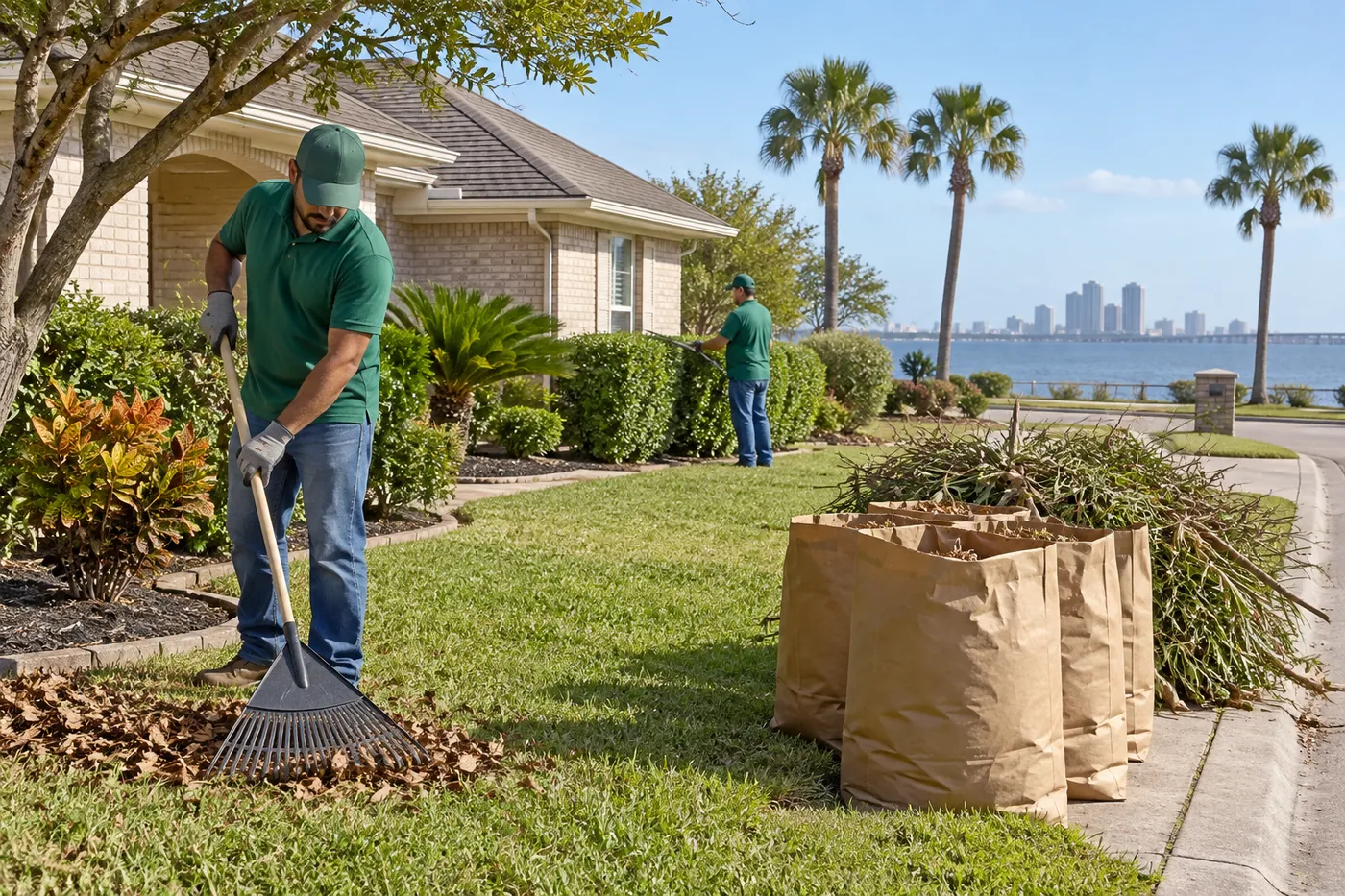
    Fall yard cleanup in Corpus Christi is less about raking leaves and more about getting a lawn and landscape ready for a mild winter and the last two months of hurricane season. October is the month to do it here: St. Augustine is still growing, the first real cold front is usually on its way, and the City of Corpus Christi’s heavy brush pickup is running through the southern and eastern collection areas.

    What should a fall yard cleanup include in Corpus Christi?

    A useful fall cleanup on the Coastal Bend covers four things: the turf, the beds, the trees and shrubs, and the debris. For most homes that means:

    • Turf: keep mowing St. Augustine at 2.5 to 3.5 inches and never take off more than a third of the blade at once.
    • Beds: pull summer weeds before they set seed, cut back spent annuals, and top up mulch where it has thinned. Texas A&M AgriLife’s Earth-Kind guidance calls for 2 to 4 inches of mulch in fall for moisture, weed control and winter protection.
    • Trees and shrubs: remove dead, broken and crossing limbs, and lift branches off the roof and away from the house. Hedges get a light shaping, not a hard cut, this late in the season.
    • Debris: clear gutters, downspouts and drainage paths so heavy fall rain actually leaves the property, and stage brush for the city’s scheduled pickup.

    If you’d rather hand the whole list to one crew, our seasonal cleanup and storm prep service covers the turf, beds, trimming and haul-off in one visit.

    When is the city brush pickup in Corpus Christi this fall?

    The City of Corpus Christi collects heavy brush and bulky items on a published schedule by collection area, and you may only set brush out during your area’s authorized set-out dates. Collection starts the day after the last set-out date. According to the city’s Heavy Brush and Bulky Items page, the current cycle runs Area 9-A (Sept. 30 to Oct. 4), 9-B (Oct. 7 to 11), 9-C (Oct. 14 to 18), 9-D (Oct. 21 to 25), 10-A (Oct. 28 to Nov. 1), 10-B (Nov. 4 to 8) and 10-C (Nov. 11 to 15), then starts over at Area 1-A in late November. Use the city’s interactive map or the CC Recycles app to confirm your area before you cut.

    A few of the city’s rules that catch people:

    • Brush goes where your carts normally go, never in the street, gutter, sidewalk or drainage ditch.
    • Keep brush separate from bulky items like furniture or appliances.
    • No single pile larger than 6 feet high, 10 feet long and 6 feet deep, and each household is limited to one truckload per collection. Extra loads are billed to your utility account.
    • Lumber, fencing, concrete, dirt and roofing materials are not accepted as brush.
    • Outside your pickup window, yard waste can be bagged and put in your regular garbage cart.

    The practical takeaway: time big trimming jobs so the cuttings are ready the week your area opens.

    Should I bag leaves and grass clippings in the fall?

    Usually not. AgriLife recommends leaving clippings on the lawn when you mow at the right height and frequency; recycled clippings return nitrogen to the soil and can cut the need for fertilizer. The same goes for a light layer of leaves: run the mower over them and let the shredded pieces settle into the turf. Only rake or bag when leaves are thick enough to mat down and shade the grass, which in Corpus Christi usually means under live oaks and near hedges.

    How do I prep my St. Augustine lawn for winter in Corpus Christi?

    Corpus Christi rarely sees a hard freeze, and in many years the first freeze does not arrive until December, if it arrives at all. That means the lawn keeps growing slowly through fall, and the main risks are disease and overfeeding, not cold.

    • Watch for large patch. AgriLife notes St. Augustine is very susceptible once fall temperatures cool. Water early in the morning so blades dry during the day, and keep nitrogen balanced.
    • Finish fertilizing on time. AgriLife’s cut-off for the last nitrogen feeding in the Corpus Christi area is about November 1. We covered the details in our post on the last fall fertilizer for St. Augustine in Corpus Christi.
    • Follow the watering rules. The city’s Stage 1 water restrictions are still in effect, which means lawn watering once a week on your assigned day, before 10 a.m. or after 6 p.m.

    Is fall cleanup part of hurricane prep?

    Yes. Atlantic hurricane season runs through November 30, and a late-season Gulf system is the reason fall cleanup matters more here than inland. Dead limbs, loose brush piles and clogged gutters are what turn a windy night into damage. Before any storm threat, get limbs off the roof line, clear drainage paths, and make sure nothing is stacked at the curb outside a pickup window. For larger limbs or anything near a roof or power line, see our tree trimming and limb removal page.

    Fall yard cleanup FAQs

    How much does fall yard cleanup cost in Corpus Christi?

    It depends on lot size, how much trimming is involved and how much debris needs to be hauled off. We give an estimated range first, then confirm it with a free walkthrough of the property.

    When is the best time for fall cleanup in Corpus Christi?

    October into early November. The heat has eased, St. Augustine is still growing enough to recover from mowing and trimming, and you can line up the work with your area’s city brush pickup dates.

    If you want the lawn, beds, trimming and haul-off handled together, see our seasonal cleanup and storm prep service or request a free quote. We’ll walk the property and give you a clear estimate before any work starts.
  • Mulch Installation in Corpus Christi: Fall Bed Refresh

    Beds & Mulch

    Mulch Installation in Corpus Christi: Fall Bed Refresh

    SiteHarbor · Corpus Christi & the Coastal Bend
    Mulch Installation in Corpus Christi: Fall Bed Refresh

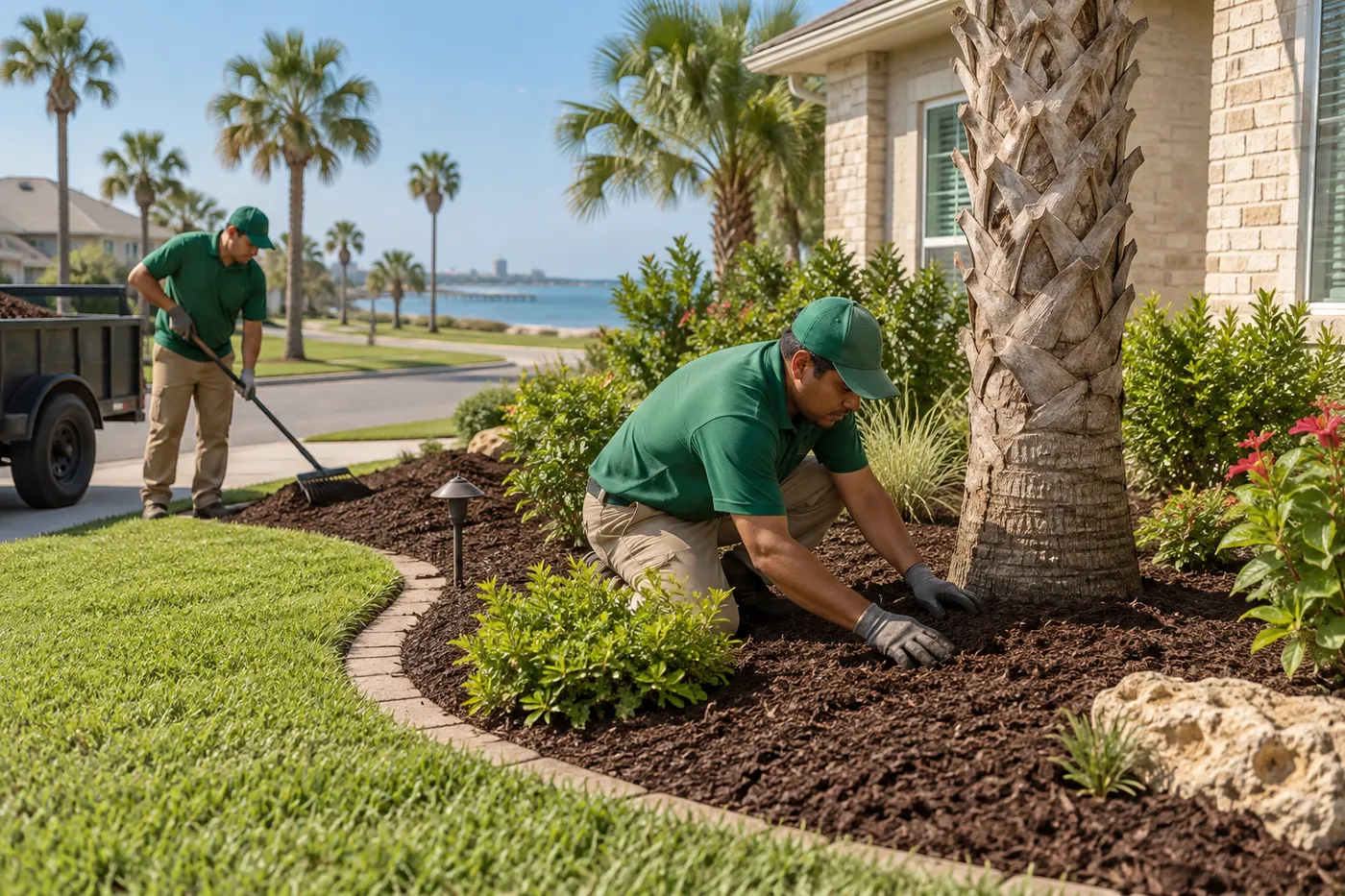
    Mulch installation in Corpus Christi works best in the fall: pull the weeds and old breakdown out of the beds, edge them, and lay a fresh 2 to 4 inch layer of mulch while the soil is still warm and before winter wind and the occasional cold snap arrive. Done that way, a bed refresh holds soil moisture through a dry winter, keeps weeds down, and makes a Coastal Bend yard look finished for the holidays. Here is what a proper job includes and what to watch for if you hire it out.

    When is the best time to put down mulch in Corpus Christi?

    Most people think of mulch as a spring job, but Texas A&M AgriLife’s Earth-Kind fall practices list mulching as a fall task. AgriLife notes that a 2 to 4 inch layer holds in soil moisture, suppresses weeds, moderates soil temperature and gives tender plants some winter protection.

    That matters here for a few reasons:

    • Watering is limited. Corpus Christi has been under Stage 1 water restrictions since late August, which means lawn and landscape watering once a week on your assigned day. A mulched bed loses water to evaporation more slowly than bare soil.
    • Fall is planting season. Shrubs and perennials planted now keep growing roots through our mild winter. Mulch keeps that root zone from swinging between wet and dry.
    • Late September is still hot. Highs are running around 90 degrees this weekend. Mulch shades the soil surface during the last warm stretch of the year.

    What does a mulch installation service include?

    Dumping bags on top of weeds is not a bed refresh. A job worth paying for usually covers these steps in this order:

    • Weed removal. Pull weeds by the root. Mulch slows new weeds from seed; it does not smother established grass runners or nutsedge.
    • Clear out the old layer where it has packed down. Old mulch that has matted into a crust can shed water instead of letting it soak in. Break it up or rake some of it out before adding new material so the total depth stays in range.
    • Edge the beds. A clean edge between St. Augustine and the bed keeps stolons from creeping in and holds the mulch in place.
    • Trim what’s hanging over. Shrubs lightly shaped and dead growth removed before the mulch goes down, so the clippings don’t end up buried in it.
    • Spread to the right depth. Level, even coverage, pulled back from trunks and stems, and extended toward the outer branches of trees and shrubs where it can.
    • Haul-off. Weeds, old mulch, bags and trimmings leave with the crew.

    Our bed cleanup and mulch refresh service is built around that sequence, and it can be folded into ongoing landscape and bed maintenance so the beds don’t slide back.

    How deep should mulch be around trees and shrubs?

    Deeper is not better. The Texas A&M Forest Service recommends no more than a 2 to 3 inch layer around trees, spread evenly, with space left between the trunk and the mulch. The mounds of mulch piled against trunks that you see in some parking lots are called volcano mulching, and AgriLife horticulturists warn that they hold moisture against the bark and invite disease and pests.

    A few practical rules:

    • Keep mulch a few inches off tree trunks and shrub stems.
    • For trees, a wide, shallow ring beats a tall, narrow pile. AgriLife’s WaterSmart program says trees and shrubs benefit from mulch spread out toward the dripline.
    • In open beds, 2 to 4 inches of settled depth is the working range. Coarse material needs to be on the thicker end to stop weeds; fine material packs down and can stay thinner.
    • Top up once the layer thins instead of stacking a new full layer on top of an old one every season.

    What kind of mulch works best on the Coastal Bend?

    Salt air, wind and heavy tropical rain all shape the choice here.

    • Shredded hardwood. Knits together as it settles, so it tends to stay put in wind and on slight slopes. A common all-around choice for front beds.
    • Pine bark nuggets. Attractive and slow to break down, but AgriLife’s landscape mulch guide notes bark can float in heavy rains. Beds near downspouts or low spots that pond after a storm are a poor fit.
    • Cypress. The same AgriLife guide notes cypress resists floating, which helps in beds that take runoff.
    • Rock or gravel. Does not wash out, but holds heat against plants and doesn’t feed the soil. Better for strips along walls and drainage paths than for planted beds.

    If you’re adding plants this fall, our post on salt-tolerant shrubs to plant in Corpus Christi covers which ones handle direct salt spray.

    What does mulch installation cost in Corpus Christi?

    Cost depends on how many beds there are, their square footage, how much weeding and old material has to come out first, the mulch type, and how far it has to be carried from the truck to the beds. We give an estimated range based on your address and a photo or description, then confirm it with a free walkthrough before any work is scheduled.

    Frequently asked questions

    How often should mulch be replaced in Corpus Christi?

    Organic mulch breaks down over time, which is part of how it feeds the soil. Most beds need a top-up about once a year. Check the depth before buying: if there are still 2 inches in place, a light top-up is usually enough instead of a full new layer.

    Should I put landscape fabric under mulch?

    Fabric can help under rock, but under organic mulch the mulch eventually breaks down on top of it and weeds root into that layer anyway. In most planted beds, thorough weeding plus a proper mulch depth works better than fabric.

    If your beds need weeding, edging and a fresh layer before the holidays, see what our bed cleanup and mulch refresh includes, or request a free quote and we’ll send an estimated range, then set up a free walkthrough.

  • Choosing an HOA Landscaping Company in Corpus Christi

    HOA & Property Managers

    Choosing an HOA Landscaping Company in Corpus Christi

    SiteHarbor · Corpus Christi & the Coastal Bend
    Choosing an HOA Landscaping Company in Corpus Christi

    If you sit on an HOA board in Corpus Christi, the right landscaping company is the one that puts its scope in writing, walks the common areas before it prices them, and plans around the city’s watering rules and the Coastal Bend’s salt air. This guide covers what to ask, what the contract should spell out, and what to schedule this fall, while Corpus Christi is under Stage 1 water restrictions.

    What should an HOA landscaping contract in Corpus Christi include?

    Most disputes between boards and vendors come from a vague scope. A one-line “maintain common areas” gives neither side anything to measure. A workable contract lists the areas and the tasks, and says how often each one happens:

    • A map or list of every common area: entrances, medians, detention ponds, amenity centers, fence lines and any lots the association owns.
    • Mowing frequency by season: weekly in the growing season, with a stated change for the slower months instead of an open-ended “as needed.”
    • Mowing height: Texas A&M AgriLife recommends 2.5 to 3.5 inches for St. Augustinegrass, the turf in most Corpus Christi common areas. Cutting lower stresses it in heat and drought.
    • Edging, string trimming and blowing on every visit, including curbs, walks and around signs and monuments.
    • Bed maintenance: weeding frequency, shrub pruning schedule and how often mulch is refreshed.
    • Trees: limb clearance over sidewalks and streets, and what is included versus quoted separately.
    • Debris and storm response: how fast the vendor clears limbs and trash after a storm, and how that work is billed.
    • Reporting: a visit log or short note after each service so the board can see what was done without driving the property.

    For a closer look at how scope drives price, see our post on what commercial grounds maintenance costs in Corpus Christi.

    How do I choose an HOA landscaping company in Corpus Christi?

    Start with the walkthrough. A company that prices your common areas from a satellite image has not seen the drainage swale that stays wet, the entry bed that takes salt spray, or the median that needs a traffic plan. Ask for an on-site review and a written scope before any number is discussed.

    Then ask questions that show how the vendor actually runs:

    • Who is the single point of contact for the board or the management company, and how fast do they answer?
    • What day of the week is the crew scheduled, and what happens when rain pushes a visit?
    • How do they handle homeowner complaints that come through the management company?
    • Can they cover more than mowing, such as pressure washing entry monuments and walks or seasonal lighting, so the board manages fewer vendors?
    • Will they put a certificate of insurance on file that names the association, before work starts? Ask to see it rather than taking it on faith.

    How do Corpus Christi water restrictions affect HOA landscaping?

    The City of Corpus Christi declared Stage 1 water restrictions on August 27, 2026. Under Stage 1, lawn watering with hose-end sprinklers or automatic systems is allowed once a week on the assigned day, before 10 a.m. or after 6 p.m. The current schedule is posted at stage1.corpuschristitx.gov. Boards should confirm the watering day that applies to each common-area meter and make sure controllers match it.

    Restrictions also change how boards enforce yard standards. Texas House Bill 517, in effect since September 1, 2025, added Section 202.008 to the Property Code. It bars a property owners’ association from fining an owner over brown or discolored turf while a residential watering restriction that could reasonably cause it is in place, and until 60 days after the restriction is lifted. Separately, Section 202.007 limits an association’s ability to prohibit drought-resistant landscaping or water-conserving turf. If your deed restrictions or fine schedule predate these changes, it is worth a review with the association’s attorney.

    For the common areas themselves, a good landscaping company adjusts to the restriction instead of fighting it: keeping mowing height at the upper end of the range, avoiding fertilizer on drought-stressed turf, and flagging beds where lower-water plants would hold up better.

    What should an HOA schedule for fall in the Coastal Bend?

    • Tree work on oaks now through January. The Texas A&M Forest Service advises avoiding live oak and red oak pruning from February through June, when oak wilt spreads most easily.
    • Pre-emergent for winter weeds when soil temperature falls toward 70 degrees, which AgriLife uses as the fall trigger.
    • Last nitrogen feeding by November 1 for Corpus Christi, per AgriLife’s lawn fertilization guidance, and only on turf that is not drought-stressed.
    • Storm-season follow-through. Hurricane season runs through November 30, so keep drains, grates and pond outfalls clear of clippings and debris.
    • Holiday lighting at the entrance, booked early if the board plans to light monuments or front trees.

    Frequently asked questions

    How often should an HOA’s common areas be mowed in Corpus Christi?

    Weekly during the growing season is common for entrances and high-visibility areas, with a reduced schedule once growth slows in the cooler months. The contract should state both schedules so there are no surprises.

    Can our HOA fine homeowners for brown lawns during Corpus Christi water restrictions?

    Under Texas Property Code Section 202.008, an association may not fine an owner over brown or discolored turf while a residential watering restriction that could reasonably cause it is in effect, or until 60 days after it ends. Check your governing documents and your attorney for how this applies to your community.

    Get a written scope for your common areas

    SiteHarbor maintains HOA common areas across Corpus Christi and the Coastal Bend, and works with property managers who want one team for grounds, washing and seasonal work. Tell us about your community and we will send an estimated range, then set up a free walkthrough of the common areas. Request a free quote.

  • Driveway Pressure Washing in Corpus Christi: What to Expect

    Exterior Cleaning

    Driveway Pressure Washing in Corpus Christi: What to Expect

    SiteHarbor · Corpus Christi & the Coastal Bend
    Driveway Pressure Washing in Corpus Christi: What to Expect

    Driveway pressure washing in Corpus Christi works best when it is treated as three separate jobs: lifting the everyday grime and mildew with a surface cleaner at moderate pressure, treating rust and oil stains with the chemistry each one needs, and keeping the wash water out of the storm drain. Salt air, humidity and iron-heavy runoff mean a Coastal Bend driveway darkens faster than one inland, so knowing what a proper cleaning involves helps you judge any quote you get.

    What does driveway pressure washing include in Corpus Christi?

    A thorough driveway cleaning is more than one pass with a wand. Here is what a complete job usually covers:

    • Pre-treatment. Mildew and algae, the green-black film common on shaded Coastal Bend concrete, loosen far more easily with a cleaning solution applied first than with pressure alone.
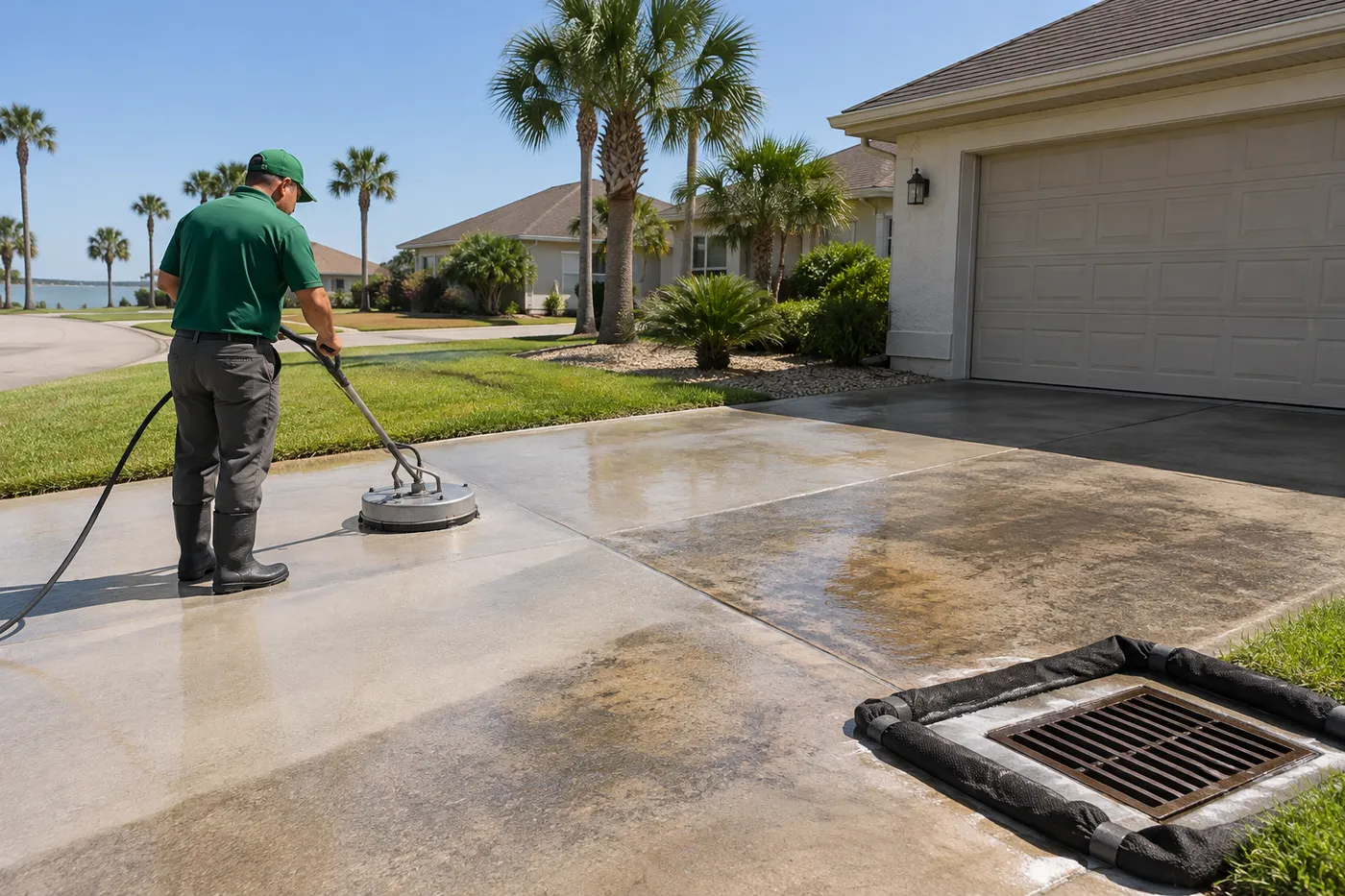
    • Surface cleaner on the flat areas. A rotary surface cleaner keeps the nozzles at a fixed height and gives an even result. Hand wands used across a whole slab are what cause the light-and-dark bands people call zebra or tiger striping.
    • Edges, joints and the apron. Expansion joints, the strip along the lawn edge and the curb apron collect soil and weeds, and they need detail work.
    • Spot treatment for stains. Rust and oil do not respond to the same cleaner (more below).
    • Post-rinse and cleanup. Rinsing off cleaning residue, and keeping debris and chemicals out of the gutter.

    Can pressure washing damage a concrete driveway?

    Yes, if the pressure is too high or the nozzle is too close. Concrete can be etched, which leaves permanent marks or a rough, sandy surface where the cream layer has been stripped away. Many exterior-cleaning guides treat roughly 2,000 to 3,000 PSI as the working range for residential concrete, with a wide fan tip or a surface cleaner rather than a narrow zero-degree tip.

    It helps to know the difference between etching and striping. Striping is uneven cleaning, and it comes out with a proper second pass. Etching is damage to the concrete itself, and it does not come out.

    New concrete is a special case. Concrete takes about 28 days to cure, and the common guidance is to wait at least that long before pressure washing a freshly poured driveway or slab.

    How do you get rust stains off a driveway?

    Orange and brown spots are one of the most common complaints on Corpus Christi driveways. The usual sources are granular fertilizer that contains iron and gets tossed onto the concrete during spreading, sprinkler water that carries iron, and metal furniture, grills or planters left in one spot.

    Bleach-based cleaners do not remove rust. Rust needs an acid-based cleaner made for it. Oxalic acid is the standard choice, and it is the active ingredient in many hardware-store concrete rust removers. Extension guidance for iron stains describes soaking the stain in an oxalic acid solution for a couple of hours, then scrubbing and rinsing. Oxalic acid is toxic, so label directions and eye and skin protection matter, and plants along the edge should be rinsed.

    If the same spots keep coming back, the source is still active. Blowing fertilizer back onto the lawn after spreading, and checking where sprinklers overspray onto the driveway, prevents repeat stains.

    What about oil stains?

    Oil and transmission-fluid drips need a degreaser that is allowed to dwell before rinsing, and sometimes more than one round. Fresh drips come out more completely than stains that have soaked in for years. Older stains often lighten a lot but can leave a faint shadow, and a fair contractor will say so before starting rather than after.

    Where does the wash water go?

    This part is easy to overlook. The City of Corpus Christi notes that its storm water system carries runoff directly to local creeks, streams and bays without any treatment, and its guidance is simple: only rain down the storm drain. Cleaning chemicals, oil lifted off the slab and loose dirt should not be washed into the curb inlet. In practice that means using the smallest amount of chemical that does the job, treating oil stains as spot work, and steering rinse water toward lawn areas rather than the street where possible. The City’s storm water pollution prevention page explains the rules.

    How often should you pressure wash a driveway on the Coastal Bend?

    There is no fixed schedule, but many homeowners here clean once or twice a year. Shaded driveways, north-facing slabs and homes near the water tend to grow mildew faster.

    Some owners follow a cleaning with a penetrating silane or siloxane sealer. These products soak into the concrete instead of forming a glossy film, and they reduce how much water, salt and dirt get into the surface. Sealing is optional, but it can make the next cleaning easier.

    The roof and siding are a different job. Shingles and stucco call for low-pressure soft washing, which we covered in what causes black streaks on Corpus Christi roofs.

    Frequently asked questions

    How long does it take to pressure wash a driveway in Corpus Christi?
    A typical two-car driveway with a sidewalk is usually a few hours of work, longer if rust or oil stains need treatment and dwell time. Allow some time afterward for the concrete to dry before parking on it.

    Will pressure washing remove fertilizer rust stains from my driveway?
    Pressure alone usually will not. Rust from fertilizer or iron in sprinkler water needs an acid-based rust cleaner such as oxalic acid, followed by a rinse. Pressure washing then cleans the rest of the slab evenly.

    Get a driveway cleaning quote

    SiteHarbor handles pressure washing and exterior cleaning for driveways, walkways, patios and home exteriors across Corpus Christi and the Coastal Bend, with commercial pressure washing for storefronts and parking areas. Tell us about your property and we will send an estimated range, then set up a free walkthrough. Request your free quote.

  • The Last Fertilizer of the Year: Fall Feeding St. Augustine in Corpus Christi

    Lawn Care

    The Last Fertilizer of the Year: Fall Feeding St. Augustine in Corpus Christi

    SiteHarbor · Corpus Christi & the Coastal Bend
    The Last Fertilizer of the Year: Fall Feeding St. Augustine in Corpus Christi

    It is the last week of September and Corpus Christi is still running in the low to mid 90s, with a cold front forecast for late in the week. That front will not end the growing season, but it is a reminder that the window for the year’s final fertilizer application is open now and closes sooner than most people think.

    Fall feeding is worth doing right. Texas A&M AgriLife notes that a modest fall nitrogen application thickens the turf so it resists winter weeds, holds color longer into fall and recovers faster in spring. Done wrong, the same bag feeds disease and leaches into the bay.

    The date that matters: November 1

    AgriLife’s lawn fertilization guidance sets a cut-off date for the last nitrogen application of the year, grouped by frost zone. Corpus Christi sits in the same group as Harlingen and McAllen, and the recommended cut-off is November 1. The rule behind the date is simple: the final late-season nitrogen should go down no later than about six weeks before the expected first frost, so the grass can actually use it before growth slows.

    In practice, for most lawns in Corpus Christi, Portland, Rockport and Flour Bluff, the sweet spot is early to mid October, once the worst heat has broken but while the grass is still growing and needing a mow every week. Out toward Robstown, Calallen and Sinton, where inland nights run cooler than on the island, lean toward the earlier end.

    How much to put down

    Less than the bag usually suggests. AgriLife recommends modest fall rates of 1 pound of actual nitrogen per 1,000 square feet or less, and the Harris County AgriLife St. Augustine guide goes further for the late-season feeding: no more than half a pound of nitrogen per 1,000 square feet, in a low-nitrogen, higher-potassium product.

    To turn that into bag math, divide the first number on the label into 100. A 15-0-15 product is 15 percent nitrogen, so about 6.7 pounds of product covers 1,000 square feet at 1 pound of nitrogen, and about 3.3 pounds gets you to half a pound. Set the spreader low and make two passes at right angles rather than one heavy pass. Striping and burned stripes are almost always a spreader problem, not a product problem.

    AgriLife’s annual ceiling for St. Augustine is 4 pounds of nitrogen per 1,000 square feet across the whole year. If the lawn was fed in spring and again this summer, a light fall application is plenty.

    When to skip it

    • The lawn is stressed. AgriLife is direct about this: do not fertilize stressed grass. If you are fighting chinch bug damage or dry, sunburned patches along the driveway, fix the water and the insects first. Nitrogen on a struggling lawn pushes top growth the roots cannot support.
    • You have a history of large patch. Large patch, the fall and spring disease that makes rings of yellow-orange St. Augustine, becomes active as soil temperatures fall toward 70°F, and AgriLife lists balanced nitrogen as one of the main defenses. If those rings showed up last November or this spring, use the half-pound rate or skip nitrogen this fall entirely.
    • It is already November. Late nitrogen sits unused in cool soil, and in our sandy soils that means it moves toward groundwater and Oso Bay instead of into the grass.
    • Heavy rain is in the forecast. Sandy Coastal Bend soil drains fast. Apply before a light rain or water it in with about a quarter inch yourself, not ahead of a two-inch tropical downpour.

    Test before you guess

    Coastal Bend soils vary lot to lot, and fertilizer that adds a nutrient the soil already has is wasted. A soil test through the Texas A&M AgriLife Soil, Water and Forage Testing Laboratory tells you what is actually missing, so you are not paying for nutrients the lawn does not need. Pull a sample from several spots in the lawn, 3 to 4 inches deep, and mix them together. Results in hand make next spring’s plan easier too.

    If you cannot test this year, AgriLife suggests watching the grass instead. A lawn that has been growing steadily and holding color through September does not need much help. One that has thinned and faded without an insect or disease cause is the one that benefits most from a light feeding.

    Common questions

    When should I stop fertilizing St. Augustine in Corpus Christi? Texas A&M AgriLife sets November 1 as the cut-off for the last nitrogen application in the Corpus Christi frost zone. Early to mid October is the practical target for most lawns, while the grass is still actively growing.

    Should I use a winterizer fertilizer on my lawn in South Texas? A low-nitrogen, higher-potassium product at no more than half a pound of nitrogen per 1,000 square feet is what the Harris County AgriLife St. Augustine guide recommends for the late-season feeding. The label name matters less than the numbers on the bag and the rate you spread it at. A soil test is the best way to know whether you need the potassium at all.

    If you would rather have someone look at the lawn and tell you whether it needs a fall feeding, a disease watch or nothing at all, we will walk the property with you — free walkthrough, then an estimated range in writing.

  • Pool Filter Fall Deep Clean in Corpus Christi

    Pool Care

    Your Pool Filter Is the Most Ignored Part of a Corpus Christi Pool

    SiteHarbor · Corpus Christi & the Coastal Bend
    Pool Filter Fall Deep Clean in Corpus Christi

    Corpus Christi is still running summer numbers. Highs this week sit in the mid 90s with feels-like readings near 100, an east wind at 15 to 25 mph pushing dust and salt inland, and a front trying to arrive at the end of the week. That combination is hard on one piece of pool equipment almost nobody looks at until the water turns cloudy: the filter.

    A filter is the only part of your system that physically removes anything. Chlorine kills, the pump moves water, but the filter is what takes suspended dirt, pollen, sunscreen, and windblown grit out of the pool. After a full South Texas swim season, most residential filters in the Coastal Bend are loaded. Here is how to tell, and what to do about it before the first cool front.

    The only number that matters: clean starting pressure

    Write down the pressure your filter reads right after it is cleaned, with the pump at normal speed and the skimmer baskets empty. That is your baseline, and it is different for every pool. Pentair’s own owner manuals tell you to clean the element when the gauge reads 8 to 10 psi above that clean reading. Not on a calendar, not when the water looks bad — on the gauge.

    If you never recorded a baseline, clean the filter now and record the reading on a piece of tape stuck to the filter tank. Then you have a real number instead of a guess for the rest of the year.

    Two common mistakes here. First, reading the gauge with a dirty pump basket, which inflates the number and sends you cleaning a filter that was fine. Second, trusting a gauge that has failed. If the needle never moves, or does not drop to zero when the pump is off and the air relief is open, replace the gauge. They are cheap and they fail often in this humidity.

    What rising pressure is actually telling you

    High pressure means restricted flow through the filter. Low pressure with poor skimming usually means the restriction is before the pump — a clogged skimmer, a blocked pump basket, or an air leak on the suction side. Knowing which side of the pump the problem is on saves you from cleaning a filter that was not the issue.

    Once the filter is restricted, everything downstream suffers. Flow drops, so your salt cell produces less chlorine, your heater short-cycles, and the returns stop turning the pool over. Cloudy water in late September is usually a flow problem wearing a chemistry costume.

    Cartridge filters

    • Shut the pump off, open the air relief valve, and let pressure drop to zero before opening the tank. Do this every time, with no exceptions.
    • Rinse the pleats with a garden hose from top to bottom, fanning the pleats open. A pressure washer will cut the fabric and shorten the cartridge’s life.
    • Rinsing alone does not remove sunscreen, body oil, or the fine mineral scale you get from hard Coastal Bend fill water. Those need a soak: a degreaser soak for oils, then a separate diluted acid soak for scale. Never mix the two, and never soak in chlorine and acid together.
    • Let the cartridge dry before reinstalling if you can. A dry element rinses cleaner next time.
    • Replace pleated cartridges when the fabric is thinning, the end caps are loose, or the pleats stay permanently flattened — not on a set date.

    DE and sand filters

    For a DE filter, the routine step is a backwash at that same 8 to 10 psi trigger, followed immediately by recharging with fresh DE through the skimmer. Skipping the recharge runs bare grids, which is how grids get coated and clogged. Backwashing alone does not equal a clean filter: grids still need to come out for a full teardown and, on year-round pools, that is a job for roughly every six months. Fall is the natural time, because you want clean grids going into the months when you run the pump less.

    Sand filters need backwashing on the same pressure rule, then a rinse cycle before returning to filter. Sand channels and clumps over time; if the pressure climbs back within days of a backwash, the bed is the problem, not the dirt.

    Why to do it before the front, not after

    When that first real cool front pushes through the Coastal Bend, three things happen at once. Water temperature drops, so your salt cell output drops with it. You cut pump run time because the water is cooler. And the north wind loads the pool with leaf litter and blown debris in a single afternoon. A filter already sitting 8 psi over baseline going into that will not keep up, and you will spend October chasing cloudy water with chemicals that were never the issue.

    A clean filter, a recorded baseline pressure, and a working gauge is maybe two hours of work. It is the highest-return thing you can do to a Corpus Christi pool in late September.

    Two questions we get

    How often should I clean my pool filter in Corpus Christi? By pressure, not by calendar. Clean it when the gauge reads 8 to 10 psi above your recorded clean starting pressure. In practice, heavy summer use, wind-blown grit, and pollen mean most local pools hit that every four to eight weeks in season and less often in winter. DE and cartridge elements also need a full teardown clean about every six months on a year-round pool.

    Why is my pool cloudy even though the chlorine is fine? Nine times out of ten it is circulation, not chemistry. A restricted filter, a clogged pump basket, or too little daily run time means the water is not passing through the filter enough times to clear. Check filter pressure against your baseline first, then look at run hours, then look at chemistry.

    If you would rather have someone else own the gauge, the grids, and the fall transition, SiteHarbor handles residential pool care across Corpus Christi, Portland, Rockport, and the surrounding Coastal Bend. A free walkthrough gets you an estimated range for your property with no obligation.

  • Fall Is Planting Season on the Coastal Bend: What Goes In the Ground Now

    Storm & Season

    Fall Is Planting Season on the Coastal Bend: What Goes In the Ground Now

    SiteHarbor · Corpus Christi & the Coastal Bend
    Fall Is Planting Season on the Coastal Bend: What Goes In the Ground Now

    Corpus Christi is still running highs near 92°F this week with dew points in the mid-70s, so it does not feel like planting weather. It is. On the Coastal Bend the best window to set out shrubs, small trees and ornamental grasses opens now and stays open through winter. Air temperatures are finally easing, but soil stays warm well past Thanksgiving, and roots keep growing any time soil temperature is above roughly 40°F. That gives a fall-planted shrub several months of root growth before it ever has to support a canopy in July heat. A spring-planted shrub gets a few weeks.

    This is the single cheapest thing a homeowner in Flour Bluff, Portland or Calallen can do for next summer’s landscape: move planting off the spring calendar and onto the fall one.

    Match the plant to its salt exposure zone, not to a nursery tag

    Texas A&M AgriLife’s plant list for the Texas coast sorts plants into two salt exposure zones, and it is the most useful distinction in coastal landscaping. Zone 1 is anywhere directly hit by wind and salt spray — Padre Island, North Beach, the bayfront side of Ocean Drive, the windward side of a Portland or Ingleside lot with nothing between it and the water. Zone 2 is anywhere with some protection: a courtyard, a lot behind a house or fence line, most of the interior of the city.

    Plants rated for Zone 1 on that list and dependably tough here include wax myrtle, pittosporum, elaeagnus, yucca, natal plum, prickly pear, rosemary and pampas grass. Goats-foot morning glory is a native dune stabilizer if you have loose sand to hold. Oleander is listed for Zone 2 but the publication notes it can be used in Zone 1, which matches what you see growing along exposed roads here.

    Step back one row into Zone 2 and the list opens up: dwarf yaupon holly, Indian hawthorn, abelia, Texas sage, bottlebrush, sandankwa viburnum, vitex, Texas persimmon. If a plant is a Zone 2 plant and you put it on an unprotected dune-side lot, salt spray burns the windward leaf margins and you will blame the irrigation or the fertilizer for something the location caused.

    Sandy soil changes how you plant, not what you plant

    Much of the Coastal Bend is sand over clay, and both layers cause problems in the planting hole.

    • Dig the hole two to three times as wide as the root ball and no deeper. The top of the root ball should sit level with grade or an inch high. Planted deep in sand, it settles lower and stays wet at the crown.
    • Do not build a rich pocket of potting soil in the hole. Roots circle inside the amended pocket instead of moving into the native soil. Backfill with what you dug out, broken up.
    • Cut or tease apart any roots circling the outside of the root ball. Container plants that have been on a nursery lot through a South Texas summer are usually root-bound.
    • Water in heavily to settle the backfill, then mulch two to three inches deep, off the trunk.
    • In sand, water goes through fast. New plantings want a deep soak every few days rather than a light daily sprinkle. Check with a screwdriver: if it pushes into the root ball easily, you do not need to water yet.

    Where fall planting and hurricane season overlap

    We are still inside hurricane season, which runs through November 30. That is an argument for planting now, not against it. A shrub or small tree with a season of root growth behind it holds in a tropical wind far better than one set out in May. Two practical rules for this stretch of the calendar: skip stakes unless the tree genuinely needs them, since staking keeps trunks from building taper, and keep new large-canopy trees away from the house and away from overhead lines. Mesquite and retama take wind well. Chinaberry grows on barrier islands but has brittle wood, so do not plant it where limbs can land on a roof or a car.

    What not to do this month

    Fall planting is not fall pruning. Hold hard structural pruning on live oaks and red oaks until the low-risk oak wilt window, and do not shear shrubs hard now — you will push tender growth right before the first front. Skip high-nitrogen fertilizer on new woody plants as well. You want roots, and the plant will find what it needs in warm soil. A slow-release or nothing at all is the right call until spring.

    Common questions

    When is the best time to plant shrubs in Corpus Christi? From late September through February. Soil is still warm enough for root growth while air temperatures are mild, so the plant establishes before summer. October and November are ideal. Plants set out in spring have almost no root system when the first 95°F week arrives.

    What shrubs survive salt spray on Padre Island? Stay with plants rated for direct salt spray: wax myrtle, pittosporum, elaeagnus, yucca, natal plum, rosemary, prickly pear and pampas grass. Oleander also holds up in exposed spots. Anything rated only for protected areas needs a fence, wall or building between it and the open water.

    If you are not sure which zone your lot is actually in, or which beds are worth replanting this fall instead of patching again, we will walk the property with you and say so — free walkthrough, then an estimated range in writing.

  • Fall Pre-Emergent in the Coastal Bend: Watch the Soil, Not the Calendar

    Lawn care

    Fall Pre-Emergent in the Coastal Bend: Watch the Soil, Not the Calendar

    SiteHarbor · Corpus Christi & the Coastal Bend
    Fall Pre-Emergent in the Coastal Bend: Watch the Soil, Not the Calendar

    Winter weeds in the Coastal Bend are decided in the next three weeks, not in February. Annual bluegrass, chickweed, henbit, spurweed and burclover all germinate from seed in fall, and by the time you can see them the window to stop them cheaply has already closed. Corpus Christi is still running hot — highs near 92 with slight showers this weekend — so most lawns here have not hit the trigger yet. That is exactly why now is the time to get the product, the spreader and the plan ready.

    The trigger is soil temperature, not the calendar

    Texas A&M AgriLife’s guidance for warm-season lawns is clear: apply fall pre-emergence herbicide when soil temperature falls to roughly 70 degrees for several days and is trending down. The 70-degree number comes from annual bluegrass, which germinates once soils drop below 70. Spring applications use a rising 55 degrees; fall uses a falling 70. In Texas that falling-70 point lands anywhere from September to late October depending on how far south you are, and on the far southern coast it is usually the later end of that range.

    Measure it, do not guess. Push a soil thermometer two inches into the turf, in the same spot, mid-morning, three or four days in a row. When the average sits near 70 and the forecast shows a front coming, spray or spread. In a year like this one, with 90s hanging on into late September, a homeowner who applies on a calendar date in early September has usually wasted the application — the barrier degrades before the weed seed ever wakes up.

    Why our sandy, salt-influenced soils punish late applications

    Much of the lawn ground from Flour Bluff out to Padre Island, and a lot of the older sandy loam inland, holds very little organic matter. Pre-emergent chemistry binds to organic matter and clay. In sand it binds less, moves with water more, and runs shorter. Two practical consequences:

    • You get less forgiveness on timing. A single heavy Gulf rain a week after application can shorten the effective barrier, so applying too early is worse here than in a Blackland clay yard in Dallas.
    • You need the activation water but not a flood. Most labels ask for rainfall or irrigation within about seven to ten days to move the product into the top layer of soil where seeds germinate. A quarter inch does that. Two inches in an hour does not help.

    The other local wrinkle is St. Augustine. Most of the residential turf in the nine cities we serve is St. Augustine, and it is sensitive to several common pre-emergents. Read the label for your exact grass before anything touches the yard. Atrazine-based products are labeled for St. Augustine and hit both germinating and very young winter annuals; prodiamine is a longer-residual option used on bermuda and, on some labels, St. Augustine at reduced rates. Label rate, label grass, label timing — that is the whole game. Never scale up a rate because the weeds were bad last year.

    What to do before the front arrives

    • Walk the yard and note where winter weeds showed up last January. Those are your seed banks: thin edges, the strip along the drive, the shady north side, anywhere the turf was bare in August.
    • Fix bare ground now. Pre-emergent does not thicken turf; it only keeps seed from establishing. Thin St. Augustine in September will be weedy in December regardless of chemistry.
    • Mow and rake before you apply so the material reaches soil, not a mat of clippings.
    • Calibrate the spreader on a driveway with a known weight. Most misses in home applications are coverage errors, not product errors.
    • Skip beds you plan to seed or plug. A pre-emergent does not distinguish between a weed seed and a wildflower seed.

    One application, or two

    AgriLife recommends two pre-emergence applications a year for warm-season lawns: one in spring for summer annuals, one in fall for winter annuals. Many lawns here also benefit from a second fall pass roughly eight to ten weeks after the first, because our germination season stretches out with mild Decembers. Check the label’s minimum retreatment interval and annual maximum before planning that, and count it into the year’s total, not as a bonus.

    FAQs

    When should I apply pre-emergent in Corpus Christi in the fall?
    When two-inch soil temperature drops to about 70 degrees and keeps falling for several days. In Corpus Christi that is usually October rather than early September, and in a hot year it can slide toward mid-October. Use a soil thermometer rather than a date.

    Will pre-emergent kill the weeds already in my lawn?
    No. Pre-emergents stop seeds from establishing. Weeds you can already see need a post-emergent labeled for your grass, or hand pulling. That is why fall timing matters — it is the only way to avoid a spring spraying project.

    If you would rather have someone read your yard before the first front, SiteHarbor does a free on-site walkthrough: we check turf density, mark the spots where winter weeds will show up first, and give you an estimated range for keeping it maintained. Call (361) 792-0247 or request a walkthrough at siteharborservices.com.

  • Commercial Grounds Maintenance Cost in Corpus Christi: What Bids Include

    Commercial

    Commercial Grounds Maintenance Cost in Corpus Christi: What Bids Include

    SiteHarbor · Corpus Christi & the Coastal Bend
    Commercial Grounds Maintenance Cost in Corpus Christi: What Bids Include

    If you manage an apartment community, office park, HOA or retail center in Corpus Christi, grounds maintenance bids arrive in wildly different formats and wildly different numbers. Here is how the pricing actually works and what a bid needs to contain before you can compare two of them honestly.

    How commercial grounds work is priced

    Almost every legitimate bid is built the same way: measured turf and bed area, visit frequency, crew hours per visit, then a flat monthly contract price across 12 months. Coastal Bend turf grows nearly year round, so the standard here is weekly service from roughly March through October and biweekly in the cooler months, billed as one even monthly amount.

    Property typeTypical monthly rangeMain cost driver
    Small office or retail pad, under 1 acre maintained$400 – $900/moEdging detail and trash/parking lot policing
    Strip center or professional building, 1 – 3 acres$900 – $2,400/moBed area, irrigation-free turf stress, litter volume
    Apartment community, 100 – 250 units$2,000 – $5,500/moAmenity areas, breezeways, pet stations, turnover litter
    HOA common areas and entrances$800 – $3,500/moEntry monuments, medians, board expectations

    These are market ranges, not a quote. A walkthrough and measurement always moves the number.

    What belongs in the bid

    • Scope by area — turf, beds, tree rings, medians, detention areas, parking islands, listed separately
    • Frequency by season — how many visits in July versus January, stated in numbers
    • Included tasks — mow, edge, string trim, blow down hard surfaces, bed weed control, shrub trimming cycles, litter policing
    • Excluded tasks with prices — palm trimming, tree work over a set height, irrigation repair, mulch installation, storm cleanup, herbicide programs
    • Insurance — general liability and workers' compensation limits, and willingness to name your ownership entity as additional insured
    • Reporting — who confirms each visit and how you see it
    • Escalation and term — 12-month term, notice period, any annual increase

    Why the lowest number often costs more

    Three patterns show up repeatedly in this market. First, a low bid with no seasonal frequency table quietly drops visits in the growing season, and you pay in resident complaints. Second, a bid that excludes bed weed control and litter policing looks cheap until you are issuing work orders every month. Third, a contractor without workers' compensation coverage moves risk onto your ownership entity — and that is the one that can cost real money.

    Storm season is part of the contract

    Any Coastal Bend property needs a clear answer on what happens after a named storm: who clears the debris, at what rate, and how fast. Get it in the bid rather than negotiating it during a cleanup.

    How to compare two bids in ten minutes

    1. Convert both to annual cost, not monthly
    2. Count the total visits each one commits to
    3. Divide annual cost by visits to get a real per-visit number
    4. List every task one includes that the other excludes
    5. Confirm insurance limits and additional-insured willingness on both

    Working with SiteHarbor

    SiteHarbor bids commercial grounds maintenance across Corpus Christi and the Coastal Bend with a measured scope, a seasonal frequency table, insured crews, documented visits, and commercial pool and pressure-washing service available on the same contract — one vendor and one invoice for the whole exterior.

    Send us your RFP or bid package at siteharborservices.com/commercial-bids, or call (361) 792-0247 to set a walkthrough.

  • Pool Service Cost in Corpus Christi: 2026 Price Guide

    Pool Care

    Pool Service Cost in Corpus Christi: 2026 Price Guide

    SiteHarbor · Corpus Christi & the Coastal Bend
    Pool Service Cost in Corpus Christi: 2026 Price Guide

    Most pool companies in the Coastal Bend will not put a number on their website. That makes it hard to tell a fair quote from a bad one. Here is what weekly pool service actually costs around Corpus Christi in 2026, and what should be inside that price.

    Typical weekly pool service prices

    These are the ranges we see in the Corpus Christi market for a standard residential in-ground pool on a weekly schedule:

    Pool size / situationTypical monthly rangeWhat that usually buys
    Small pool, no spa, screened or low-debris yard$140 – $180/moWeekly visit, brush, skim, vacuum, basket cleanout, water test
    Standard 12,000 – 20,000 gallon pool$180 – $260/moThe above plus standard chemicals and filter pressure checks
    Larger pool, spa, waterfall or heavy tree cover$260 – $360/moThe above plus longer service time and higher chemical load
    Island and bayfront properties (Padre Island, Port Aransas)Add 10 – 20%Salt air, blowing sand and vacation-rental turn schedules

    Divide the monthly number by about 4.33 to get the real per-visit cost. A $220/month program is roughly $51 a visit — less than most one-off cleanings.

    The four things that make quotes look different

    1. Chemicals included or billed separately

    This is the single biggest reason two quotes differ by $60 a month. A quote at $130 that bills chlorine, acid, stabilizer and shock on top of the visit fee is usually more expensive by August than a $200 all-in program. Ask one question: is every routine chemical included at that price, year round?

    2. Visit frequency in summer

    Corpus Christi pools run warm from May into October. Water temperature over 85°F plus sun burns through chlorine fast, and biweekly service in July is how pools go green. Weekly is the standard here for a reason.

    3. What counts as an "extra"

    Filter cleans, salt cell cleanings, draining and acid washing, pump or motor replacement and green-pool recovery are almost always separate. That is normal — what matters is that the prices are quoted up front instead of appearing on an invoice.

    4. Coastal conditions

    Sand, salt spray and constant wind mean more skimming, more basket cleanouts and faster filter loading than an inland pool. Any company that has worked the Coastal Bend for a season prices that in.

    What a fair 2026 quote should include in writing

    • A set weekly service day
    • Brushing walls and steps, skimming, vacuuming as needed
    • Skimmer and pump basket cleanout
    • Water testing with chlorine, pH and alkalinity balanced on every visit
    • All routine chemicals included in the monthly price
    • Filter pressure check and a note when a clean is due
    • A service record you can actually see
    • Flat monthly billing, not a per-visit surprise in a five-week month

    Red flags

    • A quote under about $120 a month with chemicals included — the math does not work, and it usually ends in skipped visits
    • No written scope
    • No proof of insurance
    • "We will get to you when we are in the area" instead of a set day
    • Cash-only, no invoice

    Where SiteHarbor lands

    SiteHarbor runs weekly residential pool service on a flat monthly program with routine chemicals included, a set service day, and a documented visit record. Most homes in Corpus Christi, Portland, Flour Bluff, Padre Island and Port Aransas fall inside the ranges above, and we quote add-ons before we do them, not after.

    One more thing worth knowing: if you already use a lawn service, combining lawn and pool with one company puts both on the same visit rhythm and one invoice, which is usually cheaper than two separate vendors.

    Get an instant estimate or call (361) 792-0247.