Storm & Season – Page 3 – SiteHarbor

SiteHarbor

Category: Storm & Season

  • Tropical Storm Yard Prep in Corpus Christi This Week

    Local news

    Tropical Storm Yard Prep in Corpus Christi This Week

    SiteHarbor · Corpus Christi & the Coastal Bend
    Tropical Storm Yard Prep in Corpus Christi This Week

    A low-pressure trough in the southwestern Gulf has a medium chance of becoming a tropical depression later this week, and Gulf-facing beaches around Corpus Christi are already under a Coastal Flood Advisory. Most forecasts keep any system east of the Texas coast, so this is not a reason to panic. It is a good reason to spend an hour this week on tropical storm yard prep in Corpus Christi: clear loose items, deal with dead limbs, open up drains, and know what to do if tidewater reaches the yard.

    What is happening in the Gulf this week

    The National Hurricane Center’s Monday outlook describes a surface trough along the coast of Mexico. Conditions are only marginally favorable, but a tropical depression could form in the second half of the week as the system drifts east and then turns north. The NHC puts the chance at 10 percent over 48 hours and 50 percent over seven days.

    The National Weather Service in Corpus Christi says guidance generally favors a northerly track that stays east of the Texas coast. Locally that means:

    • Mainly dry through Tuesday, with rain chances returning midweek. If the Gulf system develops, it could pull moisture away and cut those chances.
    • Highs climbing from the 80s into the lower to mid 90s by the end of the week.
    • Very high tides from persistent northeast wind during a seasonal high-tide period, with water reaching the dunes in many spots. The Coastal Flood Advisory runs until 7 p.m. Tuesday, and a developing system could add long-period swells and rip currents.

    Forecasts change quickly with Gulf systems, so check the NWS Corpus Christi page once a day until this one is resolved.

    How to prepare your yard for a tropical storm in Corpus Christi

    Ready.gov and FEMA guidance comes down to one idea: wind turns anything loose into a projectile. A calm, dry Monday and Tuesday are the right time to work through this list.

    • Loose items. Bring in patio cushions, light furniture, planters, toys, bikes and trash cans. Anchor what cannot come inside, such as grills and propane tanks.
    • Dead and hanging limbs. Look up. Dead wood, cracked limbs and anything hanging over the roof are the first things to fail. Branches near power lines are for the utility, not a ladder. Our tree trimming guide for Corpus Christi covers what to cut and what to leave, including the rule on oak cuts.
    • Palm fronds. Remove only fronds that are fully brown and dead. Stripping green fronds weakens the palm and does not make it safer.
    • Gutters and downspouts. Clear them and make sure each downspout points away from the foundation.
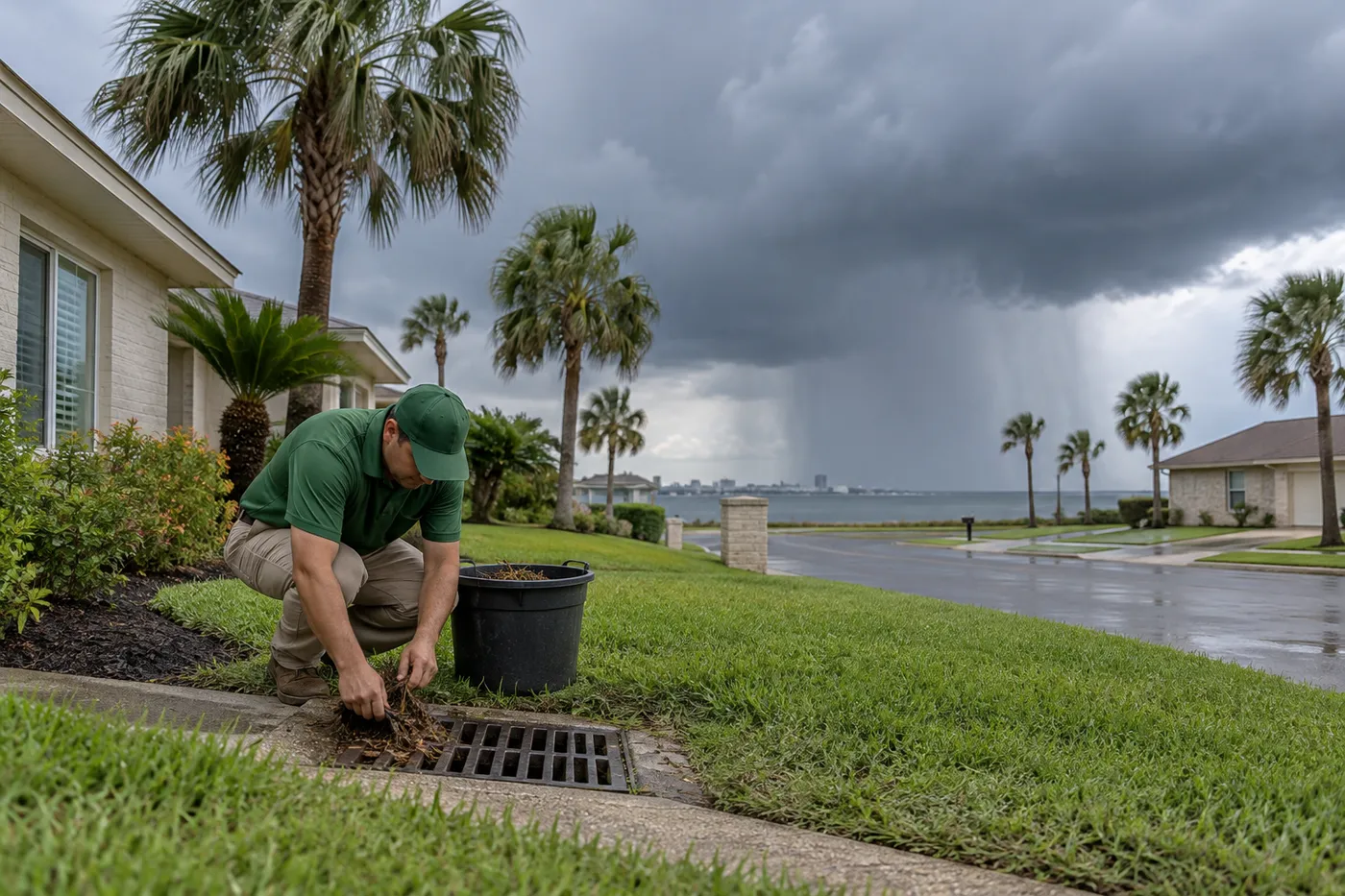
    • Storm drains and ditches. Keep leaves and grass clippings out of the street and away from inlets. The University of Florida’s hurricane landscaping guidance says not to blow or rake debris into drains. Report a clogged city inlet to 311.

    Corpus Christi brush pickup and watering rules this week

    If you trim before the weekend, timing matters. The City’s heavy brush and bulky item schedule has Section 9-B collecting October 7 to 11, followed by 9-C October 14 to 18. Piles go out by your collection week, not in the street, gutter or ditch. Do not stack a fresh brush pile in a spot where a storm could scatter it if your section is weeks away. Bag smaller trimmings or hold them in a protected spot until your week.

    The City is still under Stage 1 water restrictions, with combined storage in Lake Corpus Christi and Choke Canyon at 38.5 percent as of October 1. Lawn watering stays at once a week on your assigned day, before 10 a.m. or after 6 p.m. With rain possible later in the week, it can make sense to skip a cycle if the forecast holds.

    What to do if tidewater reaches your yard

    Homes near the bayfront, Padre Island and North Beach can see salt water reach the yard during high tides like this. Salt does its damage after the water drains. Extension guidance from Clemson and Rutgers agrees on the basics:

    • Fresh water from rain or your normal watering day helps dilute and move salt down through well-drained, sandy soil. Recovery can take months.
    • Heavier, poorly drained soils hold salt longer. Gypsum, a calcium source, can help push sodium out of clay soils, and it works best when watered in after core aeration.
    • Do not fertilize stressed turf. Wait until the grass shows it is growing again.
    • Rinse salt spray off shrubs, siding and outdoor equipment when water use allows.

    Discolored turf after a salt event is common, and St. Augustine often recovers. Give it a few weeks before deciding it needs replacing.

    When to call for help

    Most of this list is a homeowner job. Call in help when limbs are over the roof or too high to reach from the ground, when the brush pile is more than one truckload, or when you need the yard cleared fast before the weather turns. SiteHarbor’s seasonal cleanup and storm prep service handles limb removal, bed and gutter-line cleanup, and haul-off. We give an estimated range first, then a free walkthrough.

    Common questions

    Is a tropical storm going to hit Corpus Christi this week?

    As of Monday morning, the National Hurricane Center gives the Gulf system a 50 percent chance of forming over seven days, and the NWS says most guidance keeps it east of the Texas coast. The main local concerns right now are high tides, coastal flooding on Gulf-facing beaches and rip currents. Check NWS Corpus Christi daily for updates.

    Should I trim trees before a tropical storm in Corpus Christi?

    Remove dead, cracked and hanging limbs, especially over the roof, and trim back anything rubbing the house. Avoid heavy pruning or topping right before a storm, and leave work near power lines to the utility.

    If you would rather have the yard ready before the weather decides for you, see our storm prep service or request a free quote.
  • Winter Yard Prep in Corpus Christi: What to Do Now

    Seasonal

    Winter Yard Prep in Corpus Christi: What to Do Now

    SiteHarbor · Corpus Christi & the Coastal Bend
    Winter Yard Prep in Corpus Christi: What to Do Now

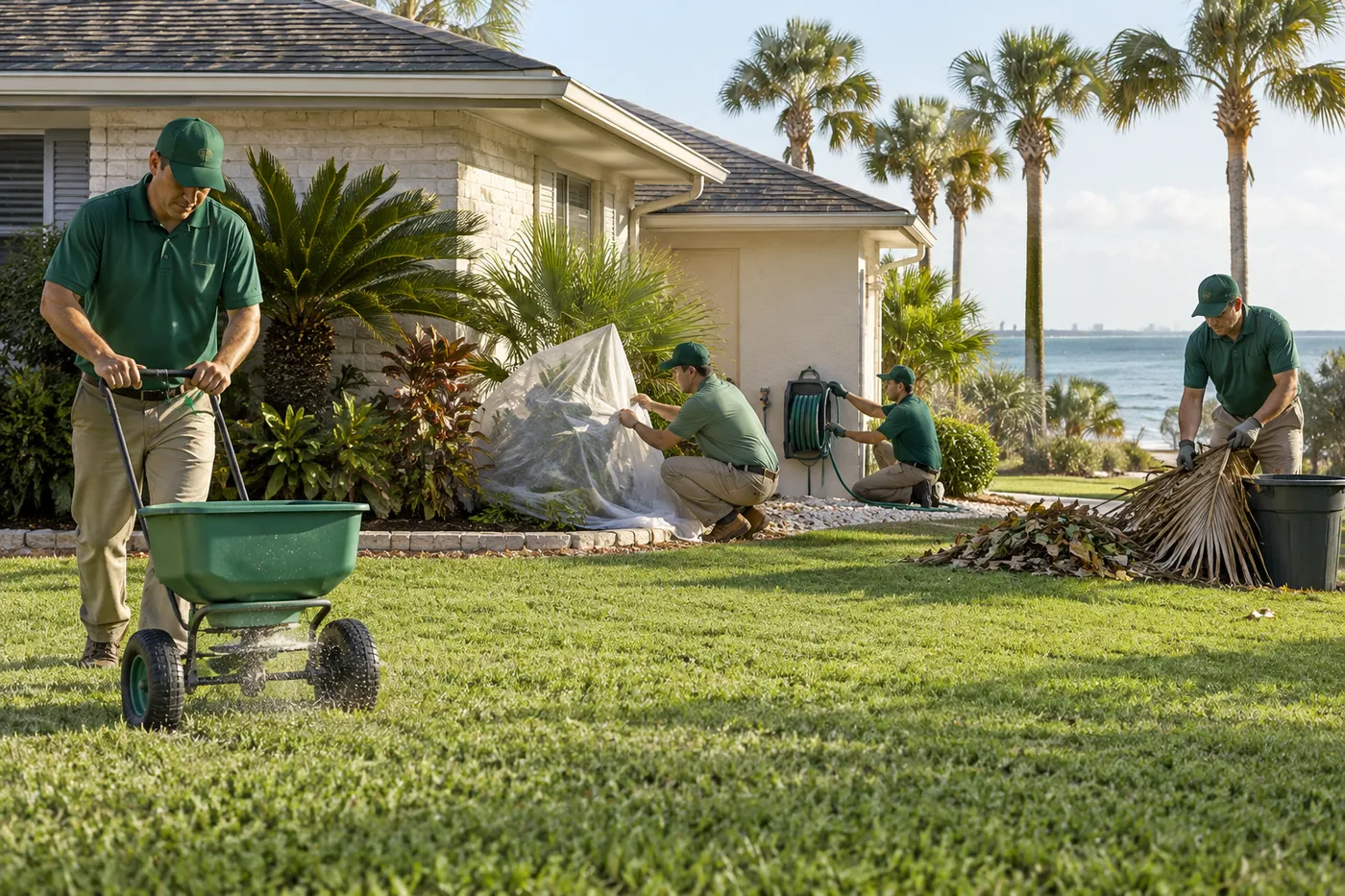
    Winter yard prep in Corpus Christi is mostly about timing, not heavy work. Our winters are mild, but hard freezes still happen every few years, so the goal for October and November is simple: slow the lawn down gently, protect tender plants before the first cold snap, and clear what a winter norther or a late tropical system could throw around. Here is what to do now, in the order it matters.

    Does Corpus Christi really need winter yard prep?

    Most winters, the yard barely notices. On NOAA’s 1991-2020 normals, the average low at the airport bottoms out in the upper 40s in early January, and many years pass with no freeze at all. The exceptions are what cost money. The airport dropped to 17 degrees on February 15, 2021, and into the mid-20s around Christmas 2022. Hibiscus, bougainvillea, citrus, young palms and potted tropicals took real damage in both events.

    Right now the Coastal Bend is still in the 80s and 90s, with the National Weather Service in Corpus Christi tracking scattered storms, a Coastal Flood Advisory on the Gulf-facing beaches this weekend, and more rain chances late in the week. That makes early October a good window: the soil is warm and moist, and you are not racing a freeze forecast.

    How should I prepare my St. Augustine lawn for winter?

    St. Augustine in South Texas often does not go fully dormant, so it still needs a little care through winter. The basics from Texas A&M AgriLife:

    • Get the last feeding in before November 1. AgriLife’s fertilizer guidance groups Corpus Christi with the Valley, with a late-fall nitrogen cut-off of November 1. Feeding after that pushes tender growth into cold weather and feeds large patch. Our post on the last fall fertilizer for St. Augustine covers rates and timing.
    • Keep the mowing height up. AggieTurf recommends 2.5 to 3.5 inches for St. Augustine. Texas A&M guidance for fall is to raise the deck a notch within that range, not scalp the lawn short going into winter.
    • Cut back watering as growth slows. AgriLife’s St. Augustine guide says irrigation can be turned off when turf stops growing, with an exception for South Texas, where grass may keep growing. Water only when the lawn shows wilt, and watch for large patch, which favors wet, cool soil below about 70 degrees.
    • Mow winter weeds before they flower. AgriLife’s St. Augustine calendar suggests occasional winter mowing to keep annual weeds from setting seed.

    How do I protect plants from a freeze in Corpus Christi?

    Do the planning now, so a freeze warning in December or January is a one-hour job instead of a scramble. AgriLife’s guide to protecting landscapes from frosts and freezes is the best local reference, and it comes down to a few steps:

    • Make a short list of tender plants. Tropicals, citrus, young palms, succulents in pots and anything planted this year are the usual losses.
    • Keep frost cloth or old sheets on hand. Cover plants all the way to the ground and secure the edges, since the warmth comes from the soil. Avoid plastic touching leaves, which can burn them on a cold night.
    • Water the soil the day before a freeze. Moist soil holds and releases more heat overnight than dry soil.
    • Uncover during the day so the sun can warm the soil again, then re-cover the next night if needed.
    • Mulch the root zone. AgriLife Galveston County recommends a 3 to 4 inch mulch layer to protect plant crowns and roots. Keep it pulled back a few inches from trunks and stems.
    • Move pots against the house or into the garage when a hard freeze is forecast.

    If something does get hit, wait. AgriLife’s advice after recent freezes is to “learn to live with ugly”: pruning too early removes dead tissue that insulates living wood and can push new growth before the cold is over. Prune back to live growth once plants start to sprout in spring.

    What outdoor water and hose prep should I do before winter?

    AgriLife’s winter-weather guidance includes draining irrigation systems, unhooking hoses and covering outdoor faucets before a hard freeze. For most Corpus Christi homes that means coiling hoses away from the house, keeping a few faucet covers in the garage, and knowing where your main shutoff is. If you have an irrigation system, check the manufacturer’s or your installer’s winter instructions; that work is outside what we offer.

    Is hurricane season over in October?

    No. The Atlantic hurricane season runs through November 30, and this week’s onshore flow and high tides are a reminder that the coast is not done with weather. Fall is still a good time to clear storm risks before winter fronts arrive:

    • Clear gutters, downspouts and yard drains of leaves and mulch that washed in during recent rains.
    • Cut out dead and hanging limbs over the roof, driveway and fence lines. For oaks, the Texas A&M Forest Service favors pruning July through January, outside the February to June oak wilt window.
    • Pick up loose items, broken pots and debris piles that a strong norther can move as easily as a tropical storm.
    • Check the City of Corpus Christi heavy brush schedule for your zone so cleanup piles go out on time.

    Our fall yard cleanup checklist has the brush cycle dates and pile rules, and the Corpus Christi lawn care calendar lays out the full year.

    Winter yard prep FAQs

    Do I need to stop mowing in winter in Corpus Christi?

    Usually not completely. St. Augustine here often keeps growing slowly in mild winters, so mow as needed at your normal height, mainly to keep winter weeds from flowering.

    When is the first freeze in Corpus Christi?

    In many years there is no freeze at all, and when one comes it is usually in December, January or February. Have covers and a plan ready by late November and watch the National Weather Service Corpus Christi forecast for freeze warnings.

    If you would rather hand off the cleanup, limb work and bed prep, SiteHarbor’s seasonal cleanup and storm prep service covers it in one visit. We start with an estimated range, then a free walkthrough. Request your free quote.

  • Tree Trimming in Corpus Christi: When to Cut and What to Ask

    Trees & Limbs

    Tree Trimming in Corpus Christi: When to Cut and What to Ask

    SiteHarbor · Corpus Christi & the Coastal Bend
    Tree Trimming in Corpus Christi: When to Cut and What to Ask

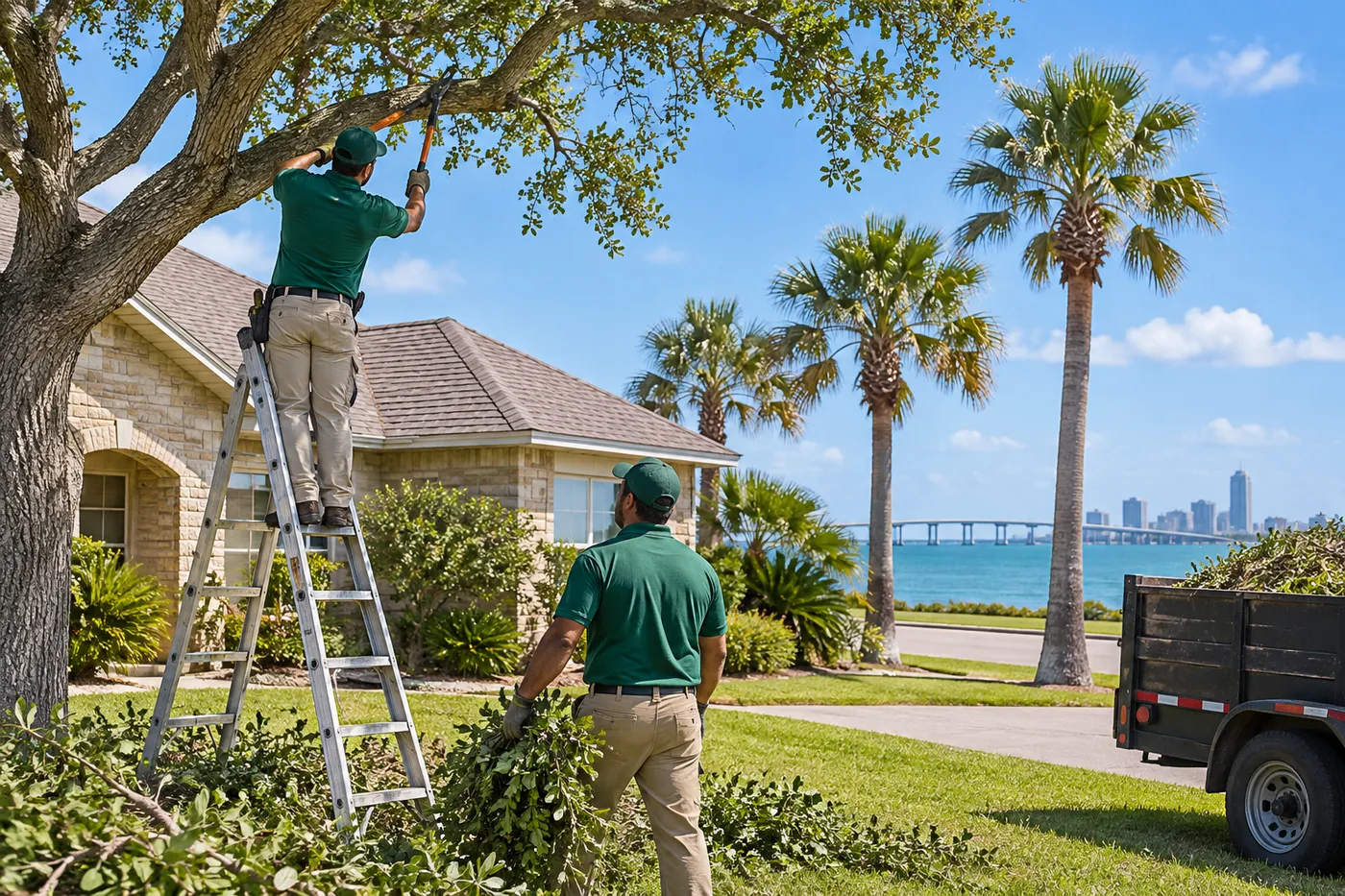
    The best time for tree trimming in Corpus Christi is the stretch from July through January, and October sits right in the middle of it. Oaks are past the spring window when oak wilt spreads, hurricane season runs through November 30, and trees in full leaf show which limbs hang over the roof. This guide covers what a good trim looks like, what to avoid, and what to ask before you hire someone.

    When is the best time to trim trees in Corpus Christi?

    For live oaks and red oaks, timing is set by oak wilt. Texas A&M Forest Service says the sap beetles that carry the oak wilt fungus are most active in late winter and spring, so pruning or wounding oaks should be avoided from February through June. Outside that window, oaks can be trimmed, and every cut on an oak should be painted right away, at any time of year. Any paint or wound dressing works. For other trees, the Forest Service says paint is not needed.

    That leaves the fall and early winter as the practical season on the Coastal Bend. October and November give you a chance to clear limbs before the last weeks of hurricane season and before the winter north winds, and December and January are still open for oaks. Mesquite, ash, palms and most ornamentals can be trimmed now as well.

    What a proper tree trim looks like

    A good trim is mostly about what stays on the tree. The goals are clearance, structure and removing wood that is dead, broken or weakly attached.

    • Cuts at the branch collar. The Forest Service says to cut just outside the collar, the swollen area where branch meets trunk. Flush cuts into the trunk and long stubs both slow the wound from closing.
    • Three cuts on heavy limbs. AgriLife Earth-Kind guidance calls for an undercut about a third of the way through, a top cut a few inches farther out to drop the weight, then the final cut at the collar. Skipping the undercut tears bark down the trunk.
    • Limited removal. The International Society of Arboriculture’s homeowner guidance says no more than about 25 percent of the crown should come off at once, and less on mature trees.
    • Clearance from the house. Limbs touching the roof, gutters or siding get cut back to a lateral branch or the collar, not sheared at the roofline.

    Tree trimming mistakes to avoid on the coast

    Topping. Cutting the top of a tree back to stubs removes a large share of the leaf canopy at once. ISA has warned against it for decades. The regrowth comes back as dense, weakly attached shoots, which are exactly the limbs that fail in high wind.

    Lion-tailing. This is stripping all the inner branches and leaving foliage only at the ends. Extension publications note it moves the weight to the branch tips and makes limbs more likely to break in wind.

    Over-pruning palms. The “hurricane cut,” where a palm is stripped down to a few fronds at the top, does not protect it. AgriLife’s Cameron County office says to remove only fully dead, brown fronds and never green ones unless they are badly damaged. University of Florida Extension notes that trimming no higher than the 9 o’clock to 3 o’clock line is the accepted limit.

    Trees near power lines and over the roof

    Do not trim around the lines that run from pole to pole. AEP Texas, which serves Corpus Christi, says cutting back trees near its power lines along streets and some private properties is its responsibility, and it asks homeowners to report trees growing close to those lines at 1-877-373-4858. AEP crews only trim or remove trees near the pole-to-pole lines, so limbs near the service line to your house are a separate question; ask the utility first.

    Large limbs hanging over the house, cracked or split leaders, and any work that needs climbing or rigging over a structure should go to an ISA Certified Arborist. You can check an arborist’s credential on the ISA site at treesaregood.org.

    What to ask before you hire a tree trimming service

    • Will you paint every cut on my oaks?
    • How much of the canopy do you plan to remove, and where will the cuts be made?
    • Do you top trees or hurricane-cut palms? (The right answer is no.)
    • Is haul-off included, or will the brush be left at the curb?
    • Which limbs are you leaving for an arborist or the utility?

    If the brush is staying with you, the City of Corpus Christi collects heavy brush on a zone schedule. Its heavy brush page lists the dates and the limits: a pile no larger than 6 by 10 by 6 feet, kept out of the street, gutter and ditch. If a trim produces more than that, a haul-off is usually simpler than waiting for the next cycle.

    SiteHarbor’s tree trimming and limb removal service covers structural and clearance trimming, canopy raising, palm work and removal of storm-vulnerable limbs, with haul-off. If a tree already came through the recent rain with damage, our guide to storm debris cleanup in Corpus Christi covers what to handle first.

    Frequently asked questions

    Can you trim live oaks in October in Corpus Christi?

    Yes. Texas A&M Forest Service only advises avoiding oak pruning from February through June. October is outside that window. Paint every cut right away, as the Forest Service recommends for oaks at any time of year.

    How often should trees be trimmed in Corpus Christi?

    Most mature yard trees do well with a light trim every few years, plus clearance work whenever limbs reach the roof, walks or driveway. Heavy cuts all at once are harder on the tree than smaller, regular ones.

    If you have limbs over the roof or trees you want cleaned up before winter, request a free quote. You will get an estimated range from your address, then a free walkthrough to confirm what our tree trimming crew will cut and haul.

  • Christmas Light Installation in Corpus Christi: What You Get

    Holiday lighting

    Christmas Light Installation Corpus Christi: What’s Included

    SiteHarbor · Corpus Christi & the Coastal Bend
    Christmas Light Installation in Corpus Christi: What You Get

    Professional Christmas light installation in Corpus Christi should cover the whole season, not just one afternoon on a ladder. A complete service includes a design walkthrough, outdoor-rated LED lights cut to your roof line, clip-on installation with no nails or staples, timers, repairs during the season, takedown in January and storage until next year. That is how SiteHarbor runs it across Corpus Christi and the Coastal Bend, and it is the checklist worth using when you compare any installer.

    What does Christmas light installation include in Corpus Christi?

    The word “installation” hides a lot of variation. Some crews hang lights you already own and leave. Others sell you a full season. Before you book, ask for each of these in writing:

    • Design and measuring. Someone walks the property, measures the roof line, peaks, gables and gutters, and agrees on what gets lit: roof, windows, palm trunks, shrubs, walkway, wreaths or garland.
    • The lights themselves. Commercial-grade LED strands cut to the measured lengths, so there are no extra loops dangling off a corner or bundled behind a downspout.
    • Clip-on installation. Clips made for shingles and gutters. Staples, nails or screws through roofing material are not part of a proper install.
    • Power and timers. Outlets checked, cords routed off walkways, and a timer set so the display turns on at dusk without anyone remembering to plug it in.
    • In-season repairs. If a section goes dark in mid-December, the installer comes back and fixes it at no extra charge.
    • Takedown and storage. Lights come down on a scheduled date after the holidays, get labeled for your house and go into storage, which makes next year’s install faster.

    You can see the full list on our Christmas light installation service page.

    Why coastal roofs change the job

    Lighting a house on the Coastal Bend is not the same job as lighting one inland. Corpus Christi roof lines take steady wind off the bay, salt in the air and the occasional strong north wind when a front comes through in December. Lights that are zip-tied or draped in a hurry are the first to sag, flap against the fascia or come loose at the corners.

    Two details matter most here. First, fastening: every few inches of strand should sit in a clip seated on the shingle edge or gutter lip, so wind cannot lift the run. Second, the product: LED strands with sealed sockets hold up better to moisture and salt than bargain incandescent sets. LEDs also run cool. ENERGY STAR says a certified LED light string uses about 70 percent less energy than an incandescent string, which matters when the display runs every night from Thanksgiving to New Year’s.

    Safety on the electrical side is simple but often skipped. The U.S. Consumer Product Safety Commission advises using only lights certified for outdoor use outdoors and plugging them into a ground-fault circuit interrupter (GFCI) protected outlet or a portable GFCI. A good installer checks that before anything is switched on.

    Is it worth hiring someone instead of doing it yourself?

    For a single-story house with a short, flat front, plenty of people do it themselves and do it well. The case for hiring out grows with roof height, roof pitch and how much you want lit. The CPSC estimates about 160 Christmas decorating injuries a day during the holiday season, with nearly half of them involving falls. If you do climb, OSHA’s ladder guidance is a good baseline: set the base about one foot out for every four feet of height, and extend the ladder at least three feet above the roof edge you are stepping onto.

    The other cost of doing it yourself is time across the whole season: the weekend to hang it, the trips back up when a strand fails, and the cold January afternoon taking it down and untangling it for the garage. A full-season service removes all three.

    How much does Christmas light installation cost in Corpus Christi?

    SiteHarbor prices residential holiday lighting at $9.50 per linear foot of roofline, with a $595 minimum, all-inclusive and installed.

    The price includes the lights, installation, in-season repairs, takedown and storage. The final number depends on the length of the roof line and how much of the yard and trees you want lit, so it is confirmed at a free walkthrough. Commercial properties, storefronts and HOA entrances are bid by scope.

    When should you book Christmas lights in Corpus Christi?

    October. Installs run from early November, and the weekend dates before Thanksgiving fill first. Booking after Thanksgiving usually means a mid-December install date and fewer nights of display.

    October is also a good time to clean the surfaces the lights will sit on. Black streaks and mildew on fascia, soffits and siding show up clearly under white LEDs at night. If the house needs it, our guide to house soft washing in Corpus Christi explains how to clean stucco and siding safely before the lights go up.

    Questions people ask

    Do Christmas light installers in Corpus Christi provide the lights?

    Many do, and a full-season service usually should. SiteHarbor supplies commercial-grade LED lighting cut to your roof line and covers it for the season. We can hang lights you already own, but without the same in-season guarantee.

    When do Christmas light installers take lights down?

    Takedown is scheduled in January. Lights are removed, labeled by property and stored, so the next season is one call and a quicker install.

    Get your lighting on the calendar

    If you want the house lit without the ladder, start with the details on our Christmas light installation page, then request a free quote. We will confirm the price at a free walkthrough and hold an early install date for you.

  • House Soft Washing in Corpus Christi: Stucco and Siding

    Exterior cleaning

    House Soft Washing in Corpus Christi: Stucco and Siding

    SiteHarbor · Corpus Christi & the Coastal Bend
    House Soft Washing in Corpus Christi: Stucco and Siding

    For most houses in Corpus Christi, the right way to clean stucco, painted siding and vinyl is a soft wash: a cleaning solution applied at low pressure, given time to work, then rinsed gently. High-pressure washing that is fine on a concrete driveway can scar stucco, strip paint and push water behind siding. On the humid, salty Coastal Bend, a soft wash cleans walls without damaging them.

    What is house soft washing?

    Soft washing is a cleaning method, not a single machine setting. The work is done by the solution, not by force. A typical house wash has three parts:

    • Apply. A detergent-based solution, usually with a measured amount of sodium hypochlorite (the active ingredient in household bleach) when mildew or algae is present, is applied at low pressure from the bottom of the wall up.
    • Dwell. The solution sits for a short time so it can break down organic growth and loosen dirt. It should not be allowed to dry on the wall.
    • Rinse. The wall is rinsed with a wide, low-pressure stream so loosened grime runs off instead of being blasted into the surface.

    The vinyl siding industry’s own care guidance follows the same logic. The Vinyl Siding Institute’s published cleaning instructions call for a detergent and household cleaner solution, with a quart of liquid laundry bleach added per gallon when mildew is a problem, and say to work from the bottom up to prevent streaking. Siding makers that allow a pressure washer tell owners to hold the stream at eye level and aim straight at the wall, never upward, so water is not driven behind the panels.

    Can you pressure wash stucco in Corpus Christi?

    It is risky, and on most homes it is not worth it. Stucco is porous and its finish coat is softer than concrete. Concentrated pressure can erode the texture unevenly, chip the finish and force water into hairline cracks, where it can sit behind the wall. Synthetic stucco systems (EIFS), found on some newer homes and commercial buildings, are even less forgiving because the outer layer is thin and covers foam insulation.

    Signs a stucco wall needs care before any cleaning:

    • Cracks wider than a hairline, especially around windows and doors
    • Hollow-sounding or soft spots when the wall is tapped
    • Staining that runs down from window corners or roof lines, which can point to water getting in

    Those issues are for a stucco or paint contractor to look at. Cleaning will not fix them, and pressure will make them worse.

    Is it mildew or dirt? A quick test

    Before you pay to clean a wall, it helps to know what is on it. The USDA Forest Products Laboratory describes a simple check for painted surfaces: put a drop or two of household bleach on the dark spot. Mildew will usually lighten within one to two minutes. If the stain does not change, it is more likely dirt, soot or rust, which need a different cleaner. Test two or three spots, because a single wall can have both.

    In Corpus Christi, Green or black growth shows up first on the north side, behind shrubs, under eaves and anywhere sprinklers hit the wall. Gray film on the south and east sides is more often airborne dirt and salt residue.

    One safety note for anyone trying this at home: never mix bleach with cleaners that contain ammonia. Iowa State University Extension warns about this specifically for siding cleaners, because the combination releases toxic gas.

    How to protect plants and grass during a house wash

    A house wash should not leave burned shrubs along the foundation. The standard precautions are simple:

    • Water beds and lawn edges thoroughly before the solution goes on, so roots and leaves take up clean water first
    • Cover delicate plants with plastic sheeting during application and remove it promptly afterward so plants do not overheat
    • Rinse plants and soil with plain water after the wall is rinsed
    • Keep wash water out of the street and storm drains. The City of Corpus Christi notes that storm water flows to creeks and bays untreated, so only rain should go down the drain

    How often should a house be washed on the Coastal Bend?

    There is no fixed schedule that fits every house. Shade, nearby trees, irrigation overspray and distance from the water all change how fast mildew and salt film return. Many homeowners find that once a year keeps walls in good shape, with shaded or bay-front homes needing it more often. Fall is a practical time: summer growth is easy to see, it is milder for plants, and the house looks clean heading into the holidays.

    If you are booking more than one service, order matters. Wash the walls and roof first, then the driveway and walks, so runoff from the house does not land on freshly cleaned concrete. Our earlier guides cover salt-air black streaks on roofs and driveway pressure washing in Corpus Christi.

    What to ask before hiring a house washing company

    • Will you soft wash stucco and painted siding, or use high pressure?
    • What solution do you use, and how do you protect plants and pets?
    • Where does the runoff go?
    • Will you note any cracks, loose trim or failing paint you see while washing?

    SiteHarbor handles pressure washing and exterior cleaning across Corpus Christi and the Coastal Bend, using soft washing on stucco and siding and surface cleaners on concrete.

    Frequently asked questions

    Does soft washing kill mildew on stucco?

    A properly mixed solution with sodium hypochlorite kills surface mildew and algae and lets it rinse away without high pressure. Growth will return over time in shade and humidity, which is why many Coastal Bend homes are washed on a regular cycle.

    Is house washing safe for windows and plants?

    Yes, when the crew pre-wets and rinses plants, covers sensitive ones and rinses glass and fixtures before the solution dries.

    If your walls are showing green, black or gray film, we can give you an estimated range and then confirm it with a free walkthrough. See our exterior cleaning service or request a free quote.

  • Storm Debris Cleanup in Corpus Christi: After the Rain

    Storm Season

    Storm Debris Cleanup in Corpus Christi: After the Rain

    SiteHarbor · Corpus Christi & the Coastal Bend
    Storm Debris Cleanup in Corpus Christi: After the Rain

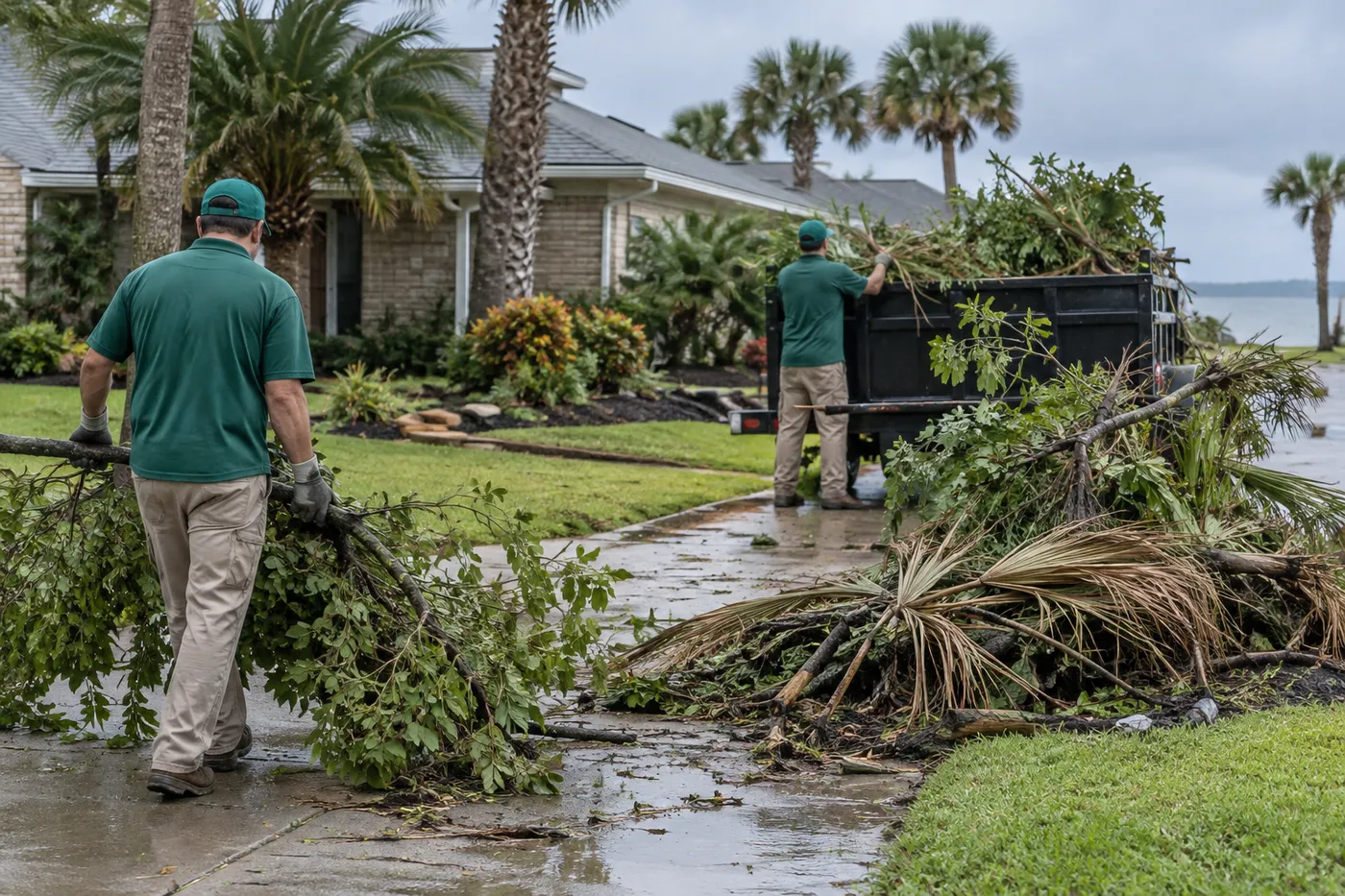
    Storm debris cleanup in Corpus Christi usually happens in the first dry days after a system passes: broken limbs come down, beds wash out, silt covers walks, and the brush pile has to be sized and placed the way the City will actually collect it. With the National Weather Service in Corpus Christi forecasting heavy rain and possible flash flooding for Thursday and Friday, October 1 and 2, here is a practical order of work for when it clears, and where it makes sense to hire help.

    What to do first after heavy rain in Corpus Christi

    Start with a walk around the property before anyone picks up a rake or a saw. The goal is to find what is dangerous, what is draining badly, and what can wait.

    • Look up first. Check trees for cracked limbs still hanging in the canopy, split trunks, and limbs resting on the roof or on lines. Anything touching a power line is a utility call, not a yard job.
    • Check low spots. Note where water stood the longest. Those areas tell you where drainage, grading, or bed edges need attention later.
    • Empty standing water. Tip out buckets, planters, tarps, and toys. Floodwater mosquitoes tend to show up a few days after heavy rain, so this is worth doing on day one.
    • Clear drains and walks. Rake leaves and mulch off the curb inlet in front of the house so the next round of rain has somewhere to go. Report a clogged City inlet to 311 instead of working in the street.

    Storm-damaged trees: what to cut and what to leave

    Texas A&M Forest Service is direct about this: do not try to do it all yourself. If large limbs are broken or hanging, or if the work means climbing or running a chainsaw overhead, it is a job for an ISA Certified Arborist. It also warns against hiring whoever knocks on the door after a storm.

    The Forest Service also says a healthy, mature tree can recover even if several major limbs are damaged, so a rough-looking live oak is not automatically a removal. What helps most is cleaning up the damage correctly:

    • Remove broken stubs back to the trunk or a main limb rather than leaving ragged ends.
    • Do not top the tree to “even it out.” Topping creates weak regrowth that fails in the next storm.
    • Pick up small limbs on the ground now; leave hangers and anything over the house to a professional.

    Ground-level limb cleanup, cutting fallen branches to length, and hauling them off is the kind of work covered by our tree trimming and limb removal service. Large or high hazard trees get referred to a certified arborist.

    Lawn and bed recovery after a flood

    St. Augustine handles a few wet days better than most people expect, but it does not like being driven on. Texas A&M AgriLife recommends keeping heavy riding mowers off turf while the soil is wet, since that causes ruts and compaction. Let the lawn firm up, then mow at your normal height and bag or blow off any silt left on the blades.

    • Hold the fertilizer. Grass sitting in wet soil is stressed, and fall is when large patch shows up in poorly drained St. Augustine. Feeding it now does more for the fungus than the grass.
    • Cut back irrigation. After several inches of rain, the soil is carrying the lawn for a while. The City’s Stage 1 schedule allows once-a-week watering, and after a soaking you can usually skip it.
    • Reset the beds. Rake washed-out mulch back into place, pull it away from trunks and stems, and scrape it off sidewalks. AgriLife notes bark mulch floats in heavy rain while cypress resists floating, which matters on slopes and near downspouts.

    How Corpus Christi brush pickup works after a storm

    Unless the City announces a special storm-debris collection, limbs go out on your area’s regular heavy brush and bulky item schedule. The City’s Heavy Brush and Bulky Items page lists the set-out dates; Area 9-A runs September 30 to October 4, with 9-B, 9-C, and 9-D following through late October. The rules that trip people up:

    • Piles go where your carts go, and never in the street, gutter, sidewalk, or drainage ditch. After heavy rain, a pile in the gutter blocks the very inlet the street needs.
    • Maximum pile size is 6 feet high, 10 feet long, and 6 feet deep, and each customer gets one truckload per collection. Extra loads are billed to the utility account.
    • Keep brush separate from bulky items. Fencing, lumber, roofing, dirt, and concrete are not collected at all, so a storm-damaged fence needs another way out.

    If your area’s set-out window is weeks away, or the pile is bigger than one truckload, debris haul-off clears it now instead of leaving a wet brush pile in the yard for a month.

    When to hire storm cleanup help in Corpus Christi

    Most homeowners can handle small limbs and a few bags of leaves. It is worth bringing in a crew when the job includes a lot of fallen wood, fence or construction debris the City will not take, beds and edges that need to be rebuilt, or a rental or commercial property where cleanup has to happen on a schedule. Our seasonal cleanup and storm cleanup service covers limb pickup, bed resets, walk and drive cleanup, and haul-off in one visit. If you are still getting ready for this week’s rain, start with our heavy rain yard prep checklist.

    Storm debris cleanup FAQs

    Will Corpus Christi pick up storm debris outside the brush schedule?
    Only if the City announces a special collection, which has happened after hurricanes. Otherwise, storm limbs follow your area’s regular heavy brush set-out dates, and bagged leaves and small yard waste can go in the garbage cart.

    How soon after heavy rain can I mow St. Augustine grass?
    Wait until the soil is firm enough that the mower does not leave ruts or tracks. AgriLife advises keeping heavy mowers off wet turf, so give it a dry day or two, then mow at your normal height.

    If the rain leaves more than you want to deal with, we can give you an estimated range, then a free walkthrough to confirm the scope. See what our storm cleanup service includes, or request a free quote.

  • Heavy Rain in Corpus Christi This Week: Yard Prep Steps

    Local News

    Heavy Rain in Corpus Christi This Week: Yard Prep Steps

    SiteHarbor · Corpus Christi & the Coastal Bend
    Heavy Rain in Corpus Christi This Week: Yard Prep Steps

    The National Weather Service in Corpus Christi expects heavy rain and possible flash flooding across South Texas on Wednesday and Thursday, September 30 and October 1, while Monday and Tuesday stay hot and mostly dry. That leaves Corpus Christi homeowners about two dry days to get the yard ready: clear the drainage paths, hold the fertilizer, turn the sprinklers off, and move anything that can float or block a gutter. Here is what to do, in order.

    What the forecast says for Corpus Christi this week

    In its Monday morning Area Forecast Discussion (issued 12:30 a.m. September 28), NWS Corpus Christi said deep Gulf moisture plus Pacific moisture from the remnants of Polo will surge into South Texas ahead of an upper-level trough. The key points:

    • Monday and Tuesday: hot and mainly dry, with a Corpus Christi high near 93F.
    • Wednesday and Thursday: heavy rainfall and flash flooding become increasingly possible. The Weather Prediction Center has all of South Texas in a Slight Risk (level 2 of 4) for excessive rainfall on Thursday.
    • Wednesday through Sunday: early rainfall estimates of 2.5 to 5 inches across South Texas, which forecasters say will be refined as the week goes on.
    • Minor coastal flooding is possible around high tide this week.

    Totals and timing will shift, so check the latest NWS forecast before planning outdoor work.

    How to prepare your yard for heavy rain in Corpus Christi

    Most rain damage in a residential yard comes from water that has nowhere to go. Work from the roof down to the street.

    • Gutters and downspouts. Clear leaves and grit, and make sure every downspout discharges away from the foundation, not into a flower bed against the slab.
    • Swales and side yards. Pull clippings, mulch and debris out of the low paths between houses where water leaves the lot.
    • Curb inlets. If the storm drain in front of your house is covered in leaves or trash, clear what you can safely reach from the curb before the rain starts. The City of Corpus Christi asks residents to report clogged inlets and street flooding by calling 311.
    • Loose items. Bring in or tie down trash cans, planters, kids’ toys and patio cushions.

    Should I water my lawn before a big rain?

    No. Turn the irrigation controller off or set it to rain delay now. Corpus Christi is still under Stage 1 water restrictions, which allow lawn watering once a week on your assigned day, and the city’s combined storage in Choke Canyon and Lake Corpus Christi was 39.3% as of September 25. Watering ahead of several inches of rain wastes that allowance and makes waterlogging worse.

    Too much water is also how fall lawn disease gets started. Texas A&M AgriLife lists poor drainage, over-irrigation, low mowing height and late-fall over-fertilization as conditions that favor large patch in St. Augustine, and the disease becomes active as soil temperatures drop below 70F. A wet week followed by the first cooler nights is exactly that setup. Leave the controller off after the storm until the soil has dried back out.

    Is it OK to fertilize before rain?

    Hold it. AgriLife’s warm-season lawn fertilization guidance is direct: do not fertilize before a rain, because it runs off. In Corpus Christi, storm water goes to creeks and the bay without treatment, so fertilizer washed off a lawn this week ends up in the water. If you had a fall feeding planned, wait until the ground dries and apply it with a normal irrigation cycle. Our last fall fertilizer post covers the November 1 cut-off for Corpus Christi.

    Mowing, mulch and brush piles before the storm

    • Mow Monday or Tuesday if the lawn needs it. Mowing saturated St. Augustine ruts the soil and tears the grass, and it may be several days before the yard is firm again. Keep the height at 2.5 to 3.5 inches.
    • Keep clippings out of the street. Blow them back onto the lawn, not into the gutter where they head straight to the storm drain.
    • Check fresh mulch. Light bark mulch floats in heavy rain. Beds on a slope or next to a driveway can lose it into the street. Pull it back an inch from edges where water runs.
    • Brush piles. The city’s heavy brush schedule puts zone 9-A on September 30 to October 4. City rules say piles cannot sit in the street, gutter or a ditch. That matters more than usual this week, because a pile in the gutter blocks the water the gutter is supposed to carry.

    After the rain: what to check in the yard

    • Standing water. Floodwater mosquitoes can emerge within about four days of heavy rain, according to Texas DSHS guidance, and container mosquitoes breed in anything that holds water. Tip out buckets, saucers, tarps, tires and clogged gutters.
    • Low spots. Note where water sat more than a day. Those are the places to watch for large patch this fall, and the places that may need grading or a drainage fix.
    • Limbs and debris. Pick up branches before mowing, and look up for hanging limbs over driveways and roofs.

    Stay off flooded streets. NWS guidance is simple: turn around, don’t drown. About six inches of moving water can knock an adult down, and about a foot can carry off many cars.

    If you would rather have the gutters, beds, debris and post-storm cleanup handled for you, our seasonal cleanup and storm prep service covers it across Corpus Christi and the Coastal Bend.

    Frequently asked questions

    Should I turn off my sprinklers when heavy rain is in the Corpus Christi forecast?

    Yes. Set the controller to off or rain delay before the rain and leave it off until the soil dries. Under Stage 1 you only get one watering day a week, and extra water on wet ground raises the risk of large patch in St. Augustine.

    How long after heavy rain can I mow my lawn?

    Wait until the soil is firm enough that you do not leave footprints or ruts. Mowing wet turf tears the blades and compacts the soil.

    Want someone to walk the property and handle the prep or the cleanup? Start with an estimated range, then a free walkthrough. See seasonal cleanup and storm prep or request your free quote.

  • Fall Yard Cleanup in Corpus Christi: October Checklist

    Seasonal

    Fall Yard Cleanup in Corpus Christi: October Checklist

    SiteHarbor · Corpus Christi & the Coastal Bend
    Fall Yard Cleanup in Corpus Christi: October Checklist

    Fall yard cleanup in Corpus Christi is less about raking leaves and more about getting a lawn and landscape ready for a mild winter and the last two months of hurricane season. October is the month to do it here: St. Augustine is still growing, the first real cold front is usually on its way, and the City of Corpus Christi’s heavy brush pickup is running through the southern and eastern collection areas.

    What should a fall yard cleanup include in Corpus Christi?

    A useful fall cleanup on the Coastal Bend covers four things: the turf, the beds, the trees and shrubs, and the debris. For most homes that means:

    • Turf: keep mowing St. Augustine at 2.5 to 3.5 inches and never take off more than a third of the blade at once.
    • Beds: pull summer weeds before they set seed, cut back spent annuals, and top up mulch where it has thinned. Texas A&M AgriLife’s Earth-Kind guidance calls for 2 to 4 inches of mulch in fall for moisture, weed control and winter protection.
    • Trees and shrubs: remove dead, broken and crossing limbs, and lift branches off the roof and away from the house. Hedges get a light shaping, not a hard cut, this late in the season.
    • Debris: clear gutters, downspouts and drainage paths so heavy fall rain actually leaves the property, and stage brush for the city’s scheduled pickup.

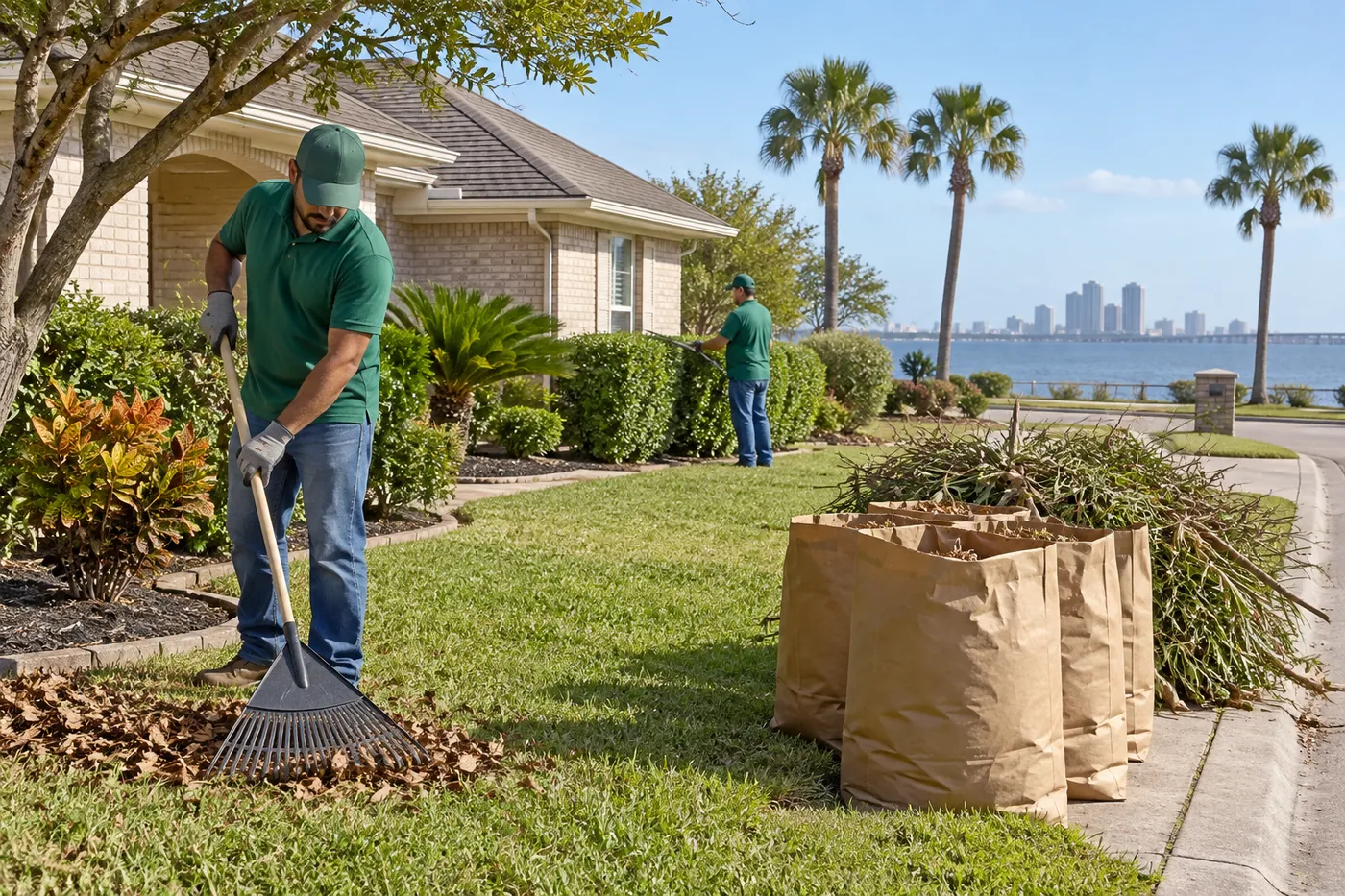
    If you’d rather hand the whole list to one crew, our seasonal cleanup and storm prep service covers the turf, beds, trimming and haul-off in one visit.

    When is the city brush pickup in Corpus Christi this fall?

    The City of Corpus Christi collects heavy brush and bulky items on a published schedule by collection area, and you may only set brush out during your area’s authorized set-out dates. Collection starts the day after the last set-out date. According to the city’s Heavy Brush and Bulky Items page, the current cycle runs Area 9-A (Sept. 30 to Oct. 4), 9-B (Oct. 7 to 11), 9-C (Oct. 14 to 18), 9-D (Oct. 21 to 25), 10-A (Oct. 28 to Nov. 1), 10-B (Nov. 4 to 8) and 10-C (Nov. 11 to 15), then starts over at Area 1-A in late November. Use the city’s interactive map or the CC Recycles app to confirm your area before you cut.

    A few of the city’s rules that catch people:

    • Brush goes where your carts normally go, never in the street, gutter, sidewalk or drainage ditch.
    • Keep brush separate from bulky items like furniture or appliances.
    • No single pile larger than 6 feet high, 10 feet long and 6 feet deep, and each household is limited to one truckload per collection. Extra loads are billed to your utility account.
    • Lumber, fencing, concrete, dirt and roofing materials are not accepted as brush.
    • Outside your pickup window, yard waste can be bagged and put in your regular garbage cart.

    The practical takeaway: time big trimming jobs so the cuttings are ready the week your area opens.

    Should I bag leaves and grass clippings in the fall?

    Usually not. AgriLife recommends leaving clippings on the lawn when you mow at the right height and frequency; recycled clippings return nitrogen to the soil and can cut the need for fertilizer. The same goes for a light layer of leaves: run the mower over them and let the shredded pieces settle into the turf. Only rake or bag when leaves are thick enough to mat down and shade the grass, which in Corpus Christi usually means under live oaks and near hedges.

    How do I prep my St. Augustine lawn for winter in Corpus Christi?

    Corpus Christi rarely sees a hard freeze, and in many years the first freeze does not arrive until December, if it arrives at all. That means the lawn keeps growing slowly through fall, and the main risks are disease and overfeeding, not cold.

    • Watch for large patch. AgriLife notes St. Augustine is very susceptible once fall temperatures cool. Water early in the morning so blades dry during the day, and keep nitrogen balanced.
    • Finish fertilizing on time. AgriLife’s cut-off for the last nitrogen feeding in the Corpus Christi area is about November 1. We covered the details in our post on the last fall fertilizer for St. Augustine in Corpus Christi.
    • Follow the watering rules. The city’s Stage 1 water restrictions are still in effect, which means lawn watering once a week on your assigned day, before 10 a.m. or after 6 p.m.

    Is fall cleanup part of hurricane prep?

    Yes. Atlantic hurricane season runs through November 30, and a late-season Gulf system is the reason fall cleanup matters more here than inland. Dead limbs, loose brush piles and clogged gutters are what turn a windy night into damage. Before any storm threat, get limbs off the roof line, clear drainage paths, and make sure nothing is stacked at the curb outside a pickup window. For larger limbs or anything near a roof or power line, see our tree trimming and limb removal page.

    Fall yard cleanup FAQs

    How much does fall yard cleanup cost in Corpus Christi?

    It depends on lot size, how much trimming is involved and how much debris needs to be hauled off. We give an estimated range first, then confirm it with a free walkthrough of the property.

    When is the best time for fall cleanup in Corpus Christi?

    October into early November. The heat has eased, St. Augustine is still growing enough to recover from mowing and trimming, and you can line up the work with your area’s city brush pickup dates.

    If you want the lawn, beds, trimming and haul-off handled together, see our seasonal cleanup and storm prep service or request a free quote. We’ll walk the property and give you a clear estimate before any work starts.

  • Mulch Installation in Corpus Christi: Fall Bed Refresh

    Beds & Mulch

    Mulch Installation in Corpus Christi: Fall Bed Refresh

    SiteHarbor · Corpus Christi & the Coastal Bend
    Mulch Installation in Corpus Christi: Fall Bed Refresh

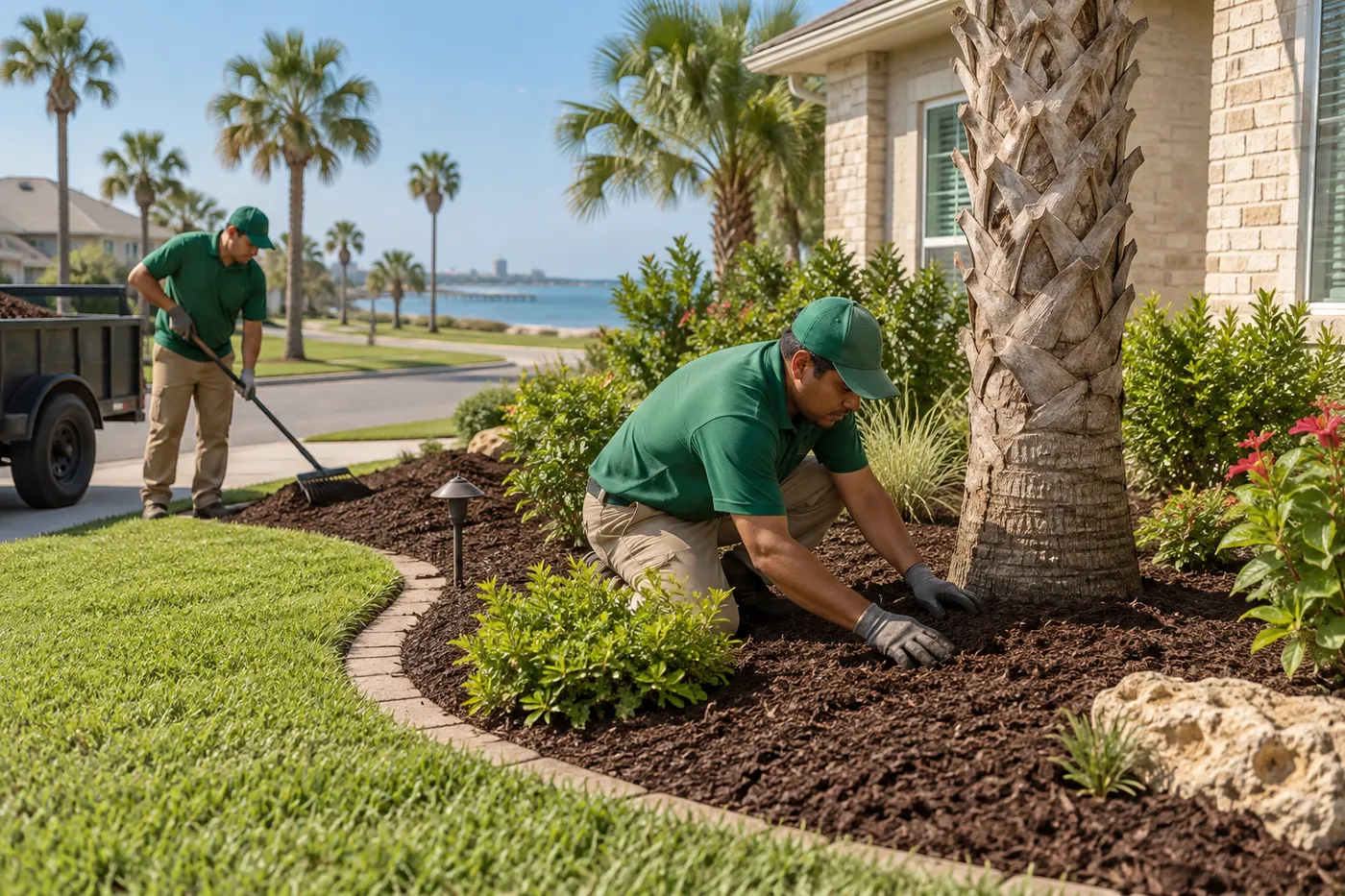
    Mulch installation in Corpus Christi works best in the fall: pull the weeds and old breakdown out of the beds, edge them, and lay a fresh 2 to 4 inch layer of mulch while the soil is still warm and before winter wind and the occasional cold snap arrive. Done that way, a bed refresh holds soil moisture through a dry winter, keeps weeds down, and makes a Coastal Bend yard look finished for the holidays. Here is what a proper job includes and what to watch for if you hire it out.

    When is the best time to put down mulch in Corpus Christi?

    Most people think of mulch as a spring job, but Texas A&M AgriLife’s Earth-Kind fall practices list mulching as a fall task. AgriLife notes that a 2 to 4 inch layer holds in soil moisture, suppresses weeds, moderates soil temperature and gives tender plants some winter protection.

    That matters here for a few reasons:

    • Watering is limited. Corpus Christi has been under Stage 1 water restrictions since late August, which means lawn and landscape watering once a week on your assigned day. A mulched bed loses water to evaporation more slowly than bare soil.
    • Fall is planting season. Shrubs and perennials planted now keep growing roots through our mild winter. Mulch keeps that root zone from swinging between wet and dry.
    • Late September is still hot. Highs are running around 90 degrees this weekend. Mulch shades the soil surface during the last warm stretch of the year.

    What does a mulch installation service include?

    Dumping bags on top of weeds is not a bed refresh. A job worth paying for usually covers these steps in this order:

    • Weed removal. Pull weeds by the root. Mulch slows new weeds from seed; it does not smother established grass runners or nutsedge.
    • Clear out the old layer where it has packed down. Old mulch that has matted into a crust can shed water instead of letting it soak in. Break it up or rake some of it out before adding new material so the total depth stays in range.
    • Edge the beds. A clean edge between St. Augustine and the bed keeps stolons from creeping in and holds the mulch in place.
    • Trim what’s hanging over. Shrubs lightly shaped and dead growth removed before the mulch goes down, so the clippings don’t end up buried in it.
    • Spread to the right depth. Level, even coverage, pulled back from trunks and stems, and extended toward the outer branches of trees and shrubs where it can.
    • Haul-off. Weeds, old mulch, bags and trimmings leave with the crew.

    Our bed cleanup and mulch refresh service is built around that sequence, and it can be folded into ongoing landscape and bed maintenance so the beds don’t slide back.

    How deep should mulch be around trees and shrubs?

    Deeper is not better. The Texas A&M Forest Service recommends no more than a 2 to 3 inch layer around trees, spread evenly, with space left between the trunk and the mulch. The mounds of mulch piled against trunks that you see in some parking lots are called volcano mulching, and AgriLife horticulturists warn that they hold moisture against the bark and invite disease and pests.

    A few practical rules:

    • Keep mulch a few inches off tree trunks and shrub stems.
    • For trees, a wide, shallow ring beats a tall, narrow pile. AgriLife’s WaterSmart program says trees and shrubs benefit from mulch spread out toward the dripline.
    • In open beds, 2 to 4 inches of settled depth is the working range. Coarse material needs to be on the thicker end to stop weeds; fine material packs down and can stay thinner.
    • Top up once the layer thins instead of stacking a new full layer on top of an old one every season.

    What kind of mulch works best on the Coastal Bend?

    Salt air, wind and heavy tropical rain all shape the choice here.

    • Shredded hardwood. Knits together as it settles, so it tends to stay put in wind and on slight slopes. A common all-around choice for front beds.
    • Pine bark nuggets. Attractive and slow to break down, but AgriLife’s landscape mulch guide notes bark can float in heavy rains. Beds near downspouts or low spots that pond after a storm are a poor fit.
    • Cypress. The same AgriLife guide notes cypress resists floating, which helps in beds that take runoff.
    • Rock or gravel. Does not wash out, but holds heat against plants and doesn’t feed the soil. Better for strips along walls and drainage paths than for planted beds.

    If you’re adding plants this fall, our post on salt-tolerant shrubs to plant in Corpus Christi covers which ones handle direct salt spray.

    What does mulch installation cost in Corpus Christi?

    Cost depends on how many beds there are, their square footage, how much weeding and old material has to come out first, the mulch type, and how far it has to be carried from the truck to the beds. We give an estimated range based on your address and a photo or description, then confirm it with a free walkthrough before any work is scheduled.

    Frequently asked questions

    How often should mulch be replaced in Corpus Christi?

    Organic mulch breaks down over time, which is part of how it feeds the soil. Most beds need a top-up about once a year. Check the depth before buying: if there are still 2 inches in place, a light top-up is usually enough instead of a full new layer.

    Should I put landscape fabric under mulch?

    Fabric can help under rock, but under organic mulch the mulch eventually breaks down on top of it and weeds root into that layer anyway. In most planted beds, thorough weeding plus a proper mulch depth works better than fabric.

    If your beds need weeding, edging and a fresh layer before the holidays, see what our bed cleanup and mulch refresh includes, or request a free quote and we’ll send an estimated range, then set up a free walkthrough.

  • Driveway Pressure Washing in Corpus Christi: What to Expect

    Exterior Cleaning

    Driveway Pressure Washing in Corpus Christi: What to Expect

    SiteHarbor · Corpus Christi & the Coastal Bend
    Driveway Pressure Washing in Corpus Christi: What to Expect

    Driveway pressure washing in Corpus Christi works best when it is treated as three separate jobs: lifting the everyday grime and mildew with a surface cleaner at moderate pressure, treating rust and oil stains with the chemistry each one needs, and keeping the wash water out of the storm drain. Salt air, humidity and iron-heavy runoff mean a Coastal Bend driveway darkens faster than one inland, so knowing what a proper cleaning involves helps you judge any quote you get.

    What does driveway pressure washing include in Corpus Christi?

    A thorough driveway cleaning is more than one pass with a wand. Here is what a complete job usually covers:

    • Pre-treatment. Mildew and algae, the green-black film common on shaded Coastal Bend concrete, loosen far more easily with a cleaning solution applied first than with pressure alone.
    • Surface cleaner on the flat areas. A rotary surface cleaner keeps the nozzles at a fixed height and gives an even result. Hand wands used across a whole slab are what cause the light-and-dark bands people call zebra or tiger striping.
    • Edges, joints and the apron. Expansion joints, the strip along the lawn edge and the curb apron collect soil and weeds, and they need detail work.
    • Spot treatment for stains. Rust and oil do not respond to the same cleaner (more below).
    • Post-rinse and cleanup. Rinsing off cleaning residue, and keeping debris and chemicals out of the gutter.

    Can pressure washing damage a concrete driveway?

    Yes, if the pressure is too high or the nozzle is too close. Concrete can be etched, which leaves permanent marks or a rough, sandy surface where the cream layer has been stripped away. Many exterior-cleaning guides treat roughly 2,000 to 3,000 PSI as the working range for residential concrete, with a wide fan tip or a surface cleaner rather than a narrow zero-degree tip.

    It helps to know the difference between etching and striping. Striping is uneven cleaning, and it comes out with a proper second pass. Etching is damage to the concrete itself, and it does not come out.

    New concrete is a special case. Concrete takes about 28 days to cure, and the common guidance is to wait at least that long before pressure washing a freshly poured driveway or slab.

    How do you get rust stains off a driveway?

    Orange and brown spots are one of the most common complaints on Corpus Christi driveways. The usual sources are granular fertilizer that contains iron and gets tossed onto the concrete during spreading, sprinkler water that carries iron, and metal furniture, grills or planters left in one spot.

    Bleach-based cleaners do not remove rust. Rust needs an acid-based cleaner made for it. Oxalic acid is the standard choice, and it is the active ingredient in many hardware-store concrete rust removers. Extension guidance for iron stains describes soaking the stain in an oxalic acid solution for a couple of hours, then scrubbing and rinsing. Oxalic acid is toxic, so label directions and eye and skin protection matter, and plants along the edge should be rinsed.

    If the same spots keep coming back, the source is still active. Blowing fertilizer back onto the lawn after spreading, and checking where sprinklers overspray onto the driveway, prevents repeat stains.

    What about oil stains?

    Oil and transmission-fluid drips need a degreaser that is allowed to dwell before rinsing, and sometimes more than one round. Fresh drips come out more completely than stains that have soaked in for years. Older stains often lighten a lot but can leave a faint shadow, and a fair contractor will say so before starting rather than after.

    Where does the wash water go?

    This part is easy to overlook. The City of Corpus Christi notes that its storm water system carries runoff directly to local creeks, streams and bays without any treatment, and its guidance is simple: only rain down the storm drain. Cleaning chemicals, oil lifted off the slab and loose dirt should not be washed into the curb inlet. In practice that means using the smallest amount of chemical that does the job, treating oil stains as spot work, and steering rinse water toward lawn areas rather than the street where possible. The City’s storm water pollution prevention page explains the rules.

    How often should you pressure wash a driveway on the Coastal Bend?

    There is no fixed schedule, but many homeowners here clean once or twice a year. Shaded driveways, north-facing slabs and homes near the water tend to grow mildew faster.

    Some owners follow a cleaning with a penetrating silane or siloxane sealer. These products soak into the concrete instead of forming a glossy film, and they reduce how much water, salt and dirt get into the surface. Sealing is optional, but it can make the next cleaning easier.

    The roof and siding are a different job. Shingles and stucco call for low-pressure soft washing, which we covered in what causes black streaks on Corpus Christi roofs.

    Frequently asked questions

    How long does it take to pressure wash a driveway in Corpus Christi?
    A typical two-car driveway with a sidewalk is usually a few hours of work, longer if rust or oil stains need treatment and dwell time. Allow some time afterward for the concrete to dry before parking on it.

    Will pressure washing remove fertilizer rust stains from my driveway?
    Pressure alone usually will not. Rust from fertilizer or iron in sprinkler water needs an acid-based rust cleaner such as oxalic acid, followed by a rinse. Pressure washing then cleans the rest of the slab evenly.

    Get a driveway cleaning quote

    SiteHarbor handles pressure washing and exterior cleaning for driveways, walkways, patios and home exteriors across Corpus Christi and the Coastal Bend, with commercial pressure washing for storefronts and parking areas. Tell us about your property and we will send an estimated range, then set up a free walkthrough. Request your free quote.